
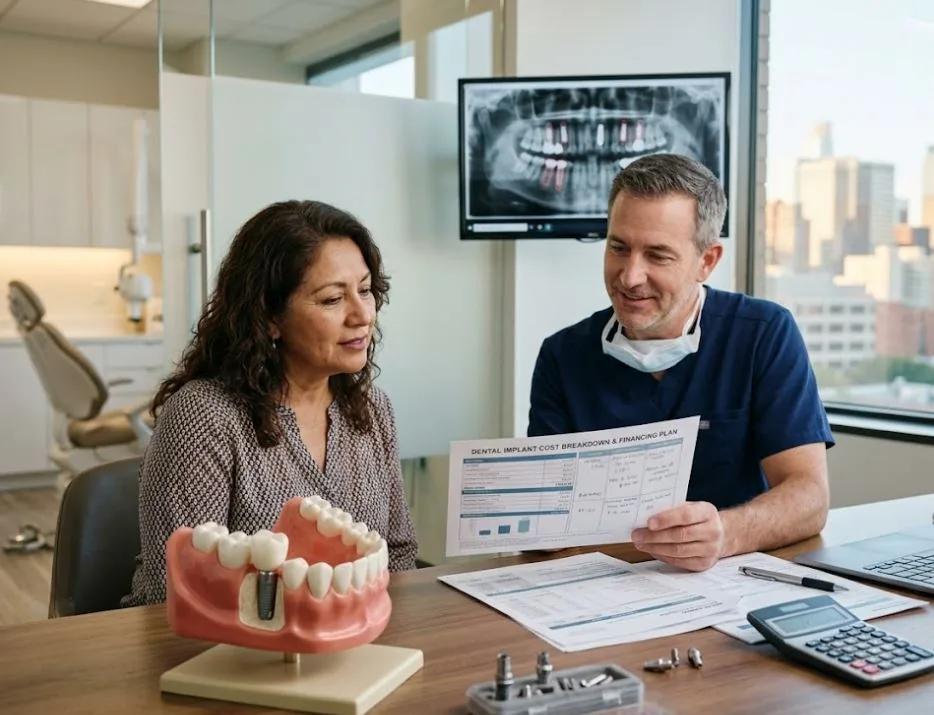
If you've been quoted $5,000 for a single dental implant — or $40,000 for a full-mouth restoration — and walked out of the consultation feeling like the work is permanently out of reach, this guide is for you. "Affordable" doesn't mean cutting corners on safety, and it doesn't mean traveling halfway across the world. It means knowing where the real costs come from, what's actually negotiable, and how to find a qualified provider who'll work within your budget.
Dental implants are one of the most price-opaque procedures in medicine. The same single-tooth implant can cost $1,800 at one practice and $6,500 at another two miles away — for materials and outcomes that are functionally identical. That gap isn't a coincidence; it's a market that hasn't been forced into pricing transparency. The good news: once you understand what drives the variance, you can actually shop the work.
This guide breaks down what implants honestly cost in the U.S. in 2026, why prices swing so wildly, what financing actually looks like, where seniors can find help, and how to spot a low-cost provider who's a real bargain versus one whose "cheap" is a warning sign. No upsell — just the information you need to make a sound financial decision about your own teeth.
What "Affordable" Actually Means
Before we get into numbers, it's worth pinning down the word. In the dental world, "affordable dental implants" doesn't have a single agreed-on price tag — it's a relative term. A $2,500 single implant in Birmingham, Alabama, is genuinely affordable. The same $2,500 quote in Manhattan is suspiciously low and worth investigating. So when you see "affordable" in clinic marketing, what you're really being told is: relative to the local market, this practice is positioned at the lower end.
That positioning generally falls into one of three buckets:
High-volume specialty centers — clinics that do nothing but implants, often 100+ cases a month. They negotiate bulk pricing on implants and crown materials, and the surgical efficiency drops the per-case cost. These are often the best value on full-arch and All-on-4 cases.
Dental schools and teaching clinics — care performed by supervised students or residents at university dental programs. The work takes longer (multiple visits, slower pace) but the cost can be 40–60% of private-practice rates with attending faculty oversight throughout.
What "affordable" should not mean: an implant placed without a CT scan, a surgeon who can't tell you their case volume, or a quote that doesn't itemize the post, the abutment, the crown, and any prep work as separate lines. We'll come back to those red flags in a minute.
The Real Cost Breakdown in 2026
Here's what implants actually run in the U.S. right now, with the typical low-end (cost-conscious) and high-end (premium urban) ranges. These are out-of-pocket numbers before any insurance contribution.
| Procedure | Affordable Range | Premium Range |
|---|---|---|
| Single implant (post + abutment + crown) | $1,800 – $3,200 | $4,500 – $6,500 |
| Cost of 3 dental implants (separate teeth) | $5,400 – $9,600 | $13,500 – $19,500 |
| Implant-supported bridge (3 teeth, 2 implants) | $5,000 – $8,500 | $10,000 – $15,000 |
| All-on-4 (full arch, one jaw) | $15,000 – $22,000 | $28,000 – $42,000 |
| Full-mouth (both jaws, All-on-4) | $28,000 – $40,000 | $55,000 – $80,000+ |
| Bone graft (per site, if needed) | $400 – $900 | $1,200 – $3,000 |
| Sinus lift (if needed) | $1,500 – $2,500 | $3,000 – $5,000 |
A note on the "cost of 3 dental implants" line: if you're missing three teeth in a row, the cheaper option is almost always an implant-supported bridge — two implants anchoring a three-tooth bridge — rather than three separate implants. The bridge route is typically $5,000–$8,500 in cost-conscious markets versus $5,400–$9,600 for three individual implants. Ask your surgeon to quote both.
Why the Prices Swing So Wildly
The 60%+ spread isn't random. Five factors drive most of the variance, and only two of them affect what you actually receive.
The takeaway: roughly two-thirds of the price spread comes from factors that don't change the medical outcome. That's the variance you can actually shop.
Insurance, Financing, and Real Help With the Bill
Out-of-pocket sticker prices aren't the whole story. Most patients use some combination of insurance, financing, and savings programs to bring the actual cash outlay down significantly.
Dental insurance — what it actually covers
Most dental plans treat implants as a "major" procedure with 50% coverage up to your annual maximum, which is typically $1,000–$2,000. That sounds modest, but on a $3,000 single implant it can mean $1,500 off — a real reduction. A few caveats: many plans exclude the implant post (covering only the abutment and crown), and almost all have a 6–12 month waiting period for major work after enrollment. Read the policy or call the carrier directly before assuming coverage.
Medicare and seniors
Original Medicare (Parts A and B) does not cover dental implants. Many Medicare Advantage plans (Part C) include dental benefits with annual allowances of $1,000–$3,000 toward major dental work — including implants — but the limits are tight and you'll still pay most of the cost out of pocket. Dual-eligible patients (Medicare + Medicaid) may have additional coverage in some states. The most valuable senior-specific programs are typically:
Federally Qualified Health Centers (FQHCs) — sliding-scale community dental programs. Implants are less commonly offered, but extractions, dentures, and basic restorative work are widely covered.
Veterans Affairs benefits — service-connected dental coverage varies; honorably discharged veterans should call their local VA dental clinic directly. Some implant work qualifies; eligibility rules are case-specific.
Manufacturer financing for fixed incomes — Straumann, Nobel, and a few other implant brands offer patient assistance programs. Ask the surgeon's office to call the rep on your behalf if budget is the deciding factor.
Third-party financing
CareCredit and LendingClub Patient Solutions are the most common dental financing platforms. Both offer 6–24 month no-interest promotional periods if paid in full within the term — useful for spreading a $4,000 single implant across a year. Miss the promo deadline and the interest backdates aggressively (often 26.99%+ APR), so set automatic payments to clear the balance before the promo expires. Avoid using these for amounts you can't realistically pay off in the promo window.
In-house payment plans at the dental practice are often a better deal than third-party financing — many implant centers offer 0% interest installments over 6–18 months with no credit check. Always ask the office directly before reaching for a credit-product application.
HSA / FSA
Dental implants are an eligible expense under both Health Savings Accounts (HSAs) and Flexible Spending Accounts (FSAs). If you have either, contribute the IRS maximum the year before your planned procedure — you'll save federal income tax (typically 22–32% of the implant cost) on the entire amount you spend through the account. For a $5,000 implant, that's potentially $1,100–$1,600 in real tax savings.
How to Find Genuinely Affordable Care
The hardest part isn't finding low-priced quotes — it's finding low-priced quotes from clinics you'd actually trust with your jawbone. Here's the playbook we recommend.
When "Cheap" Becomes a Red Flag
Pricing that's well below the affordable range — say, a single implant quoted at $799 in a U.S. metro area — usually signals that something has been left out, replaced with an inferior alternative, or that the practice is using high-pressure tactics to upsell during the actual visit.
"Total" quotes that leave out the abutment or crown — bait pricing. The advertised $899 implant is just the post; abutment and crown bring it to $2,400+. Always ask: does this number include everything I need to leave with a finished tooth?
Pressure to commit at the consultation — "this price is only good if you book today" is a sales tactic, not a clinical recommendation. A real surgeon will give you the quote in writing and tell you to take a few days. Major dental work is not an impulse purchase.
No surgeon credentials shared on request — you should be able to easily verify that whoever's drilling into your jaw is a licensed dentist, and ideally one with formal implant training. Refusal to share is disqualifying.
Anonymous "implant centers" with no named provider — chains can be fine, but you should know which dentist or surgeon is performing your case before treatment day. "We'll assign someone" is not an acceptable answer.
A Word on Dental Tourism
Mexico, Costa Rica, Hungary, and increasingly the UK are popular dental tourism destinations for U.S. patients, often advertised at 50–70% below U.S. prices. The savings are real, and many international clinics do excellent work. But the trip carries its own costs and risks that need to be honestly weighed.
The core tradeoffs: travel, lodging, and time off work narrow the savings; follow-up complications are harder to manage from another country; and the regulatory and legal recourse if something goes wrong is meaningfully different from U.S. malpractice law. For a routine single implant in a healthy patient, dental tourism can absolutely make sense. For complex full-mouth cases requiring multiple staged visits and post-op monitoring, it's a harder call.
If you're seriously considering Mexico or another international option, do it with eyes open. We have separate guides covering dental implants in Mexico and low-cost implants in the UK with the practical tradeoffs spelled out.
When Cheaper Is Actually More Expensive
The math on dental implants gets counter-intuitive if you stretch the time horizon. A $2,200 implant at a budget practice that fails after three years and needs replacement costs you $4,400 plus the lost healing time. A $4,500 implant placed by an experienced surgeon with proper imaging and bone management that lasts 25 years costs you $180/year. The "expensive" implant is often the cheap one.
The variables that genuinely affect long-term success — surgical experience, proper planning with 3D imaging, quality bone integration, and your own oral hygiene afterward — are not where to cut corners. The variables that don't affect outcomes — geography, marketing budget, lobby finishes, premium implant brand on a routine case — are where the savings live.
Done well, an affordable implant is the same implant the premium clinic places, just without the markups baked in. That's the shape of "affordable" you're looking for.
Final Thoughts
Dental implants don't have to mean choosing between your savings and your smile. The U.S. implant market has enough providers competing on price, enough financing options layered on top, and enough public-program and dental-school alternatives that almost every patient with realistic patience and a willingness to ask three offices the same questions can find work that fits a real budget.
What we'd encourage you not to do: settle for the first quote because it feels like too much hassle to keep looking, accept the cheapest number you find without verifying what's behind it, or assume that "expensive" automatically means "better." Dental implants are one of the most-shoppable major medical procedures available — the price gap is huge, the quality variance is much smaller, and the work to find good value is hours, not weeks.
Your teeth are going to be with you for the rest of your life. So is the bill. Both deserve the same level of care.
Find Affordable Implant Providers in Your City
Smyleee's curated, review-vetted directory of dental implant clinics across the U.S. — with transparent pricing, payment-plan flags, and verified ratings.
Sources & References
- U.S. Food and Drug Administration — Dental Implants: What You Should Know
- Medicare.gov — Dental Services Coverage Overview
- MetLife — How Much Do Dental Implants Cost?
- GoodRx — How Much Do Dental Implants Cost?
- American Dental Education Association — Dental School Patient Care Programs
- U.S. Department of Veterans Affairs — Dental Care Eligibility
- CareCredit — Healthcare Financing Overview
- PMC — Risks and Complications Associated with Dental Implant Failure
- IRS Publication 502 — Medical and Dental Expenses (HSA / FSA Eligibility)