
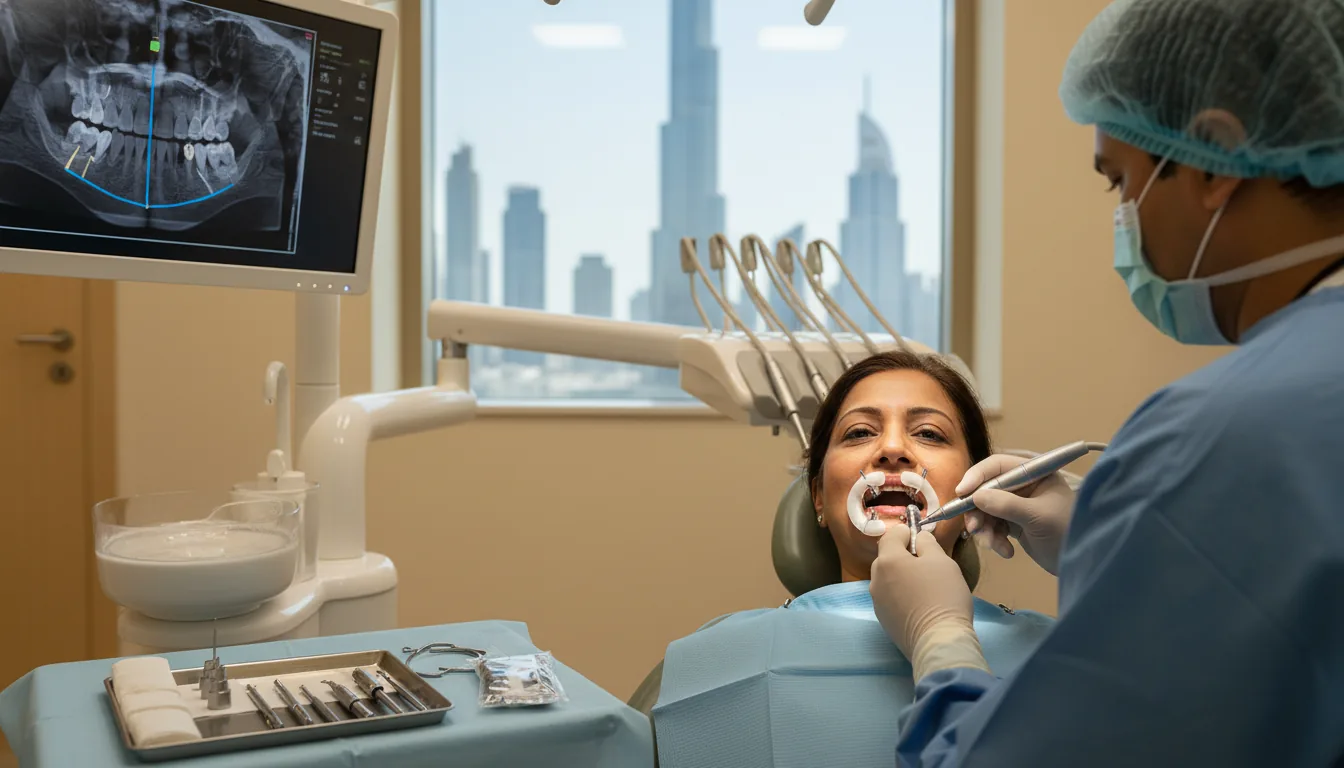
Dubai sits in an unusual place on the global dental implant map. The city has world-class oral surgeons trained in Europe, North America, and the UAE itself; one of the densest concentrations of specialty practices anywhere in the Gulf; and — sitting underneath both of those — a marketing layer that has pushed advertised implant prices in some areas to roughly double what the same procedure costs five kilometres away. The good news is that the spread between a credible cost-conscious quote and a polished Downtown specialty consultation in Dubai is enormous, and almost none of that gap reflects clinical quality. If you know what to ask for and which neighbourhoods to consider, single implants under AED 9,000 (about USD 2,450) are real, findable, and clinically equivalent to the Jumeirah specialty tier.
This guide walks through what dental implants honestly cost in Dubai in 2026, why the same single-implant procedure ranges from roughly AED 7,500 at a high-volume International City clinic to AED 22,000 at a Downtown specialty practice, what UAE health insurance actually pays for (very little, mostly), how the regional medical-tourism dynamic distorts pricing for residents, and how to separate "affordable because of efficient operations" from "cheap because something has been left out." All cost language is in dirhams with USD parentheticals — the dirham is pegged to the dollar at AED 3.673, so the conversion is the same every year — and the recommendations are in plain English. No booking pressure, no upsell.
Dubai is a top-tier implant market by Middle East standards: more expensive than Sharjah, Ajman, or Abu Dhabi outside the Corniche, comparable to Doha and Riyadh's premium districts, and noticeably cheaper than London or New York for equivalent work. But that summary hides the most important fact about shopping for implants in Dubai, which is that the city is not one market. It is three, layered on top of each other, separated more by neighbourhood and patient demographic than by clinical capability. Understanding which one you're shopping is the difference between finding genuine value and overpaying by five figures on a full-arch case.
What "Affordable" Actually Means in Dubai
Dubai's implant pricing is structured around three tiers, and the boundaries between them map fairly cleanly to geography. None of the three is inherently better or worse for routine implant work — the clinical baseline across all of them is consistently high, because the DHA licensing standard is genuinely strict. The difference is what you're paying for around the procedure itself.
The first market is the premium specialty tier: oral surgeons, prosthodontists, and large multi-specialty practices concentrated in Downtown Dubai, DIFC, Jumeirah, Al Wasl Road, and Dubai Marina. Single implants here typically run AED 16,000–22,000 all-in (about USD 4,350–6,000); full-arch All-on-4 work routinely quotes AED 95,000–145,000 per jaw (about USD 25,850–39,460). These practices are not overpriced for what they deliver to genuinely complex cases — they earn the fee on heavy bone-graft reconstructions, immediate-load full arches, zygomatic implants, and patients who flew in from Riyadh or London specifically for them. The patient experience is polished: marble lobbies, in-house CBCT, multilingual front desks, and pricing presented after consultation rather than on the website. For a routine single posterior implant in a healthy jawbone, you are paying mostly for the address, the lobby, and the medical-tourism demand layer above you.
The second market is the established mid-tier general and group practice tier: well-known dentists and group clinics in Al Barsha, Karama, Bur Dubai, Mirdif, Deira, Mankhool, and the residential pockets of JLT and Business Bay. Single implants here land in the AED 11,000–15,000 range (about USD 3,000–4,080), full-arch in the AED 65,000–90,000 range, and many of these clinics place 200–600 implants a year. Quality is consistent with the premium tier on uncomplicated cases. This is where most insured residents land, where Filipino, Indian, and Egyptian expat communities tend to be referred by friends, and where the front-desk staff have actually seen your insurance card before.
The third market is the cost-conscious tier: high-volume value clinics and large polyclinics in International City, Discovery Gardens, Al Quoz, Dubai Investment Park, Al Nahda, and Mankhool's lower-rent buildings, plus a meaningful cross-border layer in Sharjah, Ajman, and Ras Al Khaimah. Single implants here run AED 7,500–10,500 (about USD 2,050–2,850); full-arch AED 45,000–65,000 per jaw. These practices keep overhead lean — smaller offices, in-house lab arrangements, value-brand Korean fixtures alongside European ones, and clinical staff who handle high case volume daily — and pass the savings forward. This is where most "affordable dental implants Dubai" searches should typically end if the case is uncomplicated, the patient is healthy, and the timeline isn't urgent.
Dubai also has a corporate-dental marketing layer that is heavier than most cities in the region. A handful of large group brands — some legitimately strong clinically, some not — dominate paid Google results, Instagram, and outdoor advertising along Sheikh Zayed Road. The work at these chains is generally fine; the prices, however, are usually average-to-high for the city, despite the marketing volume. Do not assume "the clinic with the biggest billboard" means "the best value." It usually just means "the clinic that needs to recover its billboard budget from your treatment plan."
The Real Cost Breakdown in Dubai, 2026
Here is what implants actually cost in Dubai right now, broken into the cost-conscious low end (the price you should be shopping toward for routine cases) and the premium high end common at Downtown and Jumeirah specialty practices. These are out-of-pocket numbers in dirhams, before any insurance contribution. USD conversions use the standing peg of AED 3.673 per USD.
| Procedure | Dubai Affordable Range (AED / USD) | Dubai Premium Range (AED / USD) |
|---|---|---|
| Single implant (post + abutment + crown) | AED 7,500 – 10,500 / $2,050 – $2,850 | AED 16,000 – 22,000 / $4,350 – $6,000 |
| Cost of 3 implants (separate teeth) | AED 22,500 – 31,500 / $6,150 – $8,580 | AED 48,000 – 66,000 / $13,070 – $17,980 |
| Implant-supported bridge (3 teeth, 2 implants) | AED 18,500 – 26,000 / $5,050 – $7,080 | AED 38,000 – 54,000 / $10,350 – $14,700 |
| All-on-4 (full arch, one jaw) | AED 45,000 – 65,000 / $12,250 – $17,700 | AED 95,000 – 145,000 / $25,850 – $39,460 |
| Full-mouth (both jaws, All-on-4) | AED 85,000 – 120,000 / $23,150 – $32,680 | AED 175,000 – 275,000 / $47,650 – $74,860 |
| Bone graft (per site, if needed) | AED 1,800 – 3,500 / $490 – $950 | AED 5,500 – 11,000 / $1,500 – $3,000 |
| Sinus lift (when indicated) | AED 4,500 – 7,500 / $1,225 – $2,040 | AED 12,000 – 22,000 / $3,270 – $6,000 |
| 3D CBCT imaging (often included) | AED 300 – 600 / $80 – $165 | AED 700 – 1,200 / $190 – $325 |
Two things to flag in this table. First, the bone-graft column has an unusually wide spread because Downtown specialty practices have a much higher rate of recommending grafts than mid-tier clinics handling the same anatomy do — and the "premium graft" pricing is sometimes for a procedure that a high-volume value clinic would not have recommended in the first place. Second, the All-on-4 range is wide because brand selection (Straumann or Nobel Biocare versus a quality Korean system like Osstem or Megagen) can swing the per-jaw cost by AED 12,000–20,000 on its own.
Implant Brands and Why the Choice Matters Less Than Marketing Suggests
One of the most common ways implant quotes in Dubai get inflated is the brand-tier upsell — the idea that paying AED 6,000 more per implant for a Swiss or Swedish fixture is a meaningful clinical decision. For most patients it isn't. The peer-reviewed survival difference between top-tier Korean systems like Osstem, Dentium, and Megagen and the premium European brands (Straumann, Nobel Biocare, Astra Tech, Zimmer) at the ten-year mark is in single-digit percentage points, and the Korean systems are placed by hundreds of millions of patients globally with strong long-term data.
What does matter:
Is the implant a counterfeit? Counterfeit dental implants are a known problem regionally, including occasional cases reported in the wider Gulf. Cost-conscious Dubai clinics that quote AED 3,000 single implants with European brand names attached are statistically more likely to be using grey-market or counterfeit fixtures than the AED 7,500–10,500 cost-conscious tier. Ask to see the implant packaging on the day of surgery. A real clinic will not flinch.
Does the practice place 100+ of this specific brand per year? Familiarity with the surgical kit matters more than the brand name on the box. A surgeon who places Osstem weekly will get a more predictable result with Osstem than a surgeon who learned Straumann in residency and places one Osstem a month.
UAE Insurance Reality — and Why It Mostly Doesn't Help
The UAE has had mandatory employer-provided health insurance for residents in Dubai since 2014 and across the country in subsequent years. That sounds promising for dental implants. In practice, it is not. The standard Essential Benefits Plan (EBP) — the legal minimum cover employers must provide low-wage workers — explicitly excludes implants, orthodontics, and most cosmetic dentistry. Mid-tier corporate plans typically cover preventive dental and basic restorative work (cleanings, fillings, simple extractions) but cap or fully exclude implants. Even premium corporate plans often have a dental sub-cap (commonly AED 5,000–10,000 per year), which means a single implant burns through your annual dental allowance immediately.
What this means at the quoting stage: assume implants will be out-of-pocket. If your employer's plan includes any dental coverage at all, ask the clinic to itemise the quote so you can submit the diagnostic CBCT, extraction (if needed), and any provisional restoration separately — those component line items are more likely to be partially reimbursable than the implant line itself. A well-organised Dubai clinic will know how to format the invoice for the major UAE insurers (Daman, AXA Gulf, MetLife, Aetna, NextCare, NAS, Neuron). A clinic that cannot or will not is signalling either inexperience with insurance reimbursement or a preference for cash flow over claim work.
Financing in Dubai mirrors the regional retail pattern. Many cost-conscious and mid-tier clinics offer 0% instalment plans through partner banks (Emirates NBD, Mashreq, Dubai Islamic Bank, FAB) on cards from those issuers, typically over 6–24 months with no transaction fee. Premium specialty clinics tend to offer the same, sometimes with their own brokered tie-ups. Ask explicitly — many clinics do not advertise this on the website. The effective discount is significant: paying AED 10,500 over twelve months interest-free versus paying it upfront is a meaningful liquidity decision even at the cost-conscious end of the range.
Dubai as a Regional Dental Tourism Hub — and What That Does to Your Quote
One factor that distorts Dubai implant pricing more than residents usually realise is the regional medical-tourism layer. Saudi nationals, Kuwaitis, and high-income GCC residents fly into Dubai specifically for cosmetic and complex dental work — often booked as part of a longer leisure trip — and they pay in cash, in advance, without insurance negotiations. Premium specialty practices in Downtown, JBR, and Jumeirah price partially for that segment. When a Dubai resident walks into the same clinic for a single posterior implant, the quote often reflects the tourist-tier overhead even though the resident has none of the time pressure or convenience requirements the tourist is paying for.
The implication for residents: if you're shopping the premium tier, you are subsidising the tourism layer. If you're shopping the cost-conscious or mid tier, you are largely outside it. For routine work, this is a strong argument against assuming "premium tier means premium value." For genuinely complex work — failed previous implants, severe bone loss, full-arch immediate-load — the premium tier may earn its fee. The honest answer depends on what your case actually requires, not on the marketing.
How to Find Affordable, Credible Implant Care in Dubai
The framework below works regardless of which Dubai tier you ultimately settle in. It is the same five-step process we recommend in our national affordable dental implants pillar guide, adapted to the Dubai market specifically.
When "Cheap" in Dubai Becomes a Red Flag
Pricing well below the affordable range — say, a single implant quoted at AED 3,500 in Dubai inclusive of crown — almost always means something has been left out, replaced with an inferior alternative, or that the practice is using a bait headline to get you in for a high-pressure upsell consultation.
"Total" quotes that exclude the abutment, crown, or CBCT — the AED 1,999 headline implant becomes AED 5,000+ once components are added. Always ask for the all-in figure in writing.
Implant packaging not shown on the day of surgery — given the regional history of counterfeit fixtures, requesting to see the sealed implant packaging immediately before placement is a reasonable patient request. Reputable practices welcome it.
Heavy WhatsApp pressure to commit before consultation — "this AED 5,500 price is only good if you confirm today" is a sales tactic, not a clinical recommendation. A credible Dubai surgeon will give you the quote in writing and tell you to take a few days.
Anonymous "implant centres" with no named provider — chains can be perfectly fine, but you should know which dentist or surgeon is performing your case before treatment day. "We will assign someone based on availability" is not an acceptable answer in any market, and certainly not in a city with as many credentialed alternatives as Dubai.
No willingness to share the surgeon's DHA licence number — this is a public record and refusing to share it is disqualifying. Every legitimate Dubai dentist will give you their DHA reference on request, and most include it in their email signature.
Dubai Neighbourhood Notes
A few quick observations from how the city maps to implant pricing — useful when you're deciding which radius to consider.
Downtown Dubai, DIFC, Business Bay, and Al Wasl Road price at the top of the range. The clinical work is excellent, the patient experience is the most polished in the region, and several of the strongest oral surgeons in the country practise here. Worth it for genuinely complex cases — failed previous implants, severe bone loss, full-mouth reconstruction. Rarely worth it for routine single posterior implants.
Jumeirah, Umm Suqeim, and Dubai Marina / JBR sit just below the absolute top — established specialty practices, strong referral networks, prices typically 10–20% under Downtown for equivalent work. Often the right balance for insured residents who want a polished experience without the heaviest in-city markup.
Al Barsha, Bur Dubai, Karama, Mankhool, and Mirdif have a strong cohort of established mid-tier general and group practices that compete on referrals and patient retention rather than paid search. Single implants in the AED 11,000–14,000 range are common here, with the same Korean and European brand options the premium tier offers. This is one of the strongest "credible mid-market" zones in the city.
International City, Discovery Gardens, Al Quoz, Dubai Investment Park, and Al Nahda on the cost-conscious end are where most "affordable dental implants Dubai" searches should land for routine work. The clinics tend to be busy, high-volume, with experienced surgeons and lean overhead. Pricing typically tracks 35–50% below in-city premium quotes for equivalent procedures. The drive from Downtown is 25–45 minutes off-peak; for a procedure with three to four appointments spread over four to six months, the math almost always works.
Sharjah (Al Majaz, Al Khan, Al Nahda Sharjah), Ajman (Al Nuaimiya), and the outer Northern Emirates sit a further 15–25% below Dubai's cost-conscious tier. The clinical bar is the same — UAE dental licensing is federal in spirit even where the regulator differs — and the patient experience is more functional than polished. For Sharjah residents and price-disciplined Dubai patients, this is the cheapest credible band in the country.
Cross-Read: Other Dubai and Regional Guides Worth Knowing
Implant cost is one piece of a larger Dubai dental picture, and several adjacent cost guides may help you triangulate. Our national affordable dental implants pillar covers the framework that underlies every city version. If you're considering cosmetic-led full smile work alongside implants, the affordable veneers Dubai guide and the broader smile makeover Dubai guide cover the same three-tier framing for those procedures. If your case involves orthodontics before implant placement — common for adult patients with arch collapse after long-term tooth loss — see our affordable Invisalign Dubai guide and the parallel affordable braces Dubai guide. For preservation cases where one or two failing teeth may be salvageable rather than extracted-and-replaced, our root canal Dubai cost guide is the right starting point. And if you are deciding between Dubai and the more cost-aggressive emirates, the Dubai vs Abu Dhabi dental cost comparison is the hub piece for that decision.
Final Thoughts
Dubai's implant market is competitive enough, deep enough, and varied enough that almost every patient with realistic patience and a willingness to ask three clinics the same five questions can find work that fits a real budget. The city's marketing-heavy premium tier is loud, but it is not the only tier — and for routine single implants and many uncomplicated full-arch cases, the cost-conscious tier delivers genuinely equivalent clinical outcomes at roughly half the premium-tier price.
What we'd encourage you not to do: settle for the first Jumeirah specialty consultation because it felt thorough, accept the cheapest Instagram headline number you find without verifying what's actually included, or assume that Downtown's premium pricing reflects Downtown's actual cost of delivering the procedure. The premium-tier price largely reflects Downtown real estate, the marketing layer above it, and the medical-tourism demand subsidising both. Your jawbone is paying for all three, and your jawbone does not need any of them.
Three written quotes — at least one from outside the premium tier, ideally one from outside Dubai entirely — one careful read of every line item on each estimate, one DHA licence check on the named surgeon, and a quick sanity-check against the editorially-vetted Top 10 Dental Implants in Dubai list. That is most of the work. The savings, in this market, are routinely five figures on full-arch cases and four figures on single implants.
Find Affordable Implant Providers in Dubai
Smyleee's editorially-vetted directory of dental implant clinics across Dubai and the wider UAE — searchable by neighbourhood, with verified ratings and payment-plan flags.
Sources & References
- Dubai Health Authority — Healthcare Provider Licensing & Verification
- UAE Ministry of Health and Prevention — Federal Health Regulations
- Dubai Healthcare City Authority — Free-Zone Provider Registry
- U.S. Food and Drug Administration — Dental Implants: What You Should Know (general clinical reference)
- International Team for Implantology (ITI) — Implant Placement Clinical Guidelines
- World Health Organization — Oral Health Fact Sheet
- Straumann Group — Premium Implant System Clinical Documentation
- Nobel Biocare — Premium Implant System Clinical Documentation
- Osstem Implant — Korean Implant System Clinical Reference
- UAE Government — Mandatory Health Insurance Framework