
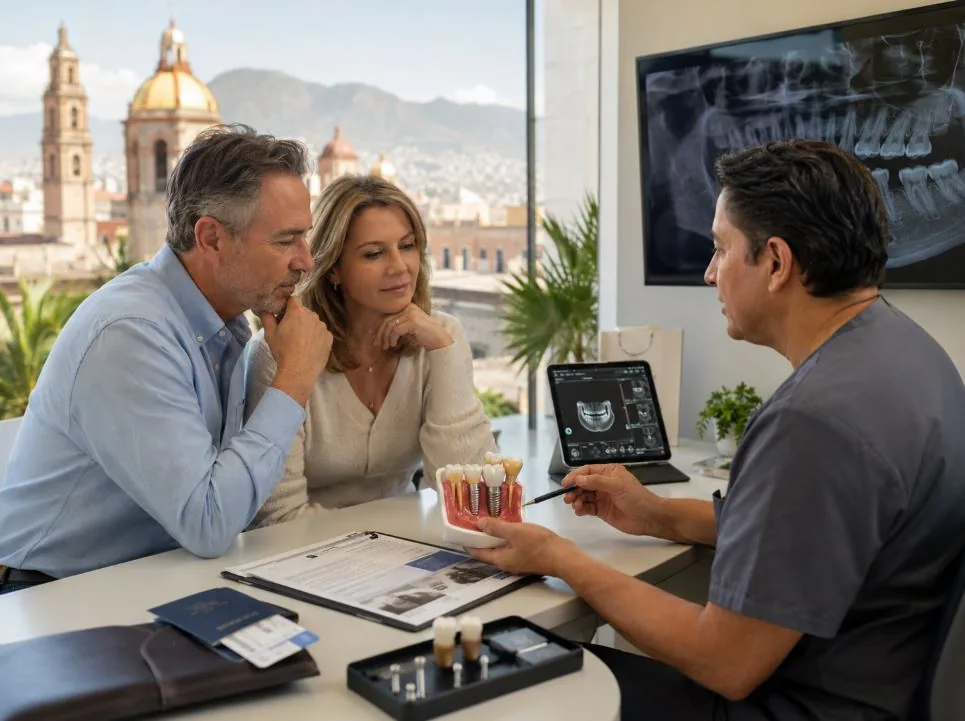
If you've gotten a $42,000 quote for a full-arch implant case in the U.S. and started looking south of the border for relief, you're not imagining the price gap — Mexico genuinely runs 50–70% below U.S. implant pricing for comparable work. The savings are real. The risks are also real. This guide is the honest version: what you actually save, what you don't, who should be considering Mexico, and who shouldn't.
Affordable dental implants in Mexico isn't a marketing slogan — it's a structural feature of the Mexican dental market. Lower commercial rents, lower labor costs, lower malpractice insurance premiums, and a competitive cluster of border-town and tourism-corridor clinics that have been serving U.S. patients for two decades drive prices that look almost unbelievable from a Phoenix or Denver vantage point. But "almost unbelievable" deserves scrutiny, and that's what this post is for.
For the U.S. baseline cost picture, our national pillar guide on affordable dental implants covers the domestic market in depth. This post sits next to it as the international comparison.
What U.S. Patients Actually Pay vs. Mexico
Here's the head-to-head that's driving most of the dental tourism interest. These are out-of-pocket numbers — U.S. ranges reflect mid-tier private practice in 2026, Mexico ranges reflect the established U.S.-patient-serving clinics in Los Algodones, Tijuana, Cancún, Puerto Vallarta, and Mexico City.
| Procedure | U.S. Mid-Tier | Mexico (Established Clinics) | Mexico Savings |
|---|---|---|---|
| Single implant (post + abutment + crown) | $3,200 – $5,500 | $1,200 – $2,000 | ~60% |
| Implant-supported bridge (2 implants, 3 teeth) | $7,500 – $12,000 | $3,000 – $4,800 | ~60% |
| All-on-4 (full arch, one jaw) | $22,000 – $38,000 | $8,500 – $14,500 | ~60–65% |
| Full-mouth (both jaws, All-on-4) | $42,000 – $72,000 | $16,000 – $26,000 | ~62% |
| Zirconia crown (per unit) | $1,200 – $2,200 | $350 – $600 | ~70% |
| Bone graft (per site) | $600 – $1,500 | $250 – $500 | ~65% |
| Sinus lift | $2,000 – $4,000 | $700 – $1,400 | ~65% |
The savings ratio compresses on the smallest cases (a single implant) once you add travel, and expands on the largest cases (full-mouth) where the absolute dollar gap can hit $40,000–$50,000. We'll come back to the trip-cost math in a moment, because that's where the honest analysis lives.
The Five Cities U.S. Patients Actually Go To
Mexico has dentists in every city, but five destinations have built dental-tourism infrastructure specifically for U.S. patients — multilingual front desks, wheelchair-accessible facilities, transparent dollar pricing, and proximity logistics that work for short trips.
Los Algodones, Baja California
Often called "Molar City" — a small border town directly across from Yuma, Arizona, with one of the highest dentist-per-capita densities in the world. Estimates put it at 350+ dental practices serving a town of fewer than 6,000 residents. Patients fly into Yuma or San Diego, drive across the border on foot (the Quechan border crossing is genuinely a walk-across), and stay in Yuma hotels rather than in Algodones itself. The clinics here have been doing this since the 1990s; the established ones have U.S.-trained surgeons, transparent dollar pricing, and full-arch packages running $8,500–$12,000 per jaw. The downside: it's a small town with limited non-dental amenities, so you're there strictly for the work.
Tijuana, Baja California
The closest large Mexican city to the U.S. for southern California patients. San Diego to a Tijuana Zona Río implant clinic is roughly a 30-minute drive plus border-crossing time. The Zona Río and Zona Urbana clinic clusters have several large clinics specifically built to serve the San Diego dental-tourism flow, with shuttle services from the San Ysidro border crossing. Single-implant pricing runs $1,000–$1,800; full-arch in the $9,000–$13,000 range. Tijuana also has the deepest bench of board-certified oral surgeons among the border cities, which matters for complex cases requiring grafting or sinus work.
Cancún, Quintana Roo
The vacation-and-implants combination. Cancún clinics market specifically to patients who want to combine the procedure with a beach vacation — useful if you genuinely need 5–7 days of low-activity recovery time, less useful if you're trying to minimize the trip cost. Single-implant pricing is comparable to Tijuana, but flights and lodging from most U.S. cities run $1,500–$3,000 more for a Cancún trip versus a border-town trip. The math works on full-arch cases and full-mouth restorations where the procedure savings dwarf the travel premium.
Puerto Vallarta, Jalisco
Similar profile to Cancún — vacation-corridor city with a mature U.S.-and-Canadian-patient clinic cluster. Puerto Vallarta tends to attract more retirees and snowbirds than Cancún, and the clinics reflect that demographic with conservative scheduling, longer consultation visits, and emphasis on full-mouth and All-on-4 cases. Pricing is comparable to Cancún. Direct flights from western U.S. cities make it logistically easier than Cancún for patients on the West Coast.
Mexico City
The largest dental market in the country and the deepest bench of subspecialty providers — board-certified periodontists, oral surgeons with university teaching appointments, and prosthodontists handling complex full-mouth cases. Mexico City pricing is slightly higher than the border towns ($1,400–$2,200 per single implant) but still 55–65% below the U.S., and the clinical infrastructure for complicated cases is the best in the country. Worth considering if your case involves significant medical complexity that the smaller border-town clinics may not handle as confidently.
What You Actually Save and What You Don't
The implant cost savings are real, but they're not the whole financial picture. Here's the trip-cost math that determines whether Mexico actually saves you money — and where the breakeven points sit.
Round-trip flights: $300–$800 for border cities (Tijuana, Algodones via Yuma or San Diego), $500–$1,200 for Cancún or Puerto Vallarta from most U.S. cities. Mexico City flights are $400–$900 from major U.S. hubs.
Lodging: 3–7 nights at $90–$220/night for the procedure visit ($300–$1,500). Full-arch and full-mouth cases often require a return trip 4–6 months later for final crown placement, doubling the lodging line.
Time off work: 3–5 working days for a single-implant case, 7–10 days for full arch, plus the second-trip days. For salaried patients with PTO, it's a real cost — subtract your daily wage from the procedure savings.
Follow-up logistics: If a complication arises 6 months later, you're either flying back or paying a U.S. dentist to manage someone else's surgical work. U.S. dentists charging to address another clinic's complication routinely run $400–$1,200 per visit.
Insurance: Most U.S. dental plans don't cover Mexican implant work directly, though some PPOs will reimburse a portion if you submit itemized receipts and the implants meet the policy's clinical criteria. Call your carrier in advance.
The breakeven math: for a single posterior implant, after travel and lodging, Mexico saves roughly $500–$1,500 versus a U.S. mid-tier quote — real money, but not life-changing, and the savings get eroded if a complication brings you back. For a full-arch case, Mexico saves $10,000–$22,000 net of travel — the math is overwhelming. For a full-mouth case, the savings are $25,000–$45,000 net of travel and a return trip — at that scale, the trip cost is a rounding error.
Quality and Credentialing in Mexico
The quality range in Mexico is wider than in the U.S. — not because the top clinics are worse, but because the regulatory floor is lower. The best Mexican implant clinics are equivalent to the best U.S. clinics; the worst are meaningfully worse than what U.S. licensing standards permit. The job is to find the top end.
The Mexican equivalent of the American Dental Association is the Asociación Dental Mexicana (ADM) — the Mexican Dental Association. Member dentists have completed accredited Mexican dental school programs and submit to continuing education requirements. ADM membership is the baseline credential to verify.
For oral surgery specifically, look for board certification from the Consejo Mexicano de Cirugía Oral y Maxilofacial (Mexican Council of Oral and Maxillofacial Surgery). This is the equivalent of U.S. board certification in oral and maxillofacial surgery, and it's the credential you want for full-arch and complex cases.
Many of the top Mexican implant dentists trained partly in the U.S. or Europe — Loma Linda, NYU, the University of Toronto, and several European programs run continuing-education and fellowship tracks that Mexican dentists complete to stay current on implant technique. The clinics serving U.S. patients well will display these credentials transparently. If a clinic won't tell you exactly who is placing your implant and where they trained, that's the answer.
For full-arch and complex cases, also look for clinics that have Joint Commission International (JCI) accreditation — this is the international healthcare accreditation standard, and it's a meaningful filter. JCI-accredited Mexican dental clinics meet U.S.-equivalent infection control, sterilization, and clinical documentation standards.
Risks Honestly
The savings are real and the top Mexican clinics are good. The risks are also real and worth thinking through specifically rather than dismissing.
Follow-up complication management
Implants occasionally develop complications months or years after placement — peri-implantitis (infection of the tissue around the implant), screw loosening, crown fracture, or progressive bone loss. In the U.S., your surgeon handles these in a 30-minute visit at minimal cost. With work done in Mexico, you're either flying back or hiring a U.S. dentist to manage another clinic's case — which routinely costs $400–$1,200 per visit and not all U.S. dentists will take on someone else's surgical work, particularly if the records aren't shareable.
Implant brand serviceability
Some Mexican clinics use implant brands that aren't widely stocked in U.S. dental practices. If your implant develops a problem 5 years later and the abutment needs replacing, a U.S. dentist may not be able to source the matching component. This is solvable — the major Mexican clinics use Straumann, Nobel Biocare, BioHorizons, and other globally distributed brands — but it's worth asking specifically: what brand of implant will be placed, and can a U.S. dentist source replacement components if needed?
Regulatory recourse
U.S. malpractice law gives patients meaningful legal recourse if surgical work goes wrong. Mexican consumer protection law applies to Mexican dental work, and the standards and practical mechanisms differ. If you're seriously injured by negligent care in Mexico, your legal options are mostly Mexican civil court — slower, less generous on damages, and harder to pursue from the U.S. The risk is small at established clinics with clean track records, but it's structurally different from U.S. malpractice exposure.
Travel-related medical risk
Flying within 24–48 hours of oral surgery carries some risk of dry socket, bleeding complications, and post-anesthesia issues. The good Mexican clinics build a 2–4 day buffer into the visit specifically for this reason. If the clinic is pushing you onto a flight the same day as a multi-implant placement, that's a flag.
Who SHOULD Consider Mexico
The trip economics work cleanly for specific patient profiles. If you're in any of these, Mexico is a defensible choice on the math alone.
Who SHOULDN'T Consider Mexico
And the patient profiles where the trip math doesn't work, or the clinical complexity is too high for a non-local provider.
Patients with complex medical histories. Diabetics, patients on bisphosphonates or anticoagulants, patients with cardiac conditions requiring antibiotic prophylaxis, and patients with known implant-failure history need ongoing surgeon access. Place the work somewhere a 30-minute drive can address a problem.
Patients with no flexibility for a return trip. Many full-arch cases involve a second visit 4–6 months after placement for final crown delivery. If your work or family situation can't accommodate that second trip, Mexico becomes a worse choice.
Patients without strong primary care or dental access at home. If a complication happens 18 months later, you'll need a U.S. dentist willing to take on management of another clinic's case. If you don't have that relationship — and many uninsured patients don't — the Mexican savings can flip into a U.S. emergency-room cost overnight.
Patients with active infections or unstable oral health. Implants placed into an active periodontal infection fail at sharply elevated rates. The pre-implant work — periodontal therapy, extractions, healing time — is best done where you live and where you can be monitored.
Honest Red Flags Within Mexico Itself
The Mexican market has high-quality clinics and marginal ones, and the marginal ones often look almost identical from the patient side until you start asking specific questions. Here's the screen.
Clinics without a named, credentialed surgeon. "Our team places implants" is not an answer. Every Mexican implant clinic should be willing to tell you the surgeon's name, dental school, year of graduation, and any relevant board certification. If they won't share it, walk.
"Implant tourism packages" bundling hotel, flights, and dentist. The package model creates a financial conflict — the clinic is paying the booking platform a commission, which can quietly distort treatment recommendations toward more expensive cases. The cleanest version of dental tourism is: book your own flight, book your own hotel, pay the dentist directly. The packages aren't always bad, but the incentives aren't aligned with you.
Same-day full-mouth turnaround promises. All-on-4 surgical placement can sometimes happen in a single visit, but the full restoration — final crowns, occlusal adjustment, hygiene check — should not be compressed into 24 hours. Anyone promising "fly in Monday, fly out Tuesday with new teeth" is cutting clinical corners.
No CT or 3D imaging at consultation. Modern implant placement requires 3D imaging anywhere in the world. A Mexican clinic skipping this is using outdated technique.
Mexico vs. U.S. Dental Schools and FQHCs
One comparison U.S. patients often skip: the U.S. dental school option. Most U.S. dental schools run patient clinics where implants are placed by graduate residents under faculty supervision, at fees roughly 40–55% below private practice. For a single-implant case, a dental school clinic in Texas or California can land at $1,500–$2,200 — comparable to Mexico, with no travel and full U.S. follow-up access.
Federally Qualified Health Centers (FQHCs) provide sliding-scale dental care for income-qualifying patients, and a growing number now offer implants. The U.S. domestic options aren't always available, but they're worth pricing before booking the Cancún flight. For patients who qualify, the dental school or FQHC route is often the cleanest answer for single-implant or simple bridge cases.
The Mexico advantage is largest where U.S. domestic affordable options are weakest — full-mouth cases and full-arch cases that exceed what most dental school clinics handle, and patients in markets without strong dental school presence.
Final Thoughts on Dental Implants in Mexico
Mexico is neither a scam nor a slam dunk. It's a real market with real savings, real quality at the top end, and real risks at the marginal end — and the right answer depends specifically on your case size, your proximity to the border, your medical history, and your follow-up situation back home.
What we'd encourage you not to do: book the cheapest quote you find on a Facebook ad without verifying the surgeon's credentials, fly home the day after a multi-implant surgery to save a hotel night, or assume that "Mexican dentistry" is a single homogeneous thing rather than a bimodal market with great clinics and bad ones at the same price points.
What we'd encourage you to do: get itemized quotes from two or three established U.S.-patient-serving Mexican clinics, verify Asociación Dental Mexicana membership and board certification for the surgeon, ask explicitly about implant brand and U.S.-serviceability, and price the U.S. dental school and FQHC options before you book travel. If the math still works after all that — and for full-arch and full-mouth cases it almost always does — Mexico is a defensible choice you can make with eyes open.
Compare U.S. Implant Pricing First
Before booking south, see what your home-market U.S. clinics actually charge. Smyleee's directory covers verified U.S. implant providers with transparent pricing and payment plan flags.
Sources & References
- U.S. Food and Drug Administration — Dental Implants: What You Should Know
- CDC — Medical Tourism Health Considerations
- Asociación Dental Mexicana — Member Dentist Directory
- Joint Commission International — Accredited Healthcare Organizations
- U.S. Department of State — Mexico Travel Information
- American Dental Association — Dental Implants Overview
- PMC — Risks and Complications Associated with Dental Implant Failure
- PubMed — Dental Tourism in Mexico Research Index
- American Dental Education Association — U.S. Dental School Patient Care Programs