
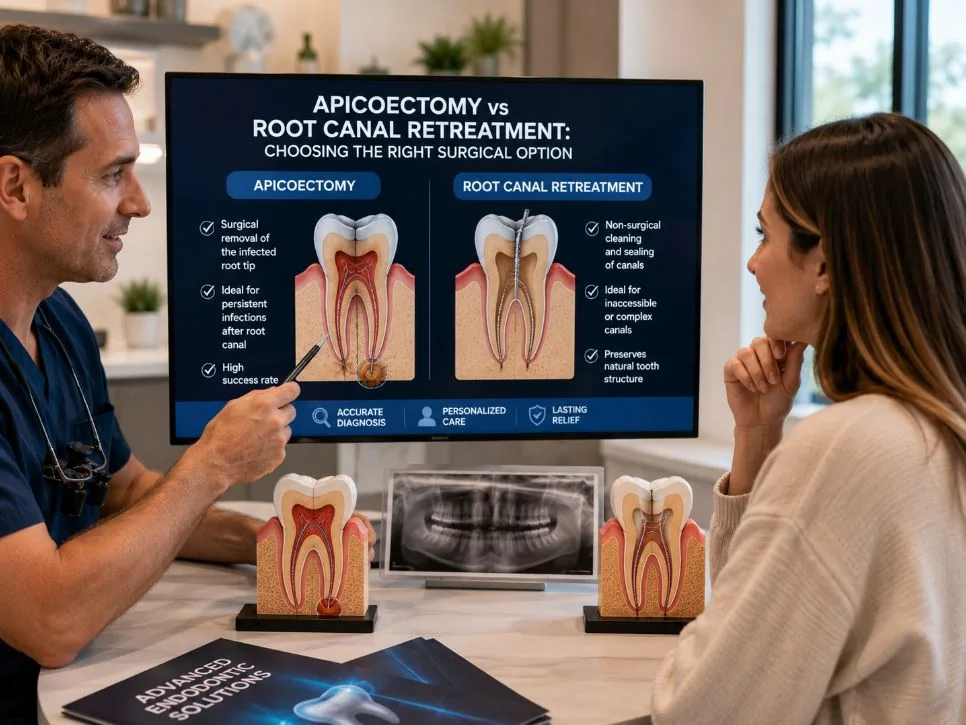
A root canal you had years ago has failed, and the recommendation on the table isn't another root canal — it's a surgical procedure called an apicoectomy. Or maybe the recommendation is retreatment, but you've read enough to know surgery is sometimes the better option and you want to understand the difference before you commit. Choosing between endodontic retreatment and apicoectomy is one of the more consequential decisions a patient makes after a failed root canal — and it's one where the right answer is genuinely case-dependent rather than universally one or the other. This post explains what apicoectomy actually is, when it's the right choice over retreatment, when retreatment is the right choice over surgery, and the realistic peer-reviewed success rates for each.
Patients reach this decision in two main ways. The first: a root canal failed and the endodontist evaluated the case and recommended apicoectomy directly because something about the tooth — usually a functional crown or a post in the canal — makes retreatment impractical. The second: the patient already had retreatment, the apical lesion didn't fully heal, and the next move is surgical. Either way, the decision matters enough to deserve more than a chair-side overview, because the wrong choice ends in a tooth that didn't need to come out, and the right choice ends in another decade-plus of natural-tooth function.
This guide walks through what apicoectomy actually is and how the procedure has evolved with modern microsurgical technique, the step-by-step procedure as performed in 2026, the case-specific decision criteria for surgery vs. retreatment, the real success rates honestly compared, what each option costs, recovery and aftercare expectations, the five questions to ask before consenting to surgery, and the red flags worth flagging. Sources are listed at the bottom — primary peer-reviewed literature, AAE position papers on endodontic surgery, ADA guidelines, and cost references. If you don't trust any specific number, the source is one click away.
What Apicoectomy Actually Is
Apicoectomy — also called endodontic microsurgery, root-end surgery, or apical surgery — is a surgical procedure performed under local anesthesia to address a persistent infection at the tip of a root in a tooth that has already had a root canal. Instead of going back through the canal from the top of the tooth (which is what retreatment does), the endodontist accesses the root tip from the side, through the gum and bone overlying the affected root.
In a single sentence: the endodontist creates a small flap in the gum, accesses the root tip through the underlying bone, removes the infected tissue surrounding the apex, surgically removes the last 3mm of root (the apicoectomy itself, which means "removal of the apex"), and seals the freshly cut root end with a biocompatible material — typically MTA or a bioceramic. Healing of the surrounding bone takes 6-8 weeks, with full radiographic resolution of the apical lesion typically visible at 6-12 months on follow-up imaging.
The procedure has evolved meaningfully over the last 25 years. "Traditional" apicoectomy — performed without a microscope, with larger surgical instruments, and using older retro-filling materials like amalgam — produced success rates in the 50-65% range in older literature. Modern microsurgical apicoectomy — performed with surgical microscope at 8-25× magnification, ultrasonic retro-preparation, and bioceramic retro-filling materials — produces success rates of 75-90% in current peer-reviewed literature. The two procedures are technically similar in outline but meaningfully different in execution and outcome. When you're being quoted on success rates, the relevant number is the modern microsurgical one, and the relevant question is whether your provider is performing the modern technique.
The Procedure, Step by Step
Total chair time for a routine single-root apicoectomy is 60-90 minutes. Multi-root cases (a molar with two or three roots requiring surgery) can run 90-120 minutes. Almost all apicoectomies are performed by endodontists; general dentists rarely perform them because the procedure requires surgical microsurgical training and the specialty equipment to do it well.
When Apicoectomy Is the Right Choice (vs. Retreatment)
The decision between apicoectomy and retreatment isn't ideological — both are valid endodontic procedures, and the right one depends on case-specific factors. Apicoectomy is generally the right choice over retreatment when one or more of the following is true:
When Retreatment Is Preferred Over Apicoectomy
The reverse case is just as important. Apicoectomy is sometimes recommended in cases where retreatment would be the more conservative and appropriate first move. Retreatment is generally preferred when:
- The crown is failing or about to be replaced anyway — if the existing crown is going to come off in the next year regardless, removing it now and doing retreatment is essentially free in terms of crown-preservation cost. The argument for surgery weakens.
- The original treatment likely missed canals — the most common cause of root canal failure is missed canal anatomy (especially MB2 in upper molars). Retreatment can find and treat the missed canal directly, addressing the actual cause. Apicoectomy doesn't fix a missed canal — it addresses the resulting apical lesion but leaves the underlying canal infected. For missed-canal failures, retreatment is almost always preferred.
- No post in canal — without a post complicating retreatment access, the technical case for surgery weakens substantially.
- The patient hasn't yet had retreatment attempted — surgery is generally the second move after a competent non-surgical retreatment, not the first move. Going to surgery first when retreatment is viable means choosing a more invasive procedure than necessary.
- The apical lesion is large and the cause is reachable from the canal — large lesions sometimes heal more reliably when the canal-side source is eliminated by retreatment than when only the apical end is addressed surgically.
If you haven't already read it, our companion failed root canal retreatment guide covers the retreatment-side decision in full detail — what the procedure involves, when it's the right first option, and when it isn't. The two posts are designed as a decision pair.
Success Rates, Honestly
This is where the modern vs. traditional distinction matters most. The peer-reviewed literature on apicoectomy outcomes splits cleanly into "older" technique (no microscope, amalgam retro-fill, larger surgical instruments) and "modern microsurgical" technique (microscope at 8-25× magnification, ultrasonic retro-preparation, bioceramic retro-fill). The two produce meaningfully different long-term outcomes.
| Apicoectomy technique | Long-term success rate (peer-reviewed) |
|---|---|
| Traditional apicoectomy (no microscope, amalgam retro-fill) | ~50-65% |
| Modern microsurgical apicoectomy (microscope, bioceramic retro-fill) | ~75-90% |
| Modern microsurgery on simple anterior root, no complicating factors | ~85-95% |
| Modern microsurgery on complex multi-root molar | ~70-85% |
By comparison, endodontic retreatment success rates run 70-85% in the same literature — broadly overlapping with modern microsurgical apicoectomy. Neither procedure is dramatically more successful than the other in absolute terms; the case features determine which one is more likely to succeed for your specific tooth. A missed-canal failure with no functional crown leans toward retreatment (where treating the missed canal directly addresses the cause). A persistent apical infection after competent retreatment leans toward apicoectomy (where surgery addresses the apical anatomy that retreatment couldn't reach).
"Success" in the underlying studies is defined the same rigorous way: clinical absence of symptoms and radiographic evidence of healing of the periapical lesion at multi-year follow-up. A treatment plan that quotes a "95% success rate" for apicoectomy without context is either misquoting the high end of the range for an ideal case or simply rounding upward.
Cost Comparison
The cost difference between apicoectomy, retreatment, and the extraction-plus-implant alternative is significant enough to factor into the decision. Realistic U.S. ranges for 2026:
| Treatment option | Typical U.S. range (all-in) |
|---|---|
| Endodontic retreatment (specialist) + new crown | $2,400 – $5,300 |
| Apicoectomy, single root (specialist only) | $1,000 – $2,500 |
| Apicoectomy, multi-root tooth (added cost per root) | +$500 – $1,500 |
| CBCT (3D scan, surgical planning) | $200 – $400 |
| Extraction + implant + crown (replacement alternative) | $3,000 – $6,500+ |
Apicoectomy is meaningfully cheaper than retreatment-plus-new-crown when the existing crown is preserved — that's part of what makes it attractive when the crown is functional and recent. Both are substantially cheaper than extraction-and-implant, which is the alternative if neither tooth-preserving option is viable. Insurance coverage for apicoectomy is generally similar to retreatment — covered as a "major" procedure at 50-80% up to the annual maximum on most plans, with the same caveats about reading the policy language.
HSA and FSA dollars cover apicoectomy in full as a qualified medical expense under IRS Publication 502. The federal tax savings on a $2,000 apicoectomy can run $400-700 depending on your bracket — meaningful relative to the procedure cost.
Recovery and Aftercare
Apicoectomy recovery is generally manageable and substantially less involved than patients expect. The procedure is technically a surgery, but it's a small, localized surgery under local anesthesia, and the recovery course reflects that.
First 24-48 hours
Mild swelling and sometimes mild bruising at the surgical site. Some patients have a small visible bruise on the cheek over the affected tooth that fades over 5-7 days. Discomfort is typically managed with over-the-counter ibuprofen, occasionally combined with acetaminophen for the first day. Severe pain is uncommon and warrants a same-day call to the endodontist.
Days 2-7
Soft food diet for 5-7 days. Avoid chewing directly on the surgical site. Gentle mouth rinses (often with prescribed chlorhexidine or warm saltwater) to keep the area clean. Most patients return to work the day after surgery if the work isn't physically demanding; some take a day off depending on their tolerance.
Days 7-14
Suture removal at 7-10 days. Soft tissue healing is essentially complete by day 14. Most patients are back to full normal diet by then.
6-8 weeks and 6-12 months
Bone healing of the apical lesion progresses through 6-8 weeks. Initial follow-up imaging is typically taken at 6 months, with full radiographic resolution of the lesion expected by 12 months. The endodontist will schedule the follow-up imaging as part of the procedure plan; it's important to actually attend those visits because they're how a persistent failure (rare) is caught early enough to act on.
Five Questions to Ask Before Apicoectomy
The Decision Framework, in One Place
Distilling the case-specific factors into a usable framework:
| Case features | Recommended first move |
|---|---|
| Tooth structurally sound, crown removable or failing, no post, treatable original failure | Retreatment |
| Tooth structurally sound, functional recent crown, no post | Either; case-specific judgment |
| Tooth structurally sound, functional crown, post in canal, treatable failure | Apicoectomy |
| Already had competent retreatment, persistent apical lesion | Apicoectomy |
| Anatomy makes top-down access impractical | Apicoectomy |
| Vertical root fracture confirmed, severe structural compromise, repeated failures | Extraction + implant |
The framework isn't a flowchart you should follow without a provider — it's the lens that lets you understand why a particular recommendation makes sense for your specific case, and the basis on which to ask the case-specific questions during your consultation. If the recommendation you're hearing doesn't fit any row in this table cleanly, that's a signal worth investigating further with a second opinion.
For the broader extract-vs-save question — when neither retreatment nor apicoectomy is viable, or when an implant is genuinely the better long-term move — our root canal vs. extraction guide covers that decision tradeoff in full.
Red Flags That Should Stop You
Apicoectomy recommended when retreatment would be the more conservative option — particularly when the crown is failing anyway, when no post is present, or when the original failure was clearly a missed canal. Surgery first in those cases is choosing a more invasive procedure than necessary. Get a second opinion from a different endodontist before consenting.
No surgical microscope — the success rate gap between microsurgical and traditional apicoectomy (75-90% vs. 50-65%) is too large to ignore. Modern microsurgical technique is current standard of care; absence of microscope use is itself a quality signal.
Use of amalgam as the retro-filling material — outdated. Modern apicoectomy uses MTA or bioceramic materials with substantially better biocompatibility and sealing performance. Amalgam retro-fill in 2026 is operating on 1990s standards.
Same-day extraction recommendation when apicoectomy is viable — same flag as the retreatment-side warning. A general dentist or endodontist who skips both retreatment and apicoectomy and goes straight to extraction-and-implant on a tooth that has tooth-preserving options on the table is bypassing the most conservative paths. Get an endodontic-specialist opinion before consenting to extraction.
Pressure to commit at the consultation visit — apicoectomy is a surgical procedure with a multi-thousand-dollar cost. Same-day pressure is a sales tactic, not a clinical one. Take the imaging, consider a second opinion, and decide on your own timeline.
How Smyleee Helps You Find a Surgical Endodontist
Smyleee maintains city-level Top 10 root canal rankings for major U.S. metros, vetting providers on credential signals (residency training, ABE certification, AAE membership), case-volume markers, and aggregate patient feedback rather than raw review counts. For surgical cases — apicoectomy in particular — board certification and residency depth matter more than they do for routine initial treatment. Our directory flags microscope use and surgical-endodontic experience.
Useful starting points if you want a curated shortlist:
- Top 10 Root Canal Specialists in Brooklyn
- Top 10 Root Canal Specialists in Los Angeles
- Top 10 Root Canal Specialists in San Diego
- Top 10 Root Canal Specialists in Miami
- Top 10 Root Canal Specialists in Charlotte
For broader context on the procedure landscape, the root canal pillar guide covers the procedure end to end. For specific decisions, the companion failed root canal retreatment guide covers the retreatment side of the same decision pair, and dedicated guides cover what root canal pain actually feels like, the science behind root canal safety, and when to save the tooth vs. replace it with an implant.
Final Thoughts
The choice between apicoectomy and retreatment is rarely binary. For some cases, the case features point clearly to one or the other — a missed-canal failure with no functional crown points to retreatment; a persistent apical lesion after a competent retreatment with a functional crown points to apicoectomy. For other cases, both options are clinically viable and the right choice depends on patient preference, cost, and the specific provider's experience with each.
What separates good outcomes from regretted ones is, again, almost never which procedure was performed — it's whether the right provider used the right modern technique on the right case after the right workup. Endodontist for both options. CBCT before the recommendation. Microscope during the procedure. Modern microsurgical retro-fill materials for apicoectomy. Honest second opinion when the recommendation skipped any of those steps. The tooth you save with the right second-line endodontic procedure today is the one you don't have to replace with an implant tomorrow.
Take the time. Get the imaging. Ask the questions. Don't accept a surgical recommendation without first hearing whether retreatment is viable, and don't accept a retreatment recommendation without first hearing whether the case features actually argue for surgery instead. The right answer is the one that fits the specific tooth — not the procedure your provider does most often.
Find a Vetted Surgical Endodontist
Browse Smyleee's curated, credential-vetted directory of endodontists experienced in apicoectomy and surgical endodontics — with microscope-use flags, ABE certification markers, and aggregate patient ratings.
Sources & References
- American Association of Endodontists — Position Statements (Endodontic Surgery, Apical Surgery, Microsurgery)
- American Association of Endodontists — Clinical Resources Library & Surgical Treatment Guidelines
- American Board of Endodontics — Board Certification Standards & Specialist Verification
- American Dental Association — Endodontics Oral Health Topic & Council on Scientific Affairs Statement
- Journal of Endodontics — Peer-Reviewed Microsurgical Apicoectomy Outcome Studies
- PubMed / NCBI — Primary Literature on MTA, Bioceramic Retro-Fill, and Microsurgery Outcomes
- Cochrane Reviews — Systematic Reviews of Endodontic Surgery vs. Retreatment
- AAE — Endodontic Surgery Patient Resource & Apicoectomy Overview
- U.S. Food and Drug Administration — Dental Device & Material Safety Guidance
- MetLife Oral Fitness Library — Root Canal & Apicoectomy Cost Reference
- GoodRx — Root Canal and Apicoectomy Cost Guide
- CareCredit — Endodontic Surgery Financing
- American Dental Association MouthHealthy — Patient Guide to Root Canals
- IRS Publication 502 — Medical and Dental Expenses (HSA / FSA Eligibility)