
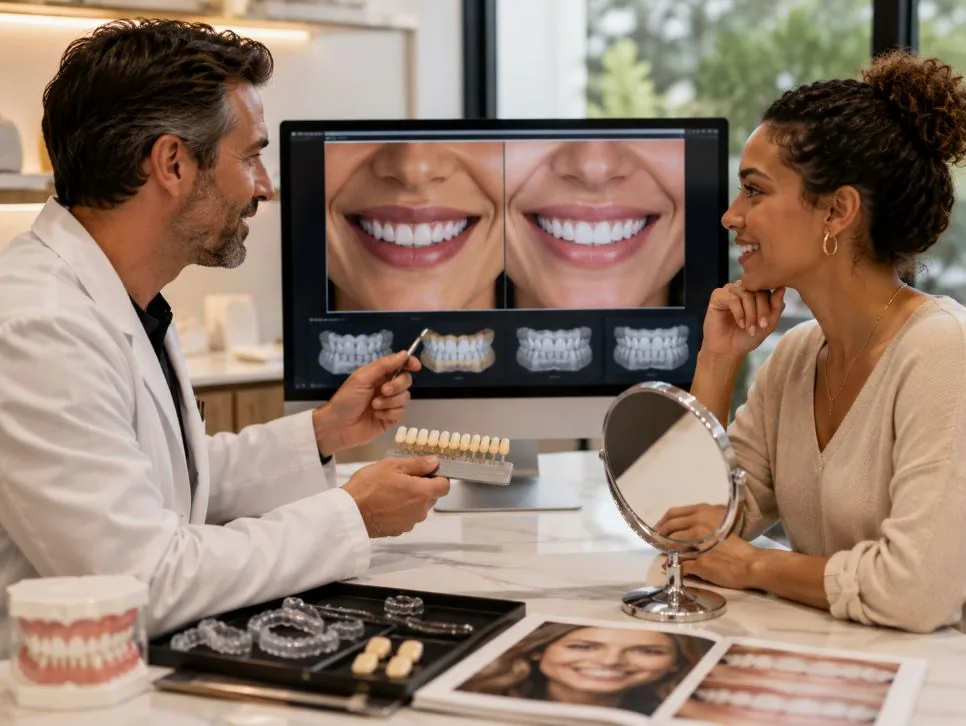
Search "best veneer dentist near me" and the wall of clinics that comes back is functionally identical — every practice five-starred, every smile gallery dramatically lit, every dentist describing themselves as a porcelain veneer specialist. What "best veneer dentist" should actually mean is something narrower than "good cosmetic dentist who occasionally does veneers": a clinician with AACD-level credentialing, real annual case volume in veneer work specifically, a mockup-first planning workflow, and conservative-prep technique experience across multiple veneer materials. A general cosmetic dentist who places thirty veneers a year is a different proposition than a veneer-focused specialist who places three hundred — and the patients who don't know to draw that distinction are the ones who end up unhappy with the result.
Veneers are the single most-marketed cosmetic dental procedure in the U.S. The treatment is irreversible — enamel removed for a porcelain veneer doesn't grow back — and the difference between a great outcome and a regretted one almost never shows up in the marketing. It shows up in technique, materials, and planning workflow, none of which are visible on a clinic's home page. This guide explains the credentialing markers that actually distinguish a veneer specialist, the materials and prep depths you'll be choosing between, why the mockup phase is the single highest-leverage decision in the whole project, the five questions that surface a real veneer specialist at the consultation, the realistic 2026 cost ranges across material and case size, and the red flags specific to veneer work — including the ones that have caught a lot of patients in the Instagram-veneer era.
By the end you'll be able to evaluate any veneer dentist's "best" or "specialist" claim on the merits, not on the marketing.
What "Best Veneer Dentist" Should Actually Mean
The phrase doesn't have a regulatory definition. There is no "veneer specialist" license category in any U.S. state. Anyone with a DDS or DMD is legally allowed to place veneers, and most general dentists do at least a few cases a year. That's the floor — and the floor is not where you want to be for irreversible cosmetic work on the most visible part of your face.
The real markers that separate a veneer specialist from a general cosmetic dentist who occasionally does veneers are different from the marketing language and largely verifiable in two minutes online.
Annual case volume in veneer work specifically — a meaningful veneer specialist places 50+ veneers a year minimum, often well over 200 in a high-volume cosmetic practice. A general dentist placing 8-15 veneers a year is not a veneer specialist regardless of how the website reads. Ask the question directly: how many veneer cases did you complete last year, and what's your typical mix of single-veneer, 6-veneer, 8-veneer, and 10-veneer cases?
Mockup-first workflow — every credible veneer specialist starts every multi-veneer case with a digital smile design or trial-smile mockup, before any irreversible work begins. Practices that skip the mockup phase are not in the top tier of veneer work, regardless of their marketing or their AACD status. The mockup is non-negotiable for anyone who actually treats cosmetic dentistry as planning work rather than as a sales product.
Conservative-prep technique experience — modern veneer technique allows for far more conservative enamel reduction than was standard 20 years ago. A specialist who can offer minimal-prep (0.2-0.3mm) or no-prep options when the case allows is operating on current technique. A clinician who runs every case with 0.5mm+ reduction "because that's what we do" is operating on outdated convenience. The right answer depends on the case — but the option should be available, and the rationale should be explained.
Comfort across multiple veneer materials — a real specialist places porcelain (e.max lithium disilicate, feldspathic, sometimes zirconia), composite (direct chairside), and minimal-prep options like Lumineers when the case fits. A practice that offers only one brand or only one material regardless of case is selling whatever they happen to use, not matching the material to the patient's needs.
Lab partnership transparency — porcelain veneers are made by a dental lab, not by the dentist. The lab choice meaningfully affects the outcome. A specialist will name their lab, often boutique cosmetic-focused labs that produce custom-stained, layered porcelain veneers rather than monolithic mass-produced ones. A vague answer here is a flag.
None of these markers is a single make-or-break filter. The pattern matters more than any one item. A veneer dentist hitting four or five out of six is meaningfully different from one hitting one or two, even if the second has flashier Instagram posts and a busier waiting room. The patient's job is to read the pattern, not the marketing.
Veneer Materials — The Choices That Matter
The "best veneer dentist" question is partly the wrong frame, because the right answer depends on the material and case. A specialist who's brilliant at e.max porcelain veneers may not be the best choice for a composite-bonding refinement case, and a chairside-composite expert may not be the right pick for a 10-veneer full-arch porcelain case. Knowing the materials lets you ask the right specialist for your specific situation.
| Material | Typical Lifespan | What It's Best For |
|---|---|---|
| e.max (lithium disilicate porcelain) | 10-15+ years | The current premium-tier veneer material; strong, esthetic, allows minimal-prep options. Most common premium veneer in 2026. |
| Feldspathic porcelain (hand-stacked) | 10-15+ years | The most natural-looking veneer material; layered by hand by a master ceramist. Often used in AACD-accredited practices for highest-aesthetic cases. Requires skilled lab partnership. |
| Zirconia veneers | 10-15+ years | Strongest material, more opaque than e.max. Less commonly used for front-tooth veneers because of esthetics; better for high-stress cases or patients with bruxism. |
| Composite veneers (direct, chairside) | 5-7 years typical | Tooth-colored resin sculpted directly onto the tooth in one visit. Less expensive, reversible, easier to refresh, but lower durability and color stability than porcelain. |
| Lumineers (brand-name minimal-prep) | 10-15+ years | A brand of pressed-ceramic minimal-prep veneers from DenMat. Marketed as "no-prep," though typical cases still involve some preparation. Worth knowing the brand exists; also worth being skeptical of any practice that treats Lumineers as the answer for every case. |
The honest summary: e.max is the workhorse premium veneer material in 2026 and what most AACD-accredited practices use for the majority of cases. Feldspathic porcelain is the highest-aesthetic option when the case calls for it and when the practice has a master-ceramist lab partner. Composite is the right answer for younger patients, single-veneer cases, and refinement work where reversibility and lower cost matter. Lumineers is one minimal-prep option among several, not a universal solution.
Prep Depth — The Single Most Important Technical Choice
Prep depth is how much enamel the dentist removes from your tooth before bonding the veneer on. The choice ranges from zero (true no-prep, possible only on small or recessed teeth) up to 0.7mm or more (aggressive, more typical of older technique). Prep is irreversible — enamel doesn't grow back — so the choice meaningfully affects the long-term health of the underlying tooth.
No-prep / minimal-prep (0-0.2mm) — possible when the existing teeth are small, recessed, or worn enough that adding 0.3-0.5mm of veneer thickness on top doesn't make the smile look bulky. The lab makes a thinner veneer; the dentist removes very little or no enamel; the bond is to enamel rather than to dentin, which is structurally stronger. The constraint is case-fit: not every patient is a candidate.
Conservative prep (0.3-0.4mm) — the modern standard for most cases. Removes a thin layer of enamel to make room for the veneer without the smile looking added-onto. Stays largely or entirely within enamel, which preserves bond strength. The right answer for the majority of contemporary cases.
Standard prep (0.5mm) — slightly more aggressive. Used when the existing teeth are forward-positioned, when significant alignment correction is being done with the veneer, or when material constraints require it. Typically still mostly within enamel.
Aggressive prep (0.6mm+) — historically common, less defensible in 2026 unless specifically justified by the case. Often crosses into dentin, weakens the bond, and can cause sensitivity. A practice that runs aggressive prep as the default is operating on outdated convenience or training.
Ask the dentist what prep depth they're planning for your case and why. The answer should be specific — "0.3mm because your existing teeth are slightly forward" — not generic — "we always use 0.5mm." A specialist who can articulate the prep choice in terms of your specific dentition is operating on current technique. One who can't is selling a procedure they've memorized rather than designing an outcome.
The Mockup-First Workflow — The Single Most Important Decision
Of every choice in a veneer case, the mockup decision has the highest leverage on whether you end up happy with the result. Best veneer dentists start every multi-veneer case with one of two workflows: a digital smile design (a software simulation overlaid on photographs of your face), or a trial-smile mockup (a temporary composite version of the proposed veneers, bonded onto your unprepped teeth for one to two weeks of real-world wear-testing). Often both. Practices that skip this step are not in the top tier of veneer work, regardless of marketing, price tier, or how busy the waiting room is.
The reason the mockup matters: veneers are irreversible. Tooth structure removed for the prep doesn't grow back. The first time a patient sees the final result is sitting in the chair after the porcelain has been bonded — at which point the design is locked in. The mockup phase moves that "first time you see the result" forward by a week or two, while the design is still revisable. Patients who skip the mockup are reacting to the final outcome for the first time after the irreversible work has been done. Patients who do the mockup get to revise the plan while it's still revisable.
What a real mockup workflow looks like: at the planning visit, the dentist photographs your face and smile from multiple angles, takes a digital scan of your teeth, and runs the photos through smile-design software (often Digital Smile Design / DSD or 3Shape) to produce a simulated proposed smile. You review and adjust — wider, narrower, more or less translucent, different incisal-edge shape. The design iterates over one or two visits. Once the design is approved, the dentist makes a temporary composite version that's bonded onto your unprepped teeth for one to two weeks. You wear it. You eat with it. You photograph it in different light. You decide if it's right. Only then is any irreversible prep done.
Practices that skip directly from "we like this look" at the consultation to "here's your prep appointment" two weeks later are running a sales workflow, not a planning workflow. The mockup question is the single highest-signal filter in the entire shopping process. Use it.
Five Questions to Ask a Prospective Veneer Dentist
These five questions, asked plainly, surface the things the consultation script tends to skip. They work whether you're shopping at a Manhattan cosmetic flagship, a Beverly Hills boutique, a Miami high-end practice, or a mid-tier veneer specialist in a Sun Belt metro. A confident specialist welcomes them; a less-confident one finds them inconvenient.
None of these questions are aggressive or unusual. A confident veneer specialist welcomes them — these are the things a thoughtful patient should be asking. A defensive or rushed reaction to any of the five is itself the answer.
What Veneers Actually Cost in 2026
Pricing is set by the practice, not by any national fee schedule. The U.S. range is wide because case complexity, material, prep depth, lab choice, geography, and provider tier all affect the number. Here's the realistic 2026 range across the common scenarios.
| Veneer Type / Case Size | Typical U.S. Range |
|---|---|
| Single porcelain veneer (e.max, standard prep) | $1,200 – $2,800 |
| Single feldspathic porcelain veneer (master ceramist) | $2,000 – $4,500 |
| Single composite veneer (direct, chairside) | $300 – $900 |
| Single Lumineers veneer (brand minimal-prep) | $1,200 – $2,500 |
| 6-veneer case (premium e.max) | $8,000 – $18,000 |
| 8-veneer case (premium e.max) | $10,500 – $25,000 |
| 10-veneer full smile zone (premium e.max) | $13,000 – $32,000 |
| Digital smile design / trial-smile mockup phase | $300 – $1,500 |
| Refinement / single-veneer remake (post-warranty) | $1,000 – $2,800 |
The top of these ranges sits in NYC, LA, Beverly Hills, Miami's South Beach, and high-end West Coast markets. The lower end shows up in mid-tier metros (Charlotte, Phoenix, Jacksonville) and value-conscious cosmetic practices everywhere. Quality variance does not track price one-to-one — a $14,000 6-veneer case at an AACD-accredited, mockup-driven mid-tier practice often produces a better outcome than a $22,000 case at a flashier practice that skips the mockup. The practice's planning workflow matters more than the city.
Insurance, Financing, and HSA / FSA
Most veneer work is not covered by dental insurance. The standard exclusion language in dental policies treats elective cosmetic procedures (veneers placed for purely aesthetic reasons) as out-of-pocket. There are exceptions — bonding to repair a chipped tooth from trauma, a porcelain restoration placed to restore a structurally compromised tooth — but the cosmetic-driven version of veneer work is generally not reimbursed.
That said, a few angles are worth exploring before assuming zero coverage.
HSA and FSA dollars — the IRS treats most cosmetic veneer work as ineligible for HSA/FSA coverage unless the procedure has a non-cosmetic medical purpose. A veneer placed to restore trauma damage, a porcelain restoration for structural integrity, or veneer work tied to bite reconstruction can qualify. Pure aesthetic veneer work generally doesn't. Document the medical necessity in writing if it applies to your case.
In-house payment plans — most credible veneer practices offer 12-24 month no-interest plans on multi-veneer cases, often without a credit check. This is usually a better deal than CareCredit's promotional period, and certainly better than CareCredit's backdated interest if you miss the promo deadline.
Phased treatment — many veneer cases can be staged across two calendar years to spread the cost. Whitening + composite refinement in year one, porcelain veneers in year two. Discuss phased options before assuming you have to do everything at once.
Cash-pay discount — many veneer practices quietly discount 5-10% for paid-up-front cases, particularly on multi-veneer work where the lab cost has to be paid before delivery anyway. Almost never advertised; always worth asking.
Red Flags Specific to Veneer Work
The veneer market has its own particular traps, separate from general cosmetic-dentistry red flags. Some are obvious in hindsight, some have caught a lot of patients in the past few years — particularly in the Instagram-veneer era.
No mockup or trial-smile offered — see Question 3 above. This is the single highest-signal filter on a veneer practice. A dentist who skips the mockup phase is selling a procedure, not designing an outcome — regardless of credentials, price tier, or how the practice presents itself.
"Lumineers-only" practices — Lumineers is one minimal-prep veneer brand among several, and the right answer for some cases. A practice that exclusively offers Lumineers regardless of case fit is selling a brand, not matching the material to the patient. Some cases genuinely call for e.max, feldspathic, or composite — and a one-brand practice can't deliver them.
Aggressive prep without justification — heavy enamel reduction (0.6mm+) is sometimes necessary but should be specifically justified in your case, not assumed as default. A veneer dentist running aggressive prep on every case is operating on outdated convenience or training. Ask. Get the specific reason.
Instagram-styled translucent veneers that don't match the patient's natural face — a meaningful share of the cosmetic-dentistry market has built portfolios optimized for ring-light Instagram photographs: ultra-white, ultra-translucent, dramatically uniform veneers that look stunning at photo-day distance and unnatural in everyday daylight or at conversational distance. Some patients want this look, and that's a valid choice. Many patients don't realize they're choosing it until the work is done. Ask to see natural-light photographs of the practice's work, not just ring-light close-ups.
Refusal to itemize cost — bundled "veneer package" pricing with one bottom-line number obscures what's actually being charged for each component. This is where unbundling happens later — additional fees for retainers, refinements, and follow-up that weren't in the original conversation. A specialist itemizes per-veneer, names the lab, and lists the mockup phase as its own line.
Pressure to commit at the consultation — multi-veneer cases are $10,000-$32,000+ decisions, often irreversible. A practice pushing same-day signing — "today's price only," "we'll need to start prep tomorrow to fit you in" — is using a sales tactic, not a clinical one. The good practices give you the quote and tell you to take a few days.
Refusal to share lab name or material brand — a real veneer specialist names their lab. The lab choice meaningfully affects the outcome — boutique cosmetic-focused labs produce custom-stained, layered veneers that are visually different from monolithic mass-produced ones. A vague answer here tells you the practice isn't curating its lab partnership, which is a meaningful technical signal.
"Veneers will fix anything" framing — a real specialist will sometimes tell you that veneers are not the right answer for your case, that you'd be better served by orthodontics first, by composite bonding, or by a different cosmetic approach entirely. A practice that recommends veneers for every patient who walks in is selling the procedure, not treating the case.
Where Smyleee Helps You Find a Veneer Specialist
Smyleee maintains city-level Top 10 rankings specifically for veneer dentists in major U.S. metros, separate from our general cosmetic-dentist rankings. Each practice is vetted on credential signals (AACD accreditation and member status, residency training, prosthodontic credentials), case-volume markers in veneer work specifically, mockup-phase emphasis, and aggregate patient feedback rather than raw review count.
Useful starting points if you want a curated, veneer-specific shortlist:
- Top Veneer Dentists in New York City
- Top Veneer Dentists in Los Angeles
- Top Veneer Dentists in San Diego
- Top Veneer Dentists in Miami
- Top Veneer Dentists in Charlotte
- Top Veneer Dentists in Scottsdale
- Top Veneer Dentists in San Francisco
For broader cosmetic-dentistry shopping that might include veneer work alongside whitening, bonding, or gum recontouring, our city cosmetic-dentist Top 10 lists are the right starting point. The veneer-specific lists above surface practices that may not appear on the general cosmetic ranking because their case volume is concentrated in veneer work specifically.
Cross-Read: Other Guides Worth Knowing
If you're flexible on which procedure is the right answer for your case, comparing veneer work against alternatives, or want a deeper read on the broader cosmetic-dentistry framework, several related guides may help. Our national smile makeover pillar covers the planning framework that underlies any cosmetic project, including multi-veneer cases. For city-specific cosmetic shopping: New York, Brooklyn, Los Angeles, San Diego, Miami, Charlotte, and Phoenix are the natural city anchors. For specific procedure-led research, we cover what professional teeth whitening actually achieves and the real-pricing breakdown for a comprehensive smile makeover.
Final Thoughts
"Best veneer dentist near me" sounds like a single thing. It isn't. It's the intersection of credential depth (AACD accreditation versus member versus none), annual case volume in veneer work specifically, mockup-first planning workflow, conservative-prep technique, materials and lab partnership, and pricing transparency. The practice with the brightest Instagram feed may genuinely be the best porcelain veneer specialist for your case — or they may be optimizing for ring-light photography rather than for everyday-natural outcomes, and the AACD-accredited practice across town with the quieter feed is the right pick. You can't tell from the home page.
Spend an extra hour on the consultation phase. Ask the five questions. Get the all-in cost in writing — itemized per veneer, with the lab named, the mockup phase as its own line, and the warranty and refinement policy in writing. Ask for case-similar before-and-afters in natural light, not just ring-light close-ups. Walk out without committing if anything feels rushed or evasive. A multi-veneer case is a $10,000-$32,000+ commitment that will be on your face for the next decade or longer. The consultation hour is the cheapest part of the whole project and the one with the highest leverage on the outcome.
The mockup-first workflow is the single most important commitment a veneer specialist can make to you, and the single most important one you can require of them. Find a practice that runs it as standard. The rest follows.
Find a Genuinely Top Veneer Dentist
Browse Smyleee's curated, credential-vetted directory of veneer dentists and cosmetic specialists across the U.S. — with AACD-status flags, mockup-workflow markers, lab-partnership signals, and aggregate patient ratings.
Sources & References
- American Academy of Cosmetic Dentistry — Accreditation Standards & Member Directory
- American Dental Association Health Policy Institute — Cosmetic Procedure Cost Data
- U.S. Food and Drug Administration — Dental Device Safety
- Ivoclar — IPS e.max Lithium Disilicate Material Reference
- Lumineers (DenMat) — Brand & Provider Resources
- PMC — Patient Satisfaction in Cosmetic Dental Treatment: A Systematic Review
- PMC — Long-Term Clinical Performance of Porcelain Laminate Veneers
- MetLife Oral Fitness Library — Cosmetic Dental Treatment Cost Reference
- GoodRx — Cosmetic Dental Procedure Cost Guide
- CareCredit — Cosmetic Dentistry Financing Options
- American Dental Association MouthHealthy — Veneers Patient Guide
- IRS Publication 502 — Medical and Dental Expenses (HSA / FSA Eligibility)