
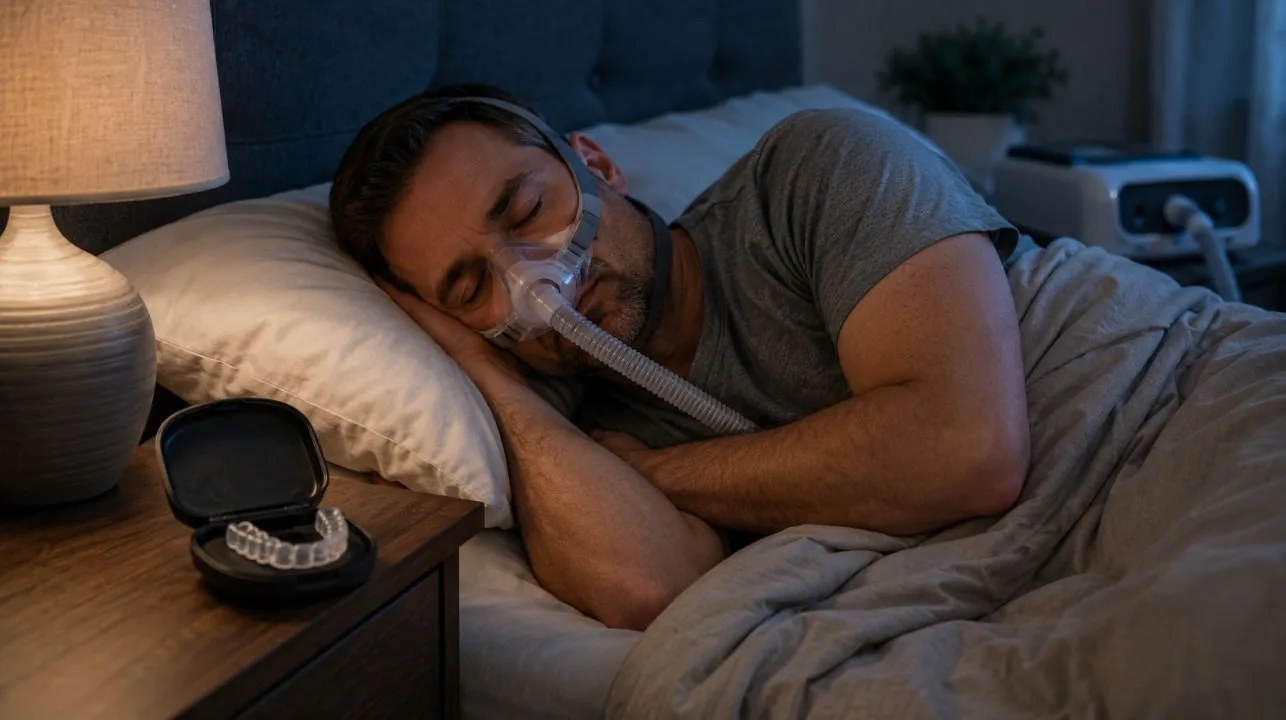
If you grind your teeth at night, a night guard protects your teeth — but it doesn't address why you grind. For a substantial subset of bruxers, the root cause is obstructive sleep apnea (OSA), and treating the apnea often resolves the grinding entirely. Yet sleep apnea is routinely missed in bruxism evaluations. This guide explains the connection, how to recognize the signs, and how to get tested.
For the broader picture, see the pillar: Teeth Grinding and Bruxism.
Key Facts (at a glance)
- Up to 25% of nighttime bruxers have undiagnosed obstructive sleep apnea.
- Bruxism episodes cluster around apnea events — the brain often grinds in the seconds after an oxygen drop, possibly as an arousal mechanism to reopen the airway.
- Treating the apnea often resolves the bruxism. CPAP, oral appliances, and weight loss all show this effect.
- Daytime symptoms (loud snoring, witnessed pauses, morning headache, daytime sleepiness) are more reliable predictors than dental signs alone.
- At-home sleep studies are inexpensive and increasingly accessible — the right first step if signs are present.
The physiological link
When breathing stops or partially stops during sleep (apnea or hypopnea), oxygen saturation drops. The brain reacts with a partial arousal — a brief shift toward wakefulness designed to reopen the airway. This arousal is associated with: - A surge of sympathetic nervous system activity - Activation of mandibular muscles - Jaw clenching or grinding episodes - Often a tongue thrust or jaw protrusion that helps reopen the airway
Studies using simultaneous polysomnography and EMG have shown that bruxism episodes cluster around apnea events — they often occur within 5–10 seconds after the oxygen desaturation, suggesting a protective or reflexive role.
The implication: in some patients, grinding isn't a separate disorder — it's a symptom of disturbed breathing.
Who's at risk
Sleep apnea is more common in: - Adults over 40 (rises with age) - Men (women catch up after menopause) - Patients with elevated BMI - People with large neck circumference (>17 inches men, >16 inches women) - Patients with narrow upper airways, retruded jaws, or large tongues - Smokers and heavy drinkers
Bruxism alone is common across all demographics. But the combination of bruxism plus any of the above raises the suspicion of OSA significantly.
Symptoms that suggest OSA-related bruxism
The more of these you have, the more suspicion is warranted:
- Loud snoring (especially with pauses)
- Witnessed breathing pauses during sleep (partner-reported)
- Gasping or choking awakenings
- Restless sleep with frequent position changes
- Morning headaches (especially frontal/temple) — overlaps with bruxism headaches
- Dry mouth on waking
- Sore throat on waking
- Daytime sleepiness despite 7+ hours in bed
- Difficulty concentrating during the day
- Mood changes — irritability, low mood
- High blood pressure (especially resistant hypertension)
- Erectile dysfunction
- Frequent nighttime urination
If you have bruxism + 3 or more of these, ask about a sleep study.
Dental signs your dentist might see
A few clinical findings that suggest OSA-related bruxism: - Scalloped tongue edges — the tongue is pressed against the teeth at night, often a sign of a tongue too large for the airway - Mallampati class III or IV — when the dentist looks at the back of your throat, the soft palate visibility is reduced (often a sign of crowded airway) - High narrow palate — anatomical predictor of upper airway compromise - Retruded mandible (lower jaw) — narrow airway behind the tongue - Severe wear on back teeth in particular — sometimes associated with the protective jaw protrusion patterns - Crown crack patterns matching heavy unilateral grinding
These dental findings don't diagnose OSA but they raise the question.
Why bruxism treatment alone fails some patients
If the bruxism is driven by sleep apnea, a night guard: - Protects the teeth (good) - Doesn't reduce the grinding (the underlying breathing disturbance continues) - Doesn't address daytime fatigue, headaches, or cardiovascular consequences - May make the apnea worse if the guard pushes the lower jaw backward (some traditional flat-plane guards do this)
For OSA bruxers, treating the apnea is the actual treatment. The guard then becomes optional support.
Getting tested
Home sleep apnea test (HSAT)
- Small device worn for one or more nights at home
- Measures airflow, oxygen saturation, breathing effort, sometimes heart rate
- Cost: often $150–$400 out of pocket; many insurance plans cover
- Good for diagnosing moderate-to-severe OSA in adults without major medical comorbidities
In-lab polysomnography
- Overnight in a sleep center
- Comprehensive measurement: EEG, EMG, airflow, oxygen, heart, leg movements
- Better for complex cases, suspected sleep disorders other than OSA, or pediatric cases
- Cost: $1000–$3000; often insurance-covered
Who orders it
- Primary care physician
- Sleep specialist
- Some dentists in some states can refer for home testing through partnered medical providers
What the results show
- AHI (Apnea-Hypopnea Index) — events per hour
- <5: normal
- 5–14: mild
- 15–29: moderate
- 30+: severe
- Oxygen desaturation patterns
- Heart rate variability and other secondary measures