
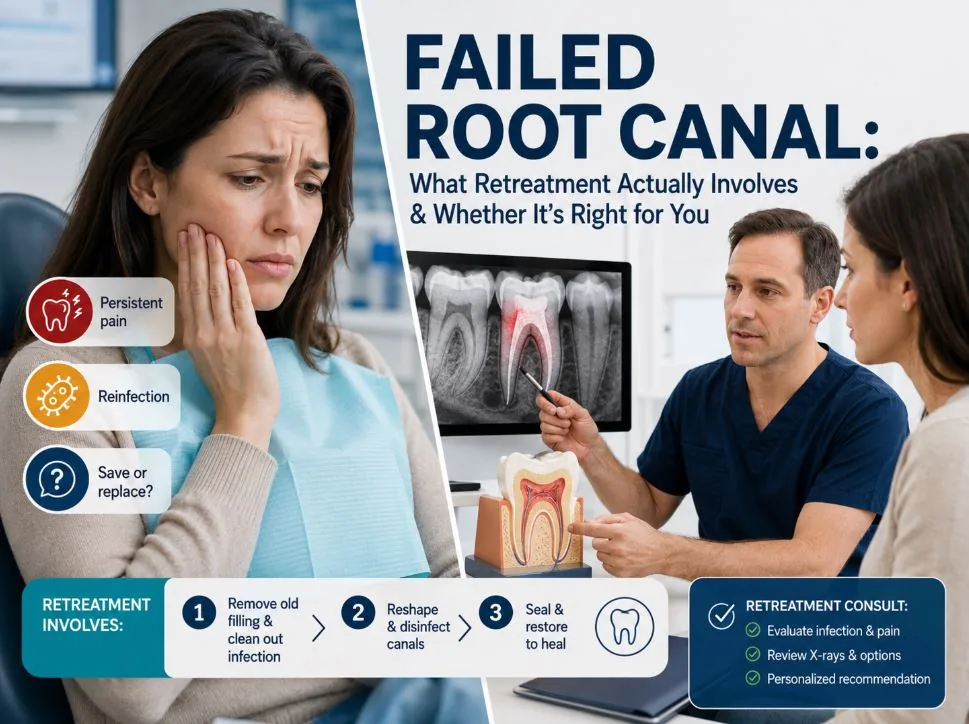
A root canal you had years ago has started to ache again, or your dentist's recent X-ray shows a shadow at the root tip that wasn't there last time. Roughly 5-15% of root canals will eventually fail, and when one does, you're suddenly facing a confusing decision tree — retreat the tooth, perform surgery on the root tip, or extract and replace with an implant — usually with anxiety, intermittent pain, and incomplete information from a single chair-side conversation. This post explains what endodontic retreatment actually involves, when it's the right first option, what the realistic success rates look like, and what to expect if you and your provider decide to go that route.
The decision is genuinely high-stakes. Once a tooth is extracted, no subsequent treatment puts the natural root, the natural ligament, or the natural bite proprioception back. Retreatment is the most conservative path that preserves the tooth — but it isn't always the right answer, and it isn't always offered when it should be. Some general dentists default to "the root canal failed; let's extract and place an implant," skipping the endodontic-specialist evaluation that would tell you whether retreatment has a 70-85% chance of saving the tooth for another decade or more. The information asymmetry between you and the practice is the single biggest reason patients lose teeth that didn't have to come out.
This guide walks through the symptoms that signal a failed root canal, the four things that actually cause failures, what retreatment looks like step by step in a modern endodontic practice, the real peer-reviewed success rates, the cases where retreatment is the right first option, the cases where it isn't, what it costs in 2026, the five questions worth asking before you commit, and the red flags that should send you to a second opinion. Sources for every clinical claim are listed at the bottom — primary peer-reviewed literature, Cochrane systematic reviews, AAE position papers, and ADA guidelines. If you don't trust any specific number here, the source is one click away.
How to Tell If a Root Canal Has Failed
Most failed root canals are asymptomatic for months or even years before they declare themselves. The infection at the root tip can quietly persist while the tooth feels fine on the surface. The first warning sign is often a routine dental X-ray showing a periapical radiolucency — a dark area at the root tip — that's either new since the original treatment or has gotten larger. By the time the tooth becomes painful again, the failure has usually been in progress for some time.
The symptoms patients actually notice tend to fall into a few patterns:
Returning pain on biting
The most common patient-reported failed root canal symptom. The tooth was comfortable for years, and now there's a dull ache or a sharp wince when you chew on that side. The pain may be intermittent at first — present some days, absent others — before becoming more consistent. It's typically lower-grade than the original toothache that prompted the root canal, but it's persistent in a way that suggests something structural rather than transient sensitivity.
Persistent or new throbbing pain
Less common but more alarming. A throbbing, pulsing pain that builds over days, often worse when lying down, sometimes radiating to the ear or jaw. This is the classic signature of a re-activated apical infection that's beginning to build pressure in the surrounding bone. If a root-canaled tooth starts throbbing, that's a same-week dentist visit, not a wait-and-see.
Gum swelling, abscess, or a draining sinus tract
A small bump on the gum near the root of the previously treated tooth — sometimes pimple-like, sometimes more diffuse swelling. The bump may come and go. Occasionally a tiny opening (a sinus tract or fistula) drains pus intermittently into the mouth, often producing a bad taste or odor that the patient can't quite locate. This is the body's way of decompressing an apical infection that has nowhere else to go. It's a near-certain sign of failure and warrants prompt endodontic evaluation.
Radiographic evidence at a routine checkup
Many failures are first caught on a periodic dental X-ray, before symptoms appear. The hygienist or general dentist sees a new or expanding dark area at the root tip and flags it. This is the best-case scenario for catching a failure — early detection means more treatment options remain on the table, and intervention is typically less complicated than waiting for the tooth to become symptomatic.
Why Root Canals Fail: The Four Primary Causes
Modern endodontics has a fairly clear understanding of why root canals fail, and the cause matters because it determines whether retreatment can fix it. The four primary failure modes account for the great majority of cases.
The first two causes — missed canals and coronal leakage — together account for the majority of failures and are both highly responsive to retreatment. Vertical root fracture is the failure mode that genuinely takes retreatment off the table. The third and fourth causes sit in between, with case-specific judgment required. The CBCT during the retreatment workup is what actually distinguishes among them.
What Endodontic Retreatment Actually Involves
Retreatment is a more complex procedure than the original root canal — partly because the endodontist is working in a tooth that already has filling material that needs to come out, partly because the original failure mode usually means the anatomy is more challenging than was apparent the first time. A modern retreatment in an endodontic practice generally proceeds through the following stages.
Total chair time is typically 90-150 minutes per visit, with cases sometimes split across two visits when additional disinfection time is warranted. Most retreatments are done by an endodontist rather than a general dentist — the technical complexity, the equipment requirements (microscope, ultrasonics, retreatment-specific instrumentation), and the diagnostic interpretation of CBCT all favor specialty practice.
Retreatment Success Rates, Honestly
Long-term success rates for endodontic retreatment are well-studied. Cochrane systematic reviews and multi-decade outcome studies in the Journal of Endodontics consistently report retreatment success in the range of 70-85% at 4-10 year follow-up, depending on case complexity, failure mode, operator skill, and the rigor of the success definition.
That number is meaningfully lower than initial endodontic treatment success (86-98% in the same literature), but it is high enough that retreatment is the right first move in most failed cases that don't have disqualifying features. To put it concretely: out of every 100 failed root canals that meet the criteria for retreatment, roughly 75-80 will heal and remain functional long-term. That's a strong outcome for a tooth-preserving procedure performed on a tooth that already had one failure.
Within that 70-85% band, the variance is driven by the failure mode and the case features:
| Retreatment scenario | Long-term success rate (peer-reviewed) |
|---|---|
| Missed canal, no apical lesion at retreatment | ~85-90% |
| Coronal leakage failure, lesion present | ~75-85% |
| Persistent apical infection, complex anatomy | ~70-80% |
| Multiple failure modes, large lesion, complex case | ~60-70% |
| Vertical root fracture present | Not predictable; not a retreatment candidate |
"Success" in the underlying studies is defined rigorously: clinical absence of symptoms and radiographic evidence of healing of any periapical lesion at multi-year follow-up. The number is not "the tooth still feels okay"; it's the actual evidence-based outcome. A treatment plan that quotes a "98% success rate" for retreatment is either misquoting the initial-treatment number or simply making it up.
When Retreatment Is the Right First Option
Most failed root canals are good retreatment candidates. The decision criteria are reasonably specific, and a competent endodontist can usually classify a case during the workup visit. Retreatment is generally the right first option when all of the following are true:
- The tooth is structurally sound — enough natural tooth structure remains to support a post-treatment crown with adequate ferrule (the band of healthy tooth the crown grips). If the tooth has been destroyed by decay or repeated procedures and there's nothing left to hold a crown, retreatment isn't going to give you a functional tooth long-term.
- The original failure is attributable to a treatable cause — missed canal anatomy (very treatable), coronal leakage from a failing restoration (treatable), or persistent infection in cleanable anatomy (treatable). Most failures fall into one of these categories.
- No vertical root fracture is present — confirmed on CBCT to the extent possible. A suspected fracture changes the recommendation immediately.
- No insurmountable post or anatomical obstruction — most posts can be safely removed with modern technique, but a few cases involve cemented metal posts in calcified canals where removal carries significant risk of root fracture. Those cases sometimes argue for apicoectomy instead.
- The patient prefers tooth preservation — most patients do, and the natural-tooth advantages over implants (proprioception, ligament support, no surgical bone work) are real. But the preference matters because retreatment is more time-intensive and lower-success than initial treatment, and the patient should choose it knowingly.
When all five criteria are met, retreatment is the conservative, evidence-supported first move. The sibling surgical option (apicoectomy) is more typically the second move — used when retreatment isn't appropriate as a first choice, or when a competent retreatment hasn't fully healed and the apical infection persists. We covered that decision in detail in our apicoectomy vs retreatment guide.
When Retreatment Isn't Appropriate
Some failed root canals are not retreatable, or are retreatable only with low predicted success. Knowing the disqualifiers up front saves you from going through the procedure, the cost, and the recovery just to end up extracting the tooth anyway.
Vertical root fracture
The single clearest disqualifier. Once a root has cracked vertically, no current technique reliably seals the fracture line, and bacteria persist along it. Retreatment of a fractured root produces short-term symptom relief at best and predictable failure at the multi-year horizon. CBCT is the imaging that most often catches a vertical fracture during retreatment workup; in some cases the fracture is only confirmed during the access procedure when the tooth is opened. Either way, fracture-positive teeth are extraction-and-replace candidates, not retreatment candidates.
Severely compromised tooth structure
If decay, fracture, or repeated procedures have destroyed the tooth such that there isn't enough remaining structure to support a post-treatment crown, retreatment doesn't solve the underlying problem. You can sterilize the canal system perfectly and still end up with a tooth that fractures under chewing forces six months later because there was no ferrule to grip. The right call in these cases is usually extraction and replacement — extracting before the fracture gives you a cleaner extraction site and better implant placement options.
Post in canal that can't be safely removed
Most posts can be removed with modern microscope-assisted ultrasonic technique — cemented metal posts, fiber posts, threaded posts — by an endodontist who does this regularly. A few cases involve posts placed at depths or angles where removal would risk perforating or fracturing the root. In those cases, retreatment isn't safe, and apicoectomy (which leaves the post in place and addresses the infection from the root tip) is often the more appropriate alternative.
Repeated failures despite competent prior retreatment
A tooth that has failed initial root canal, then failed a competent retreatment, then failed a competent apicoectomy, has demonstrated something the imaging didn't catch. At that point the right call is usually extraction and replacement; further endodontic intervention has poor predicted success and prolongs an unproductive cycle.
What Retreatment Actually Costs in 2026
Endodontic retreatment is more expensive than initial treatment in most cases — sometimes substantially so. The technical complexity, the longer chair time, the additional imaging, and the equipment requirements all push the cost up. Here are the realistic U.S. ranges:
| Retreatment service | General Dentist | Endodontist (Specialist) |
|---|---|---|
| Anterior tooth retreatment | $900 – $1,400 | $1,200 – $1,900 |
| Premolar retreatment | $1,000 – $1,600 | $1,400 – $2,300 |
| Molar retreatment | $1,200 – $1,800 | $1,600 – $2,800 |
| CBCT (3D scan, retreatment workup) | $200 – $400 | $200 – $400 |
| Post removal (when post is present) | — | $200 – $500 add-on |
| New crown after retreatment | $1,000 – $2,500 | — |
Insurance coverage for retreatment varies more than for initial treatment. Some plans treat retreatment exactly like initial endodontic care — covered as a "major" procedure at 50-80% up to the annual maximum. Some plans have a "time since original treatment" exclusion that denies coverage if the original root canal was performed within a specific window (often 1-2 years). Read the actual policy language or call the insurance carrier before scheduling — getting hit with an unexpected denial after the procedure is a worse position than knowing the coverage gap up front and budgeting for it.
HSA and FSA dollars cover retreatment in full as a qualified medical expense under IRS Publication 502. If you have either account and the case isn't urgent, contributing the IRS maximum the year before treatment can produce $400-700 of federal tax savings on a typical retreatment, materially changing the all-in out-of-pocket.
Five Questions to Ask Before Retreatment
Cross-Reference: When to Look at Apicoectomy Instead
Retreatment isn't always the right surgical alternative — sometimes the right move is apicoectomy, the surgical procedure that addresses the infection at the root tip from the side rather than going back through the canal from the top. The most common scenarios where apicoectomy is preferred over retreatment are: an existing functional crown the provider wants to preserve, a post in the canal that can't be safely removed, a previous competent retreatment that hasn't fully healed, or anatomy that makes canal access from the top impractical.
The decision between the two is the most consequential next step in the failed-root-canal pathway, and we wrote a dedicated apicoectomy vs retreatment guide to cover the framework end to end. If your endodontist is recommending one and not the other, reading the comparison in detail before you commit is worth the half hour.
Red Flags That Should Stop You
Retreatment plan without CBCT — operating without 3D imaging on a complex retreatment case is operating on less information than the case warrants. The CBCT can change the recommendation (vertical fracture turns retreatment into extraction; missed canal turns vague failure into a high-success retreatment).
"All root-canaled teeth eventually fail" framing — actually false. The peer-reviewed long-term success rate of initial endodontic treatment is 86-98%, with most of those teeth functioning for decades. Roughly 5-15% will fail over the long term. "Most fail" isn't accurate, and a provider using that framing is selling extraction-and-implant rather than describing the evidence honestly.
Pressure to commit at the consultation visit — retreatment is a multi-thousand-dollar procedure with a multi-month commitment. Same-day pressure is a sales tactic, not a clinical one. Take the workup imaging, get the diagnosis, and consider a second opinion if anything feels off.
Refusal to use microscope or rubber dam — both are essentially standard of care for endodontic retreatment per AAE guidelines. Their absence in a quoted treatment plan is itself a quality signal.
How Smyleee Helps You Find a Retreatment Specialist
Smyleee maintains city-level Top 10 root canal rankings for major U.S. metros, vetting providers on credential signals (residency training, ABE certification, AAE membership), case-volume markers, and aggregate patient feedback rather than raw review counts. Each entry flags whether the practice routinely uses microscopes and CBCT. For retreatment cases — where specialty equipment and diagnostic imaging materially affect outcomes — those flags matter more than they do for initial treatment.
Useful starting points if you want a curated shortlist:
- Top 10 Root Canal Specialists in Brooklyn
- Top 10 Root Canal Specialists in Los Angeles
- Top 10 Root Canal Specialists in San Diego
- Top 10 Root Canal Specialists in Miami
- Top 10 Root Canal Specialists in Charlotte
For broader context on the procedure and the surrounding decisions, the root canal pillar guide covers the procedure end to end. For specific situations, dedicated guides cover what root canal pain actually feels like, choosing between apicoectomy and retreatment, the science behind root canal safety, and when to save the tooth vs. replace it with an implant.
Final Thoughts
A failed root canal is not a verdict on the tooth. It's an invitation to a more careful workup than the original procedure received — usually an endodontic specialist evaluation with a CBCT that reveals what actually went wrong, followed by a treatment decision among retreatment, apicoectomy, and extraction. In most cases, retreatment is the right first move, with a 70-85% peer-reviewed long-term success rate that justifies the conservative, tooth-preserving choice. In some cases, retreatment isn't appropriate, and an honest provider will tell you so.
What separates good outcomes from regretted ones, again, is almost never which procedure was performed — it's whether the right provider used the right technique on the right case after the right workup. Endodontist for the retreatment evaluation. CBCT before the recommendation. Microscope during the procedure. New crown afterward. Honest second opinion if the recommendation skipped any of those steps. The tooth you save with a retreatment today is the one you don't have to replace with an implant tomorrow.
Take the time. Get the imaging. Ask the questions. Don't accept an extraction recommendation without first hearing what an endodontist would say — once the tooth is out, your options narrow permanently.
Find a Vetted Retreatment Specialist
Browse Smyleee's curated, credential-vetted directory of endodontists experienced in failed root canal retreatment — with microscope-use flags, ABE certification markers, and aggregate patient ratings.
Sources & References
- American Association of Endodontists — Position Statements (Treatment Standards, Retreatment, Apical Surgery)
- American Association of Endodontists — Clinical Resources Library & Treatment Guidelines
- American Board of Endodontics — Board Certification Standards & Specialist Verification
- American Dental Association — Endodontics Oral Health Topic & Council on Scientific Affairs Statement
- Cochrane Reviews — Systematic Reviews of Endodontic Retreatment Outcomes
- Journal of Endodontics — Peer-Reviewed Primary Research on Retreatment Outcomes & Failure Modes
- PubMed / NCBI — Primary Literature on MB2 Anatomy, Coronal Leakage, and Retreatment Success
- AAE — Cracked Teeth and Vertical Root Fracture Patient Resource
- U.S. Food and Drug Administration — Dental Device & Material Safety Guidance
- MetLife Oral Fitness Library — Root Canal & Retreatment Cost Reference
- GoodRx — Root Canal and Retreatment Cost Guide
- CareCredit — Root Canal & Retreatment Financing
- American Dental Association MouthHealthy — Patient Guide to Root Canals
- IRS Publication 502 — Medical and Dental Expenses (HSA / FSA Eligibility)