
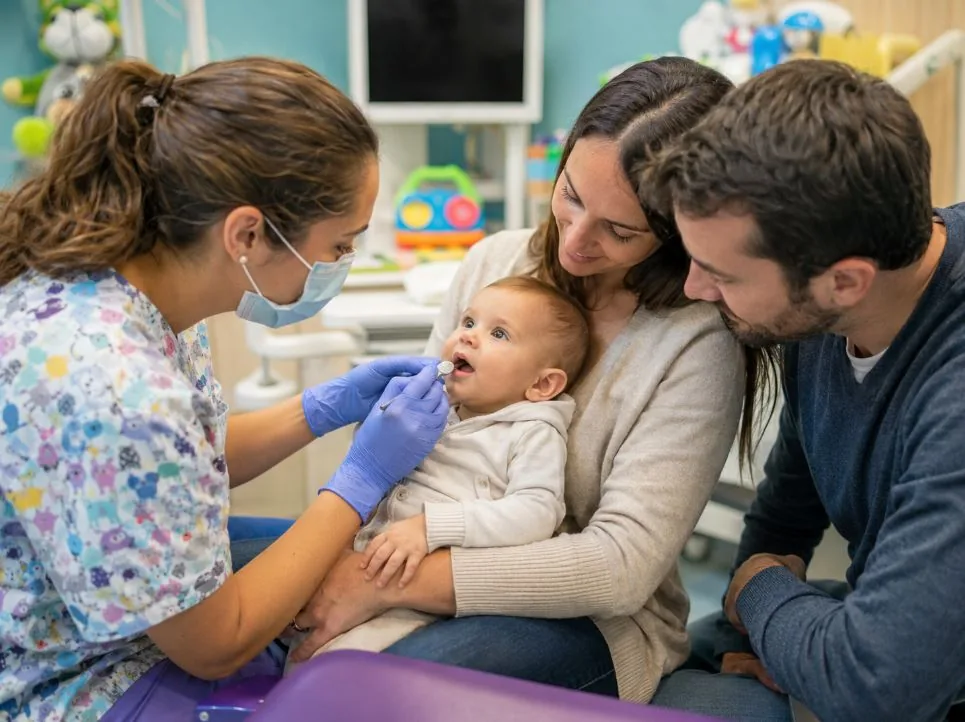
Most parents are caught off-guard by how early the recommendation actually is. The American Academy of Pediatric Dentistry, the American Academy of Pediatrics, and the American Dental Association all converge on the same advice: your baby's first dental visit should happen by age one, or within six months of the first tooth erupting — whichever comes first. Not when they have all their baby teeth. Not when they "can sit still." By age one. The recommendation surprises almost everyone, and the reasoning is genuinely good once you see what's behind it.
The age-1 visit is not a cleaning. It's a preventive risk-assessment, a relationship visit, and a parent-coaching conversation rolled into a single 20-30 minute appointment. The dentist counts erupted teeth, looks at the eruption pattern and the soft tissue, asks about feeding and bottle habits, talks through home care, applies fluoride varnish if indicated, and (importantly) gets the child comfortable being in the chair before there's anything anxiety-producing happening. By the time your kid actually needs a filling at age four or five, they've already been here several times and the office is familiar territory. That's the entire point of starting early.
This guide walks through what the recommendation is actually based on, what realistically happens at the visit (knee-to-knee positioning, the soft cleaning, the fluoride varnish, the take-home conversation), how to prepare, what to expect emotionally (yes, your baby will probably cry — and that's fine), how to choose the right pediatric practice for an infant visit specifically, what insurance and Medicaid cover, and the red flags that should send you to a different practice. The aim is to demystify the visit so you arrive informed and leave with a plan.
The Age-1 Recommendation: What the Data Actually Says
Early-childhood caries — cavities in baby teeth — is the most common chronic disease of childhood in the United States. More prevalent than asthma. More prevalent than seasonal allergies. The CDC's surveillance data consistently shows roughly one in five U.S. children ages 5-11 has at least one untreated decayed tooth. Among kids in lower-income brackets the rate is meaningfully higher. The disease is essentially preventable, and the prevention window opens before the child is old enough to talk.
The patterns that lead to early-childhood caries are set in the first 12-18 months of life. Bottle-to-bed habits. Breastfeeding-to-sleep patterns. Sippy-cup juice and milk all day. Sharing utensils with adults (which transfers cavity-causing bacteria). Inadequate fluoride exposure. Inconsistent or absent toothbrushing once the first tooth erupts. None of these are catastrophic in isolation, but the combination — and the way it compounds over months — is what produces the visible decay parents see at age three and wish they'd known about at age one.
That's the core reason the AAPD, AAP, and ADA all moved the first-visit recommendation back to age one. Not because a one-year-old needs a cleaning per se. Because the conversation that prevents the cavity at age four needs to happen at age one, before the bacterial colonization patterns and the bedtime routines and the dietary defaults are locked in. The age-1 visit is preventive risk-assessment infrastructure, not restorative work.
The convergence of professional recommendations matters here. When AAPD, AAP, and ADA all agree on the same age and the same rationale, the recommendation is well-grounded. There isn't a meaningful split in the evidence base. The split is between professional consensus and what most parents actually do — which is wait until age three or four, often because their pediatrician didn't push the dental referral and their friend group didn't either.
What Actually Happens at the First Visit
The shape of an age-1 visit is well-defined and very different from the adult dental visits parents have in their head as a reference. Here's what the appointment typically covers, in order:
The whole appointment runs 20-30 minutes. The clinical exam itself is often under 5 minutes; the parent conversation is the longer part. A practice that rushes the parent conversation — "looks fine, see you in six months" with no real risk-assessment dialogue — is missing the entire point of the age-1 visit.
What to Bring and How to Prepare
The age-1 visit doesn't require much preparation, but a small amount of advance work makes it meaningfully smoother.
What to bring
- Feeding-history summary — a quick written or mental list of what your baby drinks and eats on a typical day. Include night-time bottle or breastfeeding patterns. The dentist will ask, and a clear answer saves time.
- Medical history — any medications the baby takes, any pediatrician-flagged conditions, the baby's birth history (premature? NICU stay? feeding tube?), and any allergies. Most practices send a form ahead of time; fill it out the night before, not in the waiting room.
- Dental insurance card (or AHCCCS / Medicaid / CHIP card if applicable) — preventive infant visits are typically fully covered, but the office still needs the insurance information to bill correctly.
- A favorite toy or blanket — something familiar that lives in the bag for the visit. The blanket can stay tucked under the baby's chin during the knee-to-knee exam.
- A second adult, ideally — not strictly required, but having two adults at the visit (one to hold the baby during knee-to-knee, one to have hands free for the bag, the form, and the diaper-bag logistics) makes the appointment less stressful for everyone.
How to prepare
Schedule the appointment at the time of day when your baby is typically most agreeable — usually mid-morning, after the morning feed and a nap, before the late-afternoon fussy window. Avoid scheduling during the baby's normal nap time. Dress the baby in something comfortable and easy to unsnap if the dentist needs to check anything beyond the mouth (rare at this visit, but possible). Don't make the day feel like a big event — kids pick up on the anticipatory tension. Just go.
Will My Baby Cry? The Honest Answer
Yes, probably. Briefly. And that's developmentally normal — it's not a sign that anything went wrong, that you chose the wrong dentist, or that your baby is "bad at the dentist."
An age-1 baby is at peak stranger-anxiety stage. Being asked to lie down in an unfamiliar adult's lap while having something put in their mouth is, from the baby's developmental perspective, a reasonable thing to cry about. The crying is often loudest during the brief gauze-wipe and varnish-application moments — the actual peak of the "something is happening in my mouth" experience — and it usually subsides within a minute of being handed back to the parent. Most pediatric specialists factor this in completely; they're not trying to engineer a tear-free visit, they're trying to get the risk assessment done and the relationship started.
The visit isn't designed around tear-free outcomes. It's designed around getting the work done efficiently, building familiarity for future visits, and giving the parent the information and skills to maintain oral health between appointments. A baby who cried for 90 seconds during the varnish application and then went home is a successful age-1 visit by any reasonable standard. Don't measure the visit by your baby's emotional state at the moment of the gauze wipe.
Choosing the Right Pediatric Dentist for the First Visit
Not every dentist who treats children is the right fit for an age-1 visit. The credential and case-mix gap shows up most clearly at the youngest end of the developmental spectrum.
A residency-trained pediatric dentist completes a 24-36 month accredited specialty residency that explicitly covers infant oral health, knee-to-knee positioning, age-appropriate behavior management for non-verbal patients, and the parent-coaching framework for early-childhood caries prevention. This material is not in standard general-dentistry curriculum at the same depth. A general dentist who's friendly with kids and a residency-trained pediatric specialist are not the same thing — and the gap is widest at the infant and toddler end.
That said, plenty of general dentists do see kids and do a competent job for routine cases starting around age three or four when the child is old enough to cooperate verbally and sit alone in an adult-style chair. What they often don't do well is the under-2 visit, the knee-to-knee exam, and the specific conversation about bottle-to-bed and pre-verbal feeding patterns. Some general dentists explicitly won't see infants under three for this reason, which is honest. Others see them and rush through the visit because it's outside their daily comfort zone.
For the age-1 visit specifically, a residency-trained pediatric dentist is usually the right call. They do this visit weekly or daily; the workflow is built; the staff knows how to handle a crying baby without panic; the office has the developmental toys, the right-sized instruments, and the visit pacing built in.
Residency credential. A residency-trained pediatric dentist will name their residency program (NYU, Texas A&M, USC, ATSU, Children's Hospital programs, etc.) without hesitation. Verify on the AAPD or ABPD public lookup tools.
Knee-to-knee workflow. Ask: "Do you do knee-to-knee exams for infants?" The answer should be immediate and matter-of-fact. A practice where this question gets a confused pause is not set up for under-2 visits.
Parent-in-the-room policy. For an infant exam, the parent should be in the room — full stop. A practice that won't allow parent presence for the under-2 visit is signaling something incompatible with infant dental care.
Cavity-prevention program for under-2. Practices that take age-1 visits seriously usually have a structured program — fluoride varnish protocol, parent-coaching curriculum, written take-home plan, follow-up cadence at 3-4 months for higher-risk cases. If the practice treats the age-1 visit as a 5-minute look-and-leave, they're not really doing it.
Insurance, Medicaid, and CHIP Coverage for the First Visit
Pediatric preventive dental care is one of the better-covered categories in U.S. healthcare, and the age-1 visit specifically tends to be fully covered or nearly so under most coverage types.
Private dental insurance
Most family dental plans cover preventive infant and pediatric visits at 100%, with no deductible. The age-1 visit, fluoride varnish application, and any bitewing X-rays (rarely needed at this age) are typically zero out-of-pocket on a normal commercial dental plan. Annual maximums apply but are essentially never relevant at the infant stage because the procedures are small and inexpensive.
Medicaid and CHIP
Every state Medicaid program is required to provide comprehensive dental coverage for children under 21 through EPSDT (Early and Periodic Screening, Diagnostic, and Treatment) benefits. Infant preventive dental visits, fluoride varnish, and parent education are explicitly covered services. CHIP (Children's Health Insurance Program) covers families above the Medicaid income threshold and provides equivalent pediatric dental benefits. Together, these programs cover roughly 40% of U.S. children.
The harder problem with Medicaid/CHIP pediatric dentistry isn't whether the visit is covered — it's finding pediatric specialty practices that accept the program in your area. Reimbursement rates vary by state, and in markets where rates run low, many private pediatric practices won't take Medicaid or accept only a small Medicaid panel. Federally Qualified Health Centers (FQHCs), university dental school clinics, and dedicated Medicaid-friendly practices fill most of the gap. Smyleee's directory flags clinics that explicitly accept Medicaid/CHIP coverage; for a deeper walkthrough, see our pediatric dentist Medicaid and CHIP guide.
No coverage at all
Out-of-pocket for an age-1 visit at a typical pediatric specialty practice runs $50-180 depending on geography and whether fluoride varnish is included. It's one of the more affordable preventive healthcare visits a family will ever pay for, and many practices will work with uninsured families on payment terms.
What to Do AFTER the First Visit — The Home Routine
The age-1 visit's main deliverable is the home plan that follows. Here's what a strong post-visit routine looks like across the first three years:
Brushing
From the first tooth eruption (typically 6-10 months for the lower central incisors), brush twice daily with a rice-grain-sized smear of fluoride toothpaste on a soft infant toothbrush. Once the child is around 3 and can spit reliably, increase to a pea-sized amount. Don't wait until the child has all their baby teeth to start brushing. The bacterial colonization that drives early-childhood caries doesn't wait.
Bottle and feeding patterns
Off the bottle by 12-15 months. No bottle to bed. No sippy-cup juice or milk all day — water for thirst, milk and food at meals, then off. The single highest-impact change a family can make to reduce early-childhood caries risk is eliminating the bedtime bottle and the all-day sippy cup of milk. Both bathe the teeth in fermentable sugars for hours and create the bacterial environment for cavity formation.
Fluoride exposure
If you're on a fluoridated municipal water supply (most U.S. cities), this is largely handled by the water plus the toothpaste. If you're on well water or in a non-fluoridated jurisdiction, the dentist may recommend supplemental fluoride drops or tablets after age 6 months. This is a conversation worth having explicitly at the age-1 visit if the dentist hasn't raised it.
Future visit cadence
Standard cadence is 6-month recall visits from age one onward, with the appointments getting progressively more like an adult visit (sitting in the chair alone, accepting toothbrush and polish) over the 18-month-to-3-year window. Higher-caries-risk kids may be on a 3-4 month cadence for closer monitoring. The dentist will recommend the cadence that matches your specific child's risk profile.
Red Flags From the First Visit
Most age-1 visits are unremarkable. The signals that suggest you're at the wrong practice — and should consider switching for the long-term pediatric relationship — are specific and worth knowing.
Practice that pushes immediate restorative work at the age-1 visit — a recommendation for stainless-steel crowns, multiple fillings, or aggressive treatment at a baby's first visit, with no monitoring period and no second-opinion suggestion, is an outlier that warrants scrutiny. Some infants do have early-childhood caries that needs attention, but a same-day, full-quadrant treatment plan presented at an age-1 visit without imaging review or staged-care alternatives is sales-driven, not clinically standard.
Practice that won't allow the parent in the treatment area for the infant exam — for an under-2 visit, parent presence is the standard of care. Most modern pediatric practices welcome parents for all pediatric appointments; some still operate on the older "separate the parent at the door" model for older children, which is debatable but defensible. For the infant exam specifically, parent separation is incompatible with infant dental care. If they won't let you in the room with your one-year-old, leave.
Rushed or absent risk-assessment conversation — if the dentist looks in the baby's mouth for 90 seconds and announces "looks great, see you in six months" without asking about feeding, bottles, breastfeeding patterns, sippy-cup use, fluoride exposure, or family caries history, the visit missed the most important part. The clinical exam is the smaller half of the age-1 visit. The parent conversation is the bigger half. A practice that skips the conversation isn't doing real preventive pediatric dentistry.
Pressure to commit to expensive long-term packages or "membership plans" at the first visit — pediatric dentistry is a multi-year relationship; there's no clinical reason to commit to package pricing on day one. A practice pushing same-day membership commitments is using a sales tactic, not a clinical one.
When to Schedule
Schedule the visit when the first tooth erupts (typically 6-12 months) or by age 1 — whichever comes first. Don't wait for "when they have all their teeth." Don't wait for "when they can sit still." Don't wait until the pediatrician brings it up — they often don't, and the dental referral falls through the cracks.
If your baby is approaching age one and hasn't been seen yet, schedule now. If the first tooth has been in for more than six months, schedule now. The visit is short, the cost is low or zero with insurance, and the information you walk away with is durable. The patterns you set in the next twelve months shape your child's oral health for the next decade.
If you're in a metro and want a curated shortlist of vetted pediatric specialty practices near you, our city-level pediatric dentist Top 10 lists are the most efficient starting point. Useful entry points across major U.S. metros:
- Top 10 Pediatric Dentists in New York City
- Top 10 Pediatric Dentists in Brooklyn
- Top 10 Pediatric Dentists in San Jose
- Top 10 Pediatric Dentists in San Diego
- Top 10 Pediatric Dentists in Miami
- Top 10 Pediatric Dentists in Charlotte
Cross-Reference — Related Pediatric Resources
For the broader credential framework — what residency-trained pediatric dentistry actually means, the questions that surface a practice's true depth, the full sedation spectrum, and the red flags that apply across all pediatric care — see the pediatric dentist pillar guide.
City-specific guides are available for parents researching the local pediatric market in New York, Brooklyn, San Jose, San Diego, Miami, Charlotte, and Chandler, Arizona — each covering the local provider density, insurance landscape, and metro-specific factors.
For specific situations beyond the standard age-1 visit, our companion guides cover how to choose a pediatric dentist for a child with special healthcare needs and how to find a pediatric dentist who accepts Medicaid and CHIP.
Final Thoughts
The age-1 visit is one of the highest-leverage 30-minute appointments in pediatric healthcare. The clinical exam is short. The cost is low. The insurance coverage is strong. The information density of the parent-coaching conversation is high. And the long-term effect on the child's oral health trajectory is substantial — kids whose families establish dental care at age one have meaningfully lower rates of early-childhood caries, fewer restorative procedures across childhood, and better-built dental relationships entering the school years.
The hard part isn't the visit. It's getting parents to make the appointment in the first place. Most parents are surprised by the recommendation, default to "we'll go when they're three or four," and miss the prevention window the visit is designed to open. If your child has a tooth and you're reading this, the answer is to schedule now. A residency-trained pediatric dentist, a 30-minute knee-to-knee visit, a fluoride varnish application, and a written take-home plan — the whole thing fits inside a normal Tuesday morning.
Yes, your baby will probably cry. Yes, that's normal. Yes, the visit is still worth doing. The dental relationship you start at age one will be the same relationship your kid has at age fifteen, when they're showing up on their own to get their teeth cleaned because that's what they've always done. That's the timeframe of the decision. Start it now.
Find a Pediatric Dentist for Your Baby's First Visit
Browse Smyleee's curated, credentials-vetted directory of pediatric dentists across the U.S. — with board-certification flags, infant-visit capability markers, Medicaid/CHIP acceptance, and aggregate parent ratings.
Sources & References
- American Academy of Pediatric Dentistry — Patient Resources & Provider Standards
- American Academy of Pediatric Dentistry — Age One Dental Visit Guidance
- American Academy of Pediatrics — Oral Health Resources
- HealthyChildren.org (AAP) — Pediatric Oral Health Guides
- American Dental Association MouthHealthy — Babies and Kids Oral Health
- Centers for Disease Control and Prevention — Children's Oral Health Data
- NIH National Institute of Dental and Craniofacial Research — Children's Oral Health
- Medicaid.gov — Pediatric Dental Coverage Under EPSDT
- InsureKidsNow.gov — CHIP Coverage Resources
- American Board of Pediatric Dentistry — Board Certification Verification