
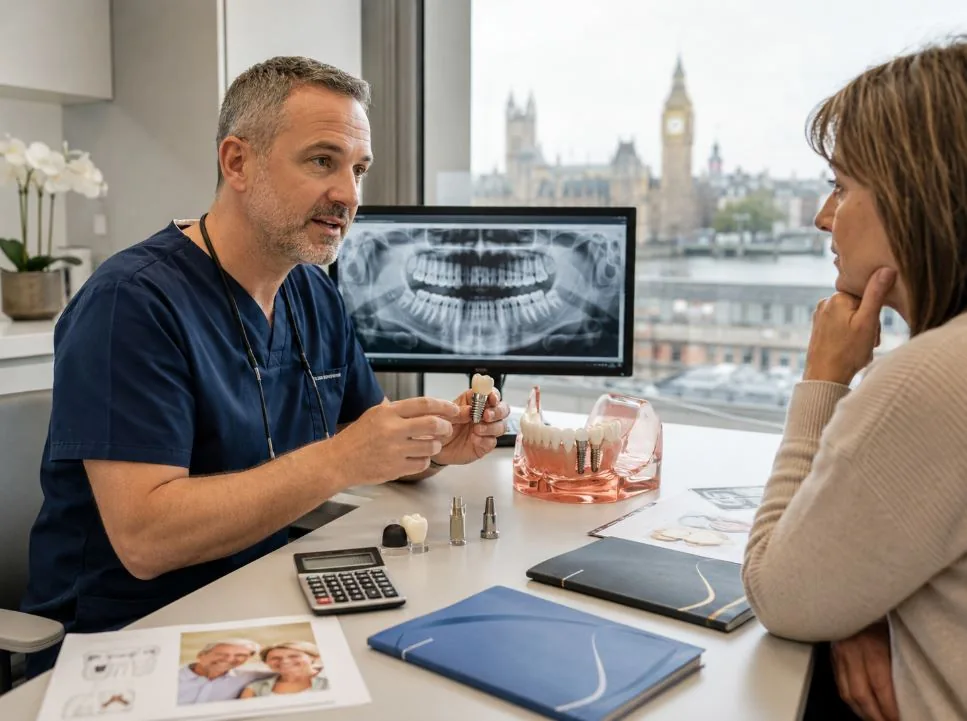
If you've been quoted £3,200 for a single implant in central London or £22,000 for an All-on-4, and you've already discovered that the NHS doesn't actually cover routine implants, you're staring at the realities of UK private dentistry in 2026. "Low-cost" implants in the UK is a relative term — the NHS isn't an option for most patients, and the private market is the only realistic path. But within that private market, the price spread between London premium practices and well-credentialed practices in the Midlands, Scotland, and Northern Ireland is wide enough to be worth a long train journey.
This guide breaks down what implants honestly cost across the UK in 2026 — when the NHS does and doesn't cover them, what private prices look like in London versus Birmingham, Manchester, Glasgow, and Belfast, the role of teaching hospitals at Guy's, King's, Manchester, Edinburgh and Birmingham, and the dental tourism options to Hungary, Turkey, and Spain that thousands of UK patients use each year. No upsell, no scare tactics — just the price reality.
For broader international cost context, our pillar guide on affordable dental implants covers the U.S. market in depth as a reference point. This post focuses specifically on UK patients and the choices realistically available within the UK market and the European tourism corridor.
The NHS / Private Split — and Why Implants Are Almost Always Private
NHS dental treatment in England is structured into three bands of patient charges (Wales, Scotland and Northern Ireland use slightly different systems, but the principle is similar). Band 1 covers examinations and basic preventive work at £26.80. Band 2 covers fillings, extractions, and root canals at £73.50. Band 3 covers crowns, dentures, bridges, and other complex work at £319.10 (2024–25 figures, with annual adjustments). On the surface, Band 3 looks like it might cover implants — it doesn't.
NHS Band 3 covers crowns, bridges and dentures as standard solutions to missing teeth, but implants are explicitly excluded from routine NHS provision. The clinical guidance treats implants as an enhanced option that the NHS provides only in narrow medical-necessity scenarios — which we'll cover in detail below. For the overwhelming majority of UK patients missing teeth, the NHS will offer a denture or a conventional bridge under Band 3, and an implant is available only privately.
This isn't an administrative quirk — it's a deliberate cost-control decision. The NHS calculates that conventional dentures and bridges meet the clinical standard of restoring function and aesthetics at a fraction of the implant cost, and it reserves implant provision for cases where conventional alternatives genuinely won't work. From a patient perspective, this means the realistic question isn't "will the NHS pay for my implant?" — it's "what does the private UK market actually charge, and where is the value within it?"
Real UK Private Implant Costs in 2026
Here's what implants actually cost across the UK private market right now. The London premium runs roughly 35–55% above provincial prices for the same procedure with the same materials. The Cost of Living Crisis drove modest UK private dental price increases in 2024–2025; 2026 figures reflect that adjustment but the inter-regional spread has stayed broadly consistent.
| Procedure | London Private | Provincial UK Private | Northern Ireland / Scotland |
|---|---|---|---|
| Single implant (post + abutment + crown) | £2,500 – £3,500 | £1,800 – £2,600 | £1,600 – £2,300 |
| Implant-supported bridge (2 implants, 3 teeth) | £6,500 – £9,500 | £4,800 – £7,000 | £4,200 – £6,200 |
| All-on-4 (full arch, one jaw) | £15,000 – £25,000 | £12,000 – £18,000 | £10,500 – £15,500 |
| Full mouth (both jaws, All-on-4) | £28,000 – £50,000 | £22,000 – £36,000 | £19,500 – £30,000 |
| Bone graft (per site, if needed) | £500 – £1,200 | £350 – £900 | £300 – £800 |
| Sinus lift (if needed) | £1,800 – £3,200 | £1,400 – £2,400 | £1,200 – £2,200 |
Practical takeaway from the numbers: a London patient travelling to Birmingham, Manchester, Edinburgh or Belfast for the surgical placement and the final crown work routinely saves £1,000–£3,500 on a single implant and £8,000–£15,000 on a full-arch case. UK rail and budget-airline costs make the trip economics work for any case above a single implant, particularly given that most implant cases involve 3–5 visits over 4–6 months.
Why Prices Vary So Much Within the UK
The UK private implant price spread isn't random. Five factors drive most of it, and only two of them affect what you actually receive clinically.
When the NHS Actually Does Cover Implants
The narrow exceptions where NHS-funded implants are genuinely available. These are real pathways for patients who qualify, but the bar is high and the waiting lists are long.
Severe congenital absence (hypodontia) — patients with documented congenital absence of multiple teeth, particularly when conventional bridges and dentures cannot adequately restore function, can be referred for NHS implant assessment through paediatric and adult restorative consultant services. The pathway typically begins in adolescence with orthodontic preparation and proceeds to implant placement once skeletal growth is complete.
Severe atrophy with documented denture failure — patients (typically older) whose mandibular ridge has atrophied to the point that conventional dentures cannot be retained, despite multiple denture iterations, may qualify for NHS-funded implant-retained overdentures. Documentation of failed denture trials is required, and assessment is through hospital restorative consultant services.
Trauma and avulsion cases — implants following traumatic tooth loss in patients meeting specific clinical criteria can sometimes be NHS-funded, particularly in younger patients where long-term dental prosthetic planning is involved.
Cleft lip and palate — implants forming part of cleft palate reconstruction are typically NHS-funded as part of the multidisciplinary cleft care pathway.
For all of these, the referral path runs through your general dental practitioner to a hospital consultant restorative or maxillofacial service. Waiting lists vary by region; 12–18 month waits are common for non-urgent assessment. If you think you might qualify under one of these criteria, ask your GDP for a referral and don't pay privately first.
Dental Tourism From the UK
UK patients facing £3,000+ private quotes for single implants and £15,000+ for full-arch work have been crossing the Channel in increasing numbers for two decades. Hungary (Budapest), Turkey (Istanbul, Antalya, Izmir), and Spain are the major destinations, with smaller flows to Poland, the Czech Republic, and Romania. The savings are real — typically 50–70% off UK private prices — and the established clinics in these destinations have been serving UK patients for long enough that the logistics are well understood.
Hungary (Budapest)
Hungary has been the European dental tourism leader for UK patients since the early 2000s. Budapest clinics specifically built for UK and Irish patients offer transparent GBP and EUR pricing, English-speaking staff, and shuttle services from Budapest Airport. Single-implant pricing typically runs £700–£1,200 (post, abutment, and crown), full-arch in the £5,500–£8,500 range. EU regulatory standards apply, and Hungarian dental qualifications are recognised under the EU professional qualifications framework. The downside is the post-Brexit travel friction (no longer fully frictionless EU travel for UK passport holders) and the same follow-up logistics challenge that applies to all dental tourism — managing a complication 18 months later when you're 1,500 miles from the surgeon who placed the implant.
Turkey (Istanbul, Antalya, Izmir)
Turkey emerged as a major UK dental tourism destination in the 2018–2024 period, often at price points 10–25% below Hungary. Turkish private dentistry has serious quality at the top end and serious quality concerns at the marginal end — the bimodal distribution is wider than Hungary's. The best Turkish clinics hold Joint Commission International (JCI) accreditation and have surgeons trained in European or U.S. fellowship programmes; the marginal ones aggressively market to UK patients on Instagram and TikTok with package deals that often compress treatment timelines below safe clinical norms. Single-implant pricing £600–£1,000, full-arch £5,000–£8,000. The General Dental Council and British Dental Association have issued patient warnings about specific quality concerns in Turkish "smile makeover" packages — worth reading those before booking.
Spain
Spain sits between UK private and the Hungary/Turkey market on price — single implants £1,200–£1,800, full-arch £8,000–£12,000. The advantage over Hungary and Turkey is the larger UK expat presence, particularly on the Costa del Sol and in the Balearics, which has driven a cluster of clinics that operate to UK clinical standards with English-speaking staff and easier logistics for UK patients combining the procedure with a holiday. The savings versus UK are smaller but the trip-cost erosion is also smaller, particularly for patients within easy budget-airline reach of Málaga, Alicante, or Palma.
For the deeper analysis on dental tourism economics — including the trip-cost math, follow-up complication management, and red flags within the international clinic market — see our companion guide on affordable dental implants in Mexico. The structural tradeoffs map closely between Mexico-for-U.S.-patients and Hungary/Turkey-for-UK-patients; the regulatory and travel-logistics specifics differ but the framework is the same.
How to Find Affordable Private Care Within the UK
If you'd rather stay within the UK — for follow-up access, regulatory recourse under GDC oversight, or simply to avoid international travel — there are real value paths within the UK private market.
Insurance, Denplan, and Payment Plans
UK dental insurance differs from US dental cover in structure, but the practical effect on implant out-of-pocket spend is similar — modest contributions, capped at relatively low annual maximums.
Denplan, Bupa Dental, and dental capitation schemes
Denplan (now part of Simplyhealth) and Bupa Dental are the major UK dental capitation organisations, where patients pay a monthly fee in return for routine and major work cover. Most Denplan and Bupa schemes have implant coverage caps of £500–£2,000 per year, similar in magnitude to typical US dental insurance maximums. For a £2,800 single-implant case, that's a real £500–£2,000 contribution — useful, but not transformative. The capitation models also typically require a 12–18 month membership period before major work is covered, so they're not retroactive solutions for a problem that's already been diagnosed.
Standalone dental insurance products
Standalone dental insurance from providers like Cigna, AXA, and several specialist dental insurers offers higher implant maximums (some up to £3,000–£5,000 per year), with corresponding higher monthly premiums and waiting periods. Worth comparing if you're planning multiple implant cases or anticipate ongoing implant work over several years — for a single one-off case, the premium and waiting period rarely make the maths work.
0% finance and practice payment plans
Most established UK implant practices offer 0% interest finance via Tabeo, Chrysalis Finance, Medenta, or in-house schemes — typically 6–24 months at 0% APR with no fees if paid within term. Miss the term and the back-dated interest is significant (typically 12–18% APR), so set automatic payments to clear the balance before the promotional window ends. For most UK patients, this is the most useful affordability lever after price-shopping itself.
Salary sacrifice and employer dental schemes
Some UK employers offer dental benefits via salary sacrifice schemes that effectively give you basic-rate or higher-rate income tax relief on dental spend. Coverage levels vary widely by employer; worth asking HR directly. For higher-rate taxpayers, the effective tax saving on a £5,000 implant case can be £1,000–£2,000 if structured through a salary sacrifice scheme.
Red Flags in the UK Private Implant Market
UK private dentistry is regulated by the General Dental Council and broadly held to consistent clinical standards, but the marketing layer is not. Here's what to watch for when comparing quotes.
No CBCT or 3D imaging at consultation. Modern implant placement requires 3D imaging to map nerve location, sinus floor, and bone density. A UK practice that skips CBCT is either using outdated technique or hoping you won't notice. Walk away.
Pressure to sign at the consultation. "This price is only valid today" is a sales tactic, not a clinical recommendation. A reputable UK practice will give you the quote in writing and tell you to take a fortnight. Major dental work is not an impulse purchase.
No surgeon credentials shared on request. Every UK patient has the right to verify the GDC registration and any specialist listing of the person operating on their jaw. The GDC register is public. A practice that won't share or which is vague about which clinician will perform the surgery is disqualifying.
Smile-makeover packages compressing multi-implant cases into 3–5 days. Same-day full-mouth surgical placement is sometimes legitimate — same-day complete restoration including final crowns rarely is. The GDC and BDA have both issued patient guidance on this specifically. If a UK or overseas package is promising "fly in Monday, fly out Friday with a complete new smile", clinical corners are being cut somewhere.
Final Thoughts on Low-Cost UK Implants
The UK implant market is structurally less affordable than the US, Mexican, or Eastern European markets — there's no NHS pathway for routine cases, the private market carries London commercial rents on top of clinical costs, and the regulatory framework (which is genuinely a patient benefit) doesn't directly reduce sticker prices. Within those constraints, "low-cost" UK implants is a real category — university teaching hospitals, well-credentialed Midlands and Northern practices, and 0% financing on private quotes can bring a £3,200 London-private single implant down to a real £1,500–£2,000 cash outlay over time.
What we'd encourage you not to do: assume the NHS will cover routine implants (it won't, with the narrow medical-necessity exceptions outlined above), accept the first London quote because the second-opinion appointment is inconvenient, or book an Istanbul "smile makeover" package without checking the surgeon's credentials and the clinic's accreditation independently of the marketing copy. Implants are one of the most price-shoppable major UK private dental procedures — the price gap between London premium and well-credentialed regional UK is roughly 30–40%, and the gap between UK private and European dental tourism is another 50–65% on top of that.
Your teeth will be with you for the rest of your life. So will the bill. Both deserve careful attention, whether you end up at Guy's, in Glasgow, or in Budapest.
Compare International Implant Options
For UK patients considering dental tourism, see how the cost-and-risk maths compares to other international destinations. The structural framework applies regardless of which country you're considering.
Sources & References
- NHS — Understanding NHS Dental Charges and Bands
- NHS — Dental Implants Overview and NHS Availability
- General Dental Council — Online Register of UK Dentists
- British Dental Association — Patient Information and Standards
- Denplan (Simplyhealth) — Dental Capitation Schemes
- Bupa Dental — Cover and Implant Coverage Limits
- Faculty of General Dental Practice — Implant Practice Guidelines
- Joint Commission International — Accredited International Healthcare Organisations
- PMC — Risks and Complications Associated with Dental Implant Failure
- UK Government — Foreign Travel Advice (Dental Tourism Considerations)