
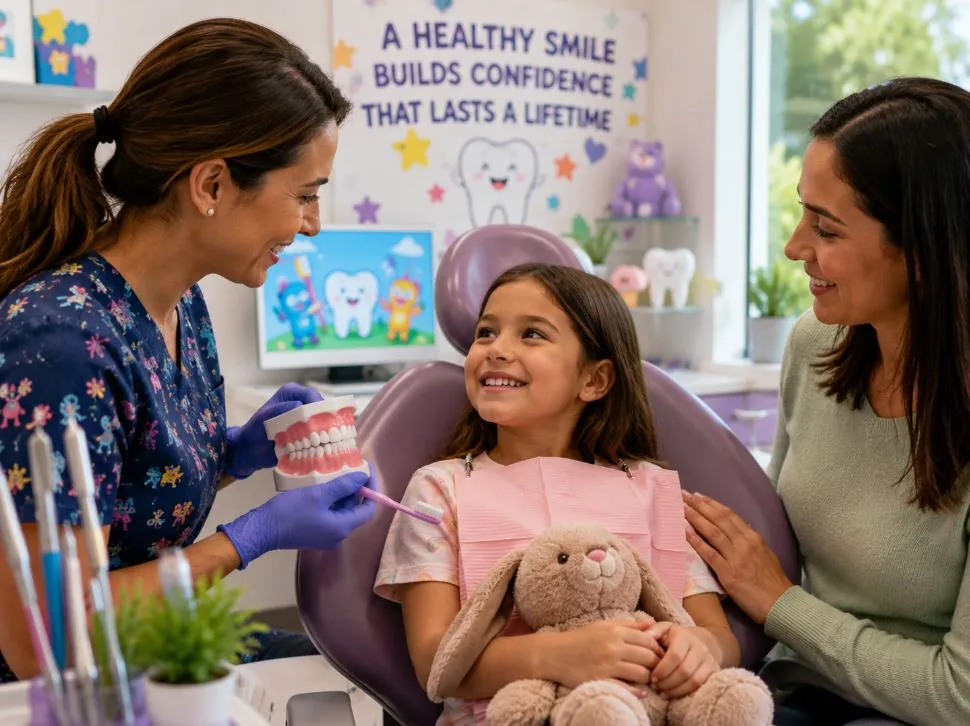
Search "pediatric dentist near me" and the front page of Google reads like every clinic is the perfect place for your kid. Bright lobbies, smiling cartoon characters, "kid-friendly" stamped on every banner. What "pediatric dentist" should actually mean — and what most parents don't know to look for — is something concrete: a dentist who completed a 2-3 year accredited pediatric residency after dental school, ideally board-certified through the American Board of Pediatric Dentistry, with the behavior-management training to handle the full age range from babies to anxious teens.
Pediatric dentistry is its own specialty. A general dentist who's friendly with kids and a residency-trained pediatric dentist are not the same thing — and the difference matters most exactly when it matters most: a frightened toddler with a complex case, a child with special healthcare needs, or a kid who's already had one bad dental experience and now refuses to open their mouth. The depth of pediatric-specific training shows up in those situations.
This guide gives you the real markers of a worth-trusting pediatric dentist — the ones that hold up under scrutiny. We walk through what specialty residency actually involves, the questions that surface a practice's quality, when to bring your child in for the first time, what behavior-management options should be on the menu, what treatment costs in 2026, what insurance and Medicaid actually cover, and the red flags that should make you walk out of a consultation. The goal is to give you the language and questions to evaluate any pediatric practice on the merits, not on the cartoon mural in the lobby.
What Pediatric Dentistry Actually Is
The American Dental Association recognizes nine dental specialties. Pediatric dentistry is one of them. To call yourself a pediatric dentist legitimately, a clinician must complete dental school (DDS or DMD), then a 24- to 36-month accredited pediatric residency that trains them specifically in child growth and development, behavior management, sedation, treatment of special-needs patients, and the developmental dentistry that doesn't apply to adult care. It's a meaningfully different scope of training from general dentistry — and it's not optional terminology. A general dentist who treats kids is allowed to do so, but they're not a "pediatric dentist" in the specialty sense.
That distinction is worth understanding because the marketing has blurred it. "Family dentist" practices regularly market themselves to parents using language that overlaps with pediatric specialty language. They're not being dishonest — many do excellent work with children — but the credential underneath is different, and the depth of training for complex cases is different.
American Board of Pediatric Dentistry (ABPD) certification is the voluntary peer-reviewed credential beyond the residency. Roughly 65% of practicing pediatric dentists in the U.S. hold board certification — a meaningfully higher rate than ABO certification in orthodontics or AACD accreditation in cosmetic dentistry. It's a fair signal that the credential bar in pediatric specialty work is taken seriously across the field.
Hospital privileges — many board-certified pediatric dentists also hold hospital privileges for cases that require general anesthesia in an OR setting. Whether your child will ever need that depends on the case, but it's a useful capability to know exists if you're choosing a long-term pediatric practice for a kid with anxiety or significant treatment needs.
When to Bring Your Child for the First Visit
The American Academy of Pediatric Dentistry, the American Academy of Pediatrics, and the American Dental Association all converge on the same recommendation: a child's first dental visit should happen by age one, or within six months of the first tooth erupting — whichever comes first. Not when they have all their baby teeth. Not when they "can sit still." By age one.
Many parents are surprised by how early that is. The reasoning isn't that a one-year-old needs a dental cleaning per se. It's that early-childhood caries (cavities in baby teeth) is the most common chronic disease of childhood — far more prevalent than asthma — and the patterns that lead to it are set in the first 12-18 months of life. Bottle-to-bed habits, breastfeeding-to-sleep patterns, fluoride exposure questions, oral hygiene routines, and risk assessment all happen better at age one than at age three when the first cavity is already showing up.
The first visit is mostly a relationship visit — the dentist counts teeth, looks at the eruption pattern, talks with the parent about feeding habits and home care, and (importantly) gets the child comfortable being in the chair before there's anything anxiety-producing happening. By the time the kid actually needs a filling at age four or five, they've already been there several times and the office is familiar territory. That's the entire point of starting early.
Behavior Management: What Should Be on the Menu
The single biggest difference between a residency-trained pediatric dentist and a general dentist seeing children is behavior management. Pediatric residency dedicates substantial time to a layered set of techniques that match the child's age, anxiety level, and case complexity. A practice should be comfortable across most of these tiers, not stuck at the simplest one.
You won't need every tier for every kid. Most children will only ever see Tiers 1-2 across their entire pediatric dental experience. But the practice you choose should be comfortable across the full spectrum, because the moment your kid actually needs something beyond TSD is the worst time to discover the practice doesn't offer it.
What's on the Treatment Menu
A residency-trained pediatric dentist's daily case mix runs across the developmental spectrum. Here's the broad shape:
| Category | Common Treatments |
|---|---|
| Preventive | Cleanings, fluoride varnish, dental sealants on permanent molars, oral hygiene coaching, dietary counseling, risk assessment |
| Restorative | Tooth-colored fillings (composite), pediatric stainless-steel crowns for primary molars, pulpotomies (baby root canals), space maintainers |
| Surgical | Primary tooth extractions, frenectomy (tongue-tie / lip-tie), management of dental trauma |
| Interceptive Orthodontics | Phase 1 ortho referrals or in-house care (ages 7-10), space maintainers after early tooth loss, expansion appliances when indicated |
| Special Needs | Treatment for children with autism spectrum, Down syndrome, cerebral palsy, severe medical conditions; often coordinated with the child's medical team |
| Emergency | Knocked-out teeth, fractured teeth, dental abscesses, after-hours coverage protocols |
The specific menu at any practice you visit will reflect the dentist's training, comfort level, and the case mix they tend to see. A practice that says they "don't do" pulpotomies or stainless-steel crowns for primary molars is a smaller-scope office, which may be fine for routine care but won't carry your kid through a complex restorative case.
What Pediatric Dental Care Actually Costs in 2026
Costs vary by geography, complexity, and whether your child has dental insurance, Medicaid/CHIP coverage, or no coverage. Here are the realistic out-of-pocket ranges for the most common services:
| Service | Typical U.S. Range |
|---|---|
| Cleaning + exam (routine recall visit) | $80 – $200 |
| First-visit (age 1) consultation | $50 – $150 |
| Bitewing X-rays (set of 2) | $50 – $120 |
| Fluoride varnish application | $25 – $60 |
| Dental sealant (per tooth) | $40 – $80 |
| Composite filling (per tooth) | $150 – $400 |
| Stainless-steel crown (primary molar) | $250 – $550 |
| Pulpotomy (baby root canal) | $200 – $450 |
| Primary tooth extraction | $100 – $300 |
| Nitrous oxide (per session) | $50 – $150 |
| Oral conscious sedation | $200 – $500 |
| IV sedation / general anesthesia (hospital) | $1,500 – $5,000+ |
The high end of these ranges shows up in NYC, San Francisco, LA, and Boston. The lower end shows up in mid-tier metros (Charlotte, Phoenix, San Antonio, Oklahoma City) and value-conscious practices everywhere. The clinical work is essentially identical at both ends of the price spread.
Insurance, Medicaid, and CHIP Reality
Pediatric dental coverage in the U.S. is meaningfully better than adult dental coverage — which is good news, because kids need more routine care than most adults realize.
Private dental insurance
Most family dental plans include comprehensive pediatric coverage with no deductible for preventive services and 50-80% coverage on basic restorative work. Pediatric annual maximums are typically the same as adult ($1,500-2,000) but used differently — kids hit the max less often because their procedures are smaller and more preventive-skewed. Sealants and fluoride are commonly fully covered as preventive.
Medicaid and CHIP
Every state Medicaid program is required to provide comprehensive dental coverage for children under 21 through EPSDT (Early and Periodic Screening, Diagnostic, and Treatment) benefits. CHIP (Children's Health Insurance Program) covers families above Medicaid thresholds. Together, these programs cover roughly 40% of U.S. children — and pediatric dental services through these programs include cleanings, fluoride, sealants, fillings, crowns, extractions, and (in most states) sedation when medically necessary.
HSA and FSA dollars — pediatric dental care (preventive, restorative, sedation, ortho) is fully eligible for Health Savings Account and Flexible Spending Account spending. For families paying out-of-pocket for high-deductible plans, this is meaningful tax savings (effectively 22-32% off the bill in real dollars).
Five Questions to Ask Before You Pick a Practice
These questions move the conversation past the lobby decor and into actual clinical depth. A confident provider welcomes them; a less-confident one finds them inconvenient.
Red Flags That Should Stop You
The pediatric dental market has a few well-known traps. Most are easy to spot once you know what they are.
Aggressive treatment plans on first visits — a recommendation for stainless-steel crowns on multiple primary molars at a first cleaning visit is an outlier that warrants a second opinion. Some kids genuinely do need extensive early-childhood-caries treatment. But a same-day, full-quadrant treatment plan presented without imaging, monitoring options, or staged-care alternatives is sales-driven, not clinical-driven.
Pediatric practices flagged for predatory Medicaid billing — there have been multiple Department of Justice settlements and state Medicaid Fraud Control Unit actions against chain pediatric practices that bill aggressively for unnecessary procedures on Medicaid-enrolled kids. Search "[clinic name] Medicaid fraud" or "[clinic name] DOJ settlement" before committing to a practice that primarily serves Medicaid patients. The specific chains involved change over time; the pattern doesn't.
"Free first visit" with high-pressure same-day treatment — the free consultation is the funnel. The high-pressure same-day plan is the upsell. Pediatric dentistry is a multi-year relationship; there's no clinical reason to commit on the first visit.
Refusal to share credentials or board-certification status on request — you should be able to verify that whoever's treating your child is a residency-trained pediatric dentist and ideally ABPD board-certified. Refusal to share is disqualifying. The AAPD and ABPD both maintain public verification tools.
Sedation provided by anyone other than the dentist or a credentialed dental anesthesiologist — pediatric sedation has specific safety requirements. The American Academy of Pediatrics and AAPD have published joint sedation safety guidelines covering pre-sedation assessment, monitoring, recovery protocols, and rescue equipment. A practice using sedation should follow them publicly and transparently.
How Smyleee Helps You Find the Right Practice
Smyleee maintains city-level Top 10 pediatric dentistry rankings for major U.S. metros, with each practice vetted on credential signals (residency training, ABPD certification), case-volume markers, sedation capability, special-needs accommodation, and aggregate parent feedback rather than raw review counts. Each entry flags whether the practice accepts Medicaid/CHIP coverage and whether they offer the full sedation spectrum.
Useful starting points if you want a curated shortlist instead of working through Google search results:
- Top 10 Pediatric Dentists in New York City
- Top 10 Pediatric Dentists in Brooklyn
- Top 10 Pediatric Dentists in San Jose
- Top 10 Pediatric Dentists in San Diego
- Top 10 Pediatric Dentists in Miami
- Top 10 Pediatric Dentists in Charlotte
- Top 10 Pediatric Dentists in Chandler
For specific situations — your baby's first dental visit, a child with special healthcare needs, finding a pediatric practice that takes Medicaid — we publish dedicated guides covering when to take your baby for their first dental visit, how to choose a pediatric dentist for a child with special needs, and how to find a pediatric dentist who accepts Medicaid and CHIP.
Final Thoughts
Pediatric dentistry done well is one of the highest-leverage things in child healthcare. The dental relationships your kid forms in the first three to five years of regular visits set patterns that hold for decades. Kids who experience competent, calm, age-appropriate dental care grow up into adults who actually keep their checkup appointments. Kids who experience the opposite — rushed, fearful, or pain-associated visits — grow up into adults who avoid dentists for years and end up with much worse outcomes.
The single best thing you can do is pick a practice deliberately. A residency-trained pediatric dentist, with the full behavior-management menu, who treats your kid like a small person rather than a small inconvenience, who's transparent about cost and credentials and treatment alternatives — that's the practice that's worth the extra time to find. The cartoon murals are nice. They're not the thing that matters.
Take the time. Ask the questions. Verify credentials. Walk out without committing if anything feels rushed. The pediatric dentist you pick today might still be your kid's dentist when they leave for college. That's the timeframe of the decision.
Find a Residency-Trained Pediatric Dentist
Browse Smyleee's curated, credentials-vetted directory of pediatric dentists across the U.S. — with board-certification flags, sedation-capability markers, Medicaid/CHIP acceptance, and aggregate parent ratings.
Sources & References
- American Academy of Pediatric Dentistry — Patient Resources & Provider Standards
- American Board of Pediatric Dentistry — Board Certification Standards
- American Academy of Pediatrics — Oral Health Resources
- HealthyChildren.org (AAP) — Pediatric Oral Health Guides
- Centers for Disease Control and Prevention — Children's Oral Health Data
- Medicaid.gov — Pediatric Dental Coverage Under EPSDT
- InsureKidsNow.gov — CHIP Coverage Resources
- U.S. Food and Drug Administration — Pediatric Dental Material Safety Guidance
- American Dental Association Health Policy Institute — Pediatric Cost & Access Data
- IRS Publication 502 — Medical and Dental Expenses (HSA / FSA Eligibility)