
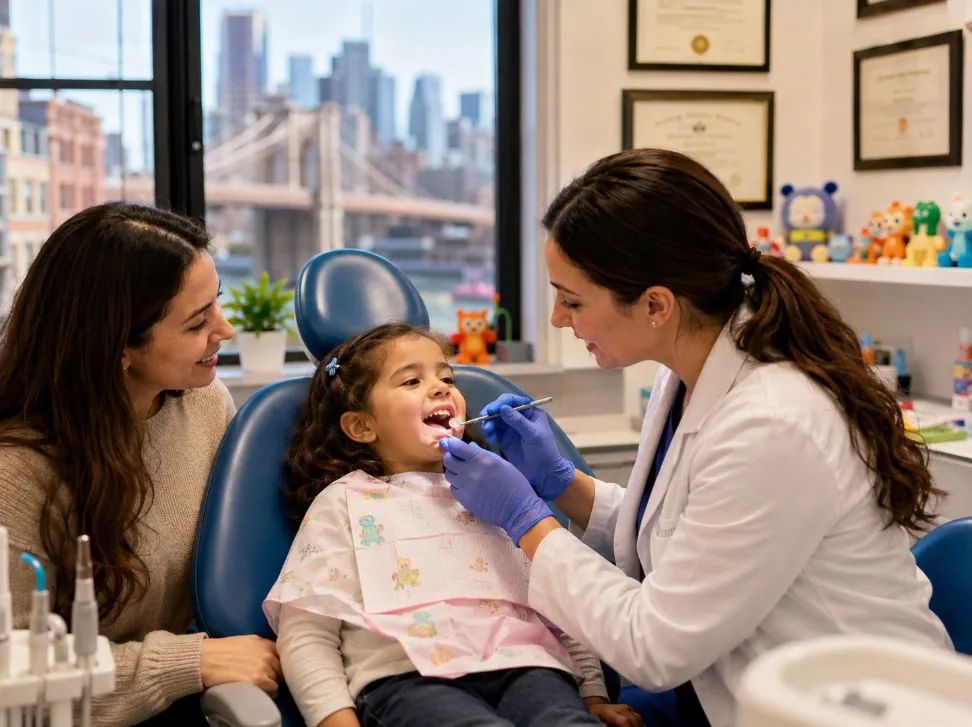
Brooklyn parents looking for a pediatric dentist face an unusual problem: the borough has more genuine pediatric specialty depth than most U.S. cities have in their entire metro area, and at the same time it has a marketing layer thick enough to obscure most of it. Search "pediatric dentist brooklyn" and the front page reads like every practice is the perfect choice for your kid — bright lobbies, cartoon mascots, "kid-friendly" language stamped across every banner. What "pediatric dentist" should actually mean for your child in Brooklyn — and what most parents miss when they pick a practice here — is something concrete: a clinician who finished a 2-3 year accredited pediatric residency after dental school, ideally board-certified through the American Board of Pediatric Dentistry, with the behavior-management training to handle a frightened toddler, an anxious teen, or a child with special healthcare needs.
Brooklyn is the second-densest pediatric specialty market in the New York metro after Manhattan, and on a per-capita basis it sits among the strongest pediatric provider pools in the country. The borough also has something Manhattan often doesn't: a workable Medicaid and Child Health Plus pediatric specialty network that includes Brooklyn Hospital Center's pediatric dental department, the Lutheran Family Health Centers / NYU Langone Family Health Centers system across Sunset Park and beyond, and a strong concentration of Federally Qualified Health Centers serving Williamsburg, Crown Heights, Bedford-Stuyvesant, Bushwick, and East New York. The infrastructure is real. The trick is knowing how to find the right practice without being routed by Google's first page into a glossy storefront with no named pediatric specialist behind it.
This guide is built for the Brooklyn parent who wants a working framework — not a vague top-10 list. We'll walk through what residency training and ABPD certification mean in this borough, the questions that surface clinical depth in any consultation between Greenpoint and Coney Island, what pediatric care realistically costs in Brooklyn in 2026, how Medicaid and Child Health Plus function across the borough's neighborhoods, and the red flags that should make you walk out without committing. No invented clinic names, no "book today" pressure — just what you need to pick a kids dentist brooklyn parents can trust to carry your child from age one through their first wisdom-tooth referral.
What "Pediatric Dentist" Actually Means in Brooklyn
The American Dental Association recognizes nine dental specialties. Pediatric dentistry is one of them, and the credential is not interchangeable with "general dentist who likes kids." To call yourself a pediatric dentist legitimately, a clinician completes dental school (DDS or DMD), then a 24- to 36-month accredited pediatric residency that trains them specifically in child growth and development, behavior management, sedation pharmacology, treatment of patients with special healthcare needs, and the developmental dentistry that doesn't apply to adult care. The training is meaningfully deeper than what general dentistry covers, and pediatric specialty practice is regulated as a distinct discipline.
Brooklyn's pediatric specialty pipeline is fed by a small set of well-respected residency programs in the broader NYC metro. The NYU College of Dentistry runs a pediatric dental residency on East 24th Street in Manhattan, with a full-spectrum clinic that trains residents in everything from infant oral health visits through hospital sedation cases. Columbia College of Dental Medicine on West 168th Street runs a pediatric program affiliated with NewYork-Presbyterian. Children's Hospital at Montefiore in the Bronx hosts a hospital-based pediatric dentistry residency that handles a high volume of medically complex cases routed in from across the metro, including from Brooklyn. A meaningful share of the pediatric dentists practicing in Park Slope, Cobble Hill, Williamsburg, Bay Ridge, Crown Heights, and Brighton Beach trained at one of these three programs, and the credential is easy to verify in two minutes by asking the practice or checking the pediatric dentist's bio page.
That regional density matters because the marketing layer around pediatric dentistry in Brooklyn is loud. "Family dentist" practices regularly market themselves to parents using language that overlaps with pediatric specialty language. They're not necessarily doing bad work — many handle routine pediatric care competently — but the residency-level training underneath is different, and the depth of capability for complex cases is different. The board certified pediatric dentist brooklyn parents are looking for is the one whose credential page actually says "completed pediatric residency at NYU/Columbia/Montefiore" or equivalent, not just "we love seeing kids."
American Board of Pediatric Dentistry (ABPD) certification is the voluntary peer-reviewed credential beyond residency. Roughly 65% of practicing pediatric dentists in the U.S. hold board certification, and Brooklyn's rate skews above the national average because of the academic concentration in the broader NYC metro. You can verify any provider on theabpd.org in under a minute.
Hospital privileges — many board-certified pediatric dentists serving Brooklyn families also hold hospital privileges at NYU Langone, NewYork-Presbyterian/Columbia, Maimonides, NYC Health + Hospitals/Kings County, NYC Health + Hospitals/Woodhull, or NYU Langone Hospital–Brooklyn for cases that require general anesthesia in an OR. Whether your child will ever need that depends on the case, but it's a useful capability to know exists if you're choosing a long-term pediatric practice for a kid with anxiety or significant treatment needs.
The Pediatric Dentistry Landscape in Brooklyn
Brooklyn isn't a single pediatric dental market. It's a layered one, and knowing which tier you're shopping in tells you most of what you need to know about price, technology, and credential depth. The pediatric dentist brooklyn shortlist that makes sense for a Cobble Hill family with private dental insurance is not the same as the one that makes sense for a Brownsville family on Child Health Plus, and pretending it is is part of why parents end up in the wrong practice.
The premium tier is concentrated in Park Slope, Cobble Hill, Brooklyn Heights, Williamsburg, and parts of Carroll Gardens and DUMBO — neighborhoods where overhead, demographics, and demand for boutique pediatric specialty practices have driven both prices and clinical credentialing higher. Many of these practices are run by ABPD-certified providers with strong NYU/Columbia/Montefiore residency training, and the clinical work is frequently excellent. Pricing in this tier is closer to mid-Manhattan than to most of the rest of Brooklyn — you're financing a larger marketing footprint, a designed-for-Instagram waiting room, and the rent on a Smith Street or Fifth Avenue storefront. Equivalent clinical work in less-curated parts of Brooklyn typically comes in 15–25% lower with no clinical difference.
The mid-tier covers most of the rest of Brooklyn — Bay Ridge, Bensonhurst, Sheepshead Bay, Brighton Beach, Crown Heights, Prospect Heights, Greenpoint, Ditmas Park, Midwood, Marine Park, and Mill Basin. These are the established pediatric specialty practices with strong residency training, real case volume across the full pediatric age range, and a working sedation menu, but without the boutique-Brooklyn overhead. For most families with private dental insurance, this tier is where the best value lives in the borough — and Brooklyn's specialty density means there's almost always a credentialed pediatric option within a 15-minute trip on the B, Q, F, or D.
The Medicaid and Child Health Plus tier is its own thing in Brooklyn, and worth understanding in detail. Brooklyn's pediatric Medicaid landscape is meaningfully better than the national average and arguably the strongest of any NYC borough on a per-capita basis. The structural advantages are real: Brooklyn Hospital Center operates a pediatric dental department with full specialty depth and Medicaid acceptance; the Lutheran Family Health Centers / NYU Langone Family Health Centers network spans Sunset Park, Bay Ridge, and Bensonhurst with strong pediatric dental capacity; NYC Health + Hospitals operates pediatric dental services at Kings County (East Flatbush) and Woodhull (Bushwick/Williamsburg); a dense network of Federally Qualified Health Centers including ODA Primary Health Care Network in Williamsburg, Sun River Health, Community Healthcare Network sites, and Brightpoint Health serves the rest of the borough; and a meaningful share of private pediatric specialty practices in Crown Heights, Bensonhurst, Brighton Beach, Borough Park, and Sheepshead Bay accept Medicaid alongside private insurance.
Then there's the academic clinic option, which is a short subway ride from most of Brooklyn. The NYU College of Dentistry's pediatric clinic on East 24th Street accepts children of all ages, including very young patients for first-visit appointments, and treats Medicaid, Child Health Plus, and self-pay families on a rolling basis. Care is delivered by graduate residents under direct attending-faculty supervision. The all-in fee for routine pediatric services typically lands well below private-practice rates, and the supervised quality is consistent with private specialty care. For Brooklyn families who can absorb the longer appointment cadence and academic-calendar scheduling, this is one of the most cost-effective pediatric specialty options anywhere in the U.S.
The AAPD Age-1 First Visit Recommendation in Brooklyn
The American Academy of Pediatric Dentistry, the American Academy of Pediatrics, and the American Dental Association converge on the same recommendation: a child's first dental visit should happen by age one, or within six months of the first tooth erupting — whichever comes first. Not when they have all their baby teeth. Not when they "can sit still." Not at age three or four when many parents instinctively schedule the first visit. By age one.
Brooklyn parents are often surprised by how early that is. The reasoning is straightforward: early-childhood caries (cavities in baby teeth) is the most common chronic disease of childhood — far more prevalent than asthma — and the patterns that lead to it are set in the first 12-18 months of life. Bottle-to-bed habits, breastfeeding-to-sleep patterns, fluoride exposure questions, oral hygiene routines, and overall caries risk assessment all happen better at age one than at age three when the first cavity is already showing up on imaging.
The first visit is mostly a relationship visit — the dentist counts teeth, looks at the eruption pattern, talks with the parent about feeding habits and home care, and (importantly) gets the child comfortable being in the chair before there's anything anxiety-producing happening. By the time the kid actually needs a filling at age four or five, they've already been there several times and the office is familiar territory. That's the whole point of starting early.
Brooklyn has good infrastructure for very young first visits. Most established pediatric specialty practices in Park Slope, Cobble Hill, Bay Ridge, Williamsburg, and Crown Heights have first-visit protocols specifically for one-year-olds — short, low-key, parent-on-the-knee exams with no expectation of a full cleaning. The NYU pediatric clinic explicitly accepts patients in the under-three age range that some private practices quietly redirect, and the academic clinics affiliated with the broader Columbia and Montefiore programs do the same. If your pediatrician hasn't mentioned the age-1 visit, ask. If your prospective Brooklyn pediatric dentist tells you to come back at age three, that's a signal they're not following current AAPD guidance.
Behavior Management: What Should Be on the Menu in Brooklyn
The single biggest difference between a residency-trained pediatric dentist and a general dentist seeing children is behavior management. Pediatric residency dedicates substantial time to a layered set of techniques that match the child's age, anxiety level, and case complexity. A real Brooklyn pediatric specialty practice should be comfortable across most of these tiers, not stuck at the simplest one. Most established pediatric practices in the borough run the full spectrum from Tell-Show-Do through nitrous oxide and oral conscious sedation in-office, with hospital-OR pathways routed through the academic medical centers in the broader metro.
You won't need every tier for every kid. Most children will only ever see Tiers 1-2 across their entire pediatric dental experience. But the practice you pick should be comfortable across the full spectrum, because the moment your kid actually needs something beyond Tell-Show-Do is the worst time to discover the practice doesn't offer it. Brooklyn's specialty density makes it relatively easy to find a practice with the full menu — that's the right bar for a long-term pediatric relationship in this borough.
Real Cost Ranges for Pediatric Dental Care in 2026 Brooklyn
Brooklyn pediatric dentistry sits in the middle of the NYC pricing range — typically 15–25% below the Manhattan premium tier for the same clinical work, and meaningfully above the U.S. national median. Here's what routine pediatric services actually cost across the borough in 2026, separated by tier so the numbers are useful instead of vague. These are out-of-pocket sticker ranges before insurance, Medicaid, or Child Health Plus reduce them.
| Service | Brooklyn premium tier | Brooklyn mid-tier & broader borough |
|---|---|---|
| First-visit (age 1) consultation | $120 – $250 | $70 – $150 |
| Cleaning + exam (routine recall visit) | $150 – $280 | $100 – $200 |
| Bitewing X-rays (set of 2) | $70 – $150 | $50 – $110 |
| Fluoride varnish | $40 – $75 | $25 – $55 |
| Dental sealant (per tooth) | $60 – $110 | $45 – $80 |
| Composite filling (single tooth) | $300 – $500 | $200 – $400 |
| Stainless-steel crown (primary molar) | $450 – $650 | $350 – $550 |
| Pulpotomy (baby root canal) | $350 – $550 | $250 – $450 |
| Primary tooth extraction | $180 – $350 | $120 – $250 |
| Nitrous oxide (per session) | $80 – $160 | $50 – $120 |
| Oral conscious sedation | $300 – $600 | $200 – $450 |
| IV sedation / hospital general anesthesia | $2,000 – $5,000+ | $1,500 – $4,000+ |
| NYU pediatric teaching clinic visit | ~40–60% below private NYC rates | |
The Brooklyn premium tier — Park Slope, Cobble Hill, Brooklyn Heights, Williamsburg, DUMBO — consistently runs above the rest of the borough for the same clinical work. That's not bait pricing; it reflects real overhead in those neighborhoods. The clinically relevant question isn't whether you can find inexpensive pediatric dentistry in Brooklyn — you generally can, especially at the academic clinics, FQHCs, and hospital-based programs — it's whether you've decided which side of the tier line you're shopping on before you walk into a consultation. Two written, itemized quotes from different parts of the borough will almost always show a meaningful spread on the same case.
Insurance, Medicaid, and Child Health Plus in Brooklyn
Pediatric dental coverage in New York is meaningfully better than adult dental coverage, and meaningfully better than the national pediatric Medicaid average. Most Brooklyn families combine private dental insurance, New York State Medicaid, Child Health Plus, HSA/FSA dollars, and academic-clinic or FQHC pricing to bring their actual outlay well below sticker.
Private dental insurance
Most family dental plans available through New York State of Health, employer benefits, or private carriers (Delta Dental, MetLife, Aetna, Cigna, Guardian, UnitedHealthcare, Healthplex, EmblemHealth) include comprehensive pediatric coverage with no deductible for preventive services and 50–80% coverage on basic restorative work. Pediatric annual maximums are typically the same as adult ($1,500–2,500) but used differently — kids hit the max less often because their procedures are smaller and more preventive-skewed. Sealants and fluoride are commonly fully covered as preventive at most Brooklyn pediatric specialty practices that take in-network plans. Sedation coverage is uneven; ask about it explicitly when verifying benefits.
New York State Medicaid and Child Health Plus
New York State Medicaid provides comprehensive dental coverage for children under 21 through EPSDT (Early and Periodic Screening, Diagnostic, and Treatment) benefits, including cleanings, fluoride, sealants, fillings, stainless-steel crowns, pulpotomies, extractions, and sedation when medically necessary. Child Health Plus covers families above Medicaid thresholds and includes pediatric dental as an essential benefit. Together, these programs cover a meaningful share of Brooklyn children, and the borough's reimbursement structure has produced a genuinely workable Medicaid pediatric specialty network — arguably the strongest in the NYC metro.
The places where Medicaid and Child Health Plus pediatric specialty care is most reliably accepted in Brooklyn are the Brooklyn Hospital Center pediatric dental department in Fort Greene; the Lutheran Family Health Centers / NYU Langone Family Health Centers system across Sunset Park, Bay Ridge, and Bensonhurst; NYC Health + Hospitals pediatric dental services at Kings County (East Flatbush) and Woodhull (Bushwick/Williamsburg); a dense network of FQHCs including ODA Primary Health Care Network (Williamsburg), Sun River Health sites, Community Healthcare Network, Brightpoint Health, and Brownsville Multi-Service Family Health Center; and a meaningful number of private pediatric specialty practices in Crown Heights, Bensonhurst, Brighton Beach, Borough Park, and Sheepshead Bay that accept Medicaid alongside private insurance. The academic clinic at NYU is also a short subway ride from most of the borough and serves as a strong fallback for medically complex Medicaid cases.
HSA and FSA dollars — pediatric dental care (preventive, restorative, sedation, ortho) is fully eligible for Health Savings Account and Flexible Spending Account spending. For families paying out-of-pocket against a high-deductible plan, this is meaningful tax savings (effectively 22–32% off the bill in real dollars). Brooklyn employer FSAs are widely used for pediatric dental.
How to Find a Top Pediatric Dentist in Brooklyn
Knowing the framework is half the work. The other half is using it. Here's the playbook for finding a kids dentist brooklyn parents can actually trust without spending three weekends on Google.
Brooklyn neighborhoods worth a closer look for pediatric specialty care
The pediatric dentist brooklyn shortlist looks meaningfully different depending on which part of the borough you're searching in. A few areas worth searching specifically:
Williamsburg and Greenpoint — mix of premium-tier pediatric storefronts along Bedford Avenue and Manhattan Avenue with mid-tier specialty practices in the surrounding blocks. The ODA Primary Health Care Network offers Medicaid-friendly pediatric dental services in South Williamsburg.
Bay Ridge and Bensonhurst — established immigrant-founded pediatric specialty practices with strong residency training, well-priced against Park Slope. NYU Langone Family Health Centers and Lutheran Family Health Centers anchor a strong Medicaid pediatric pipeline along the Bay Ridge / Sunset Park corridor.
Crown Heights and Prospect Heights — growing pediatric specialty density, mid-tier pricing, with several practices accepting Medicaid alongside private insurance.
Sheepshead Bay, Brighton Beach, and Mill Basin — lower overhead, multilingual capacity (especially Russian and Chinese), and strong specialty depth among long-running practices. Often the best value tier in the borough for routine pediatric care.
East Flatbush, Bushwick, Bedford-Stuyvesant, Brownsville, and East New York — primarily served by NYC Health + Hospitals (Kings County and Woodhull), Brooklyn Hospital Center, FQHCs, and Medicaid-accepting private pediatric specialty practices. Strong real coverage for families on Medicaid and Child Health Plus.
Red Flags That Should Stop You
The Brooklyn pediatric dental market has a few well-known traps. Some are obvious in hindsight; some have caught a lot of parents in the past few years, especially in the rapidly multiplying corporate-chain pediatric storefronts along major commercial corridors and in the heavily-marketed boutique pediatric segment in Park Slope, Cobble Hill, and Williamsburg.
Aggressive treatment plans on first visits — a recommendation for stainless-steel crowns on multiple primary molars at a first cleaning visit is an outlier that warrants a second opinion. Some kids genuinely do need extensive early-childhood-caries treatment. But a same-day, full-quadrant treatment plan presented without imaging, monitoring options, or staged-care alternatives is sales-driven, not clinical-driven. Get a second opinion at NYU's pediatric clinic, Brooklyn Hospital Center, or another credentialed practice before committing.
Pediatric practices flagged for predatory Medicaid billing — New York State has prosecuted multiple chain pediatric dental operations for fraudulent Medicaid billing, particularly involving unnecessary stainless-steel crowns and pulpotomies on Medicaid-enrolled children. Brooklyn has been the site of several enforcement actions over the past decade. The New York State Office of the Medicaid Inspector General publishes enforcement actions, and the Department of Justice has filed multiple cases against national chains operating in the borough. Search "[clinic name] Medicaid fraud" or "[clinic name] OMIG settlement" before committing to any practice that primarily serves Medicaid patients. The specific chains involved change over time; the pattern doesn't.
"Free first visit" with high-pressure same-day treatment — the free consultation is the funnel. The high-pressure same-day plan is the upsell. Pediatric dentistry is a multi-year relationship; there's no clinical reason to commit on the first visit, especially in a borough where the next credentialed practice is usually a few subway stops away.
Refusal to share credentials or board-certification status on request — you should be able to verify that whoever's treating your child is residency-trained and ideally ABPD board-certified. Refusal to share is disqualifying. The AAPD and ABPD both maintain public verification tools, and the NYS Office of the Professions confirms active dental licensure.
Sedation provided by anyone other than the dentist or a credentialed dental anesthesiologist — pediatric sedation has specific safety requirements. The American Academy of Pediatrics and AAPD have published joint sedation safety guidelines covering pre-sedation assessment, monitoring, recovery protocols, and rescue equipment. A Brooklyn practice using sedation should follow them transparently. If anyone other than the credentialed clinician is administering or monitoring sedation, walk out.
Related Pediatric Dental Reading
If you're comparing Brooklyn pediatric dental pricing or looking for guidance on a specific situation, our companion guides are useful for context. The full credentialing framework lives in the pillar at how to find a pediatric dentist. For Brooklyn-area parents comparing to other major U.S. metros, the Miami pediatric dentist guide and the San Diego pediatric dentist guide are useful side-by-side reads. For families with a one-year-old, our guide on when to take your baby for their first dental visit walks through the AAPD age-1 recommendation in detail. For specific situations, see how to choose a pediatric dentist for a child with special needs and how to find a pediatric dentist who accepts Medicaid and CHIP.
Final Thoughts
Brooklyn parents have a structural advantage in pediatric dentistry that's easy to underuse: strong specialty density across most of the borough, a workable Medicaid and Child Health Plus pediatric network anchored by Brooklyn Hospital Center, the NYU Langone Family Health Centers system, and a dense FQHC pipeline, full-spectrum sedation capability, and short access to the academic clinic at NYU for cases that benefit from supervised-resident pricing. The infrastructure is here. The question is whether you use it deliberately or default to whichever practice has the friendliest mascot on Google's first page.
The dental relationships your kid forms in the first three to five years of regular visits set patterns that hold for decades. Kids who experience competent, calm, age-appropriate dental care grow up into adults who actually keep their checkup appointments. Kids who experience the opposite — rushed, fearful, or pain-associated visits — grow up into adults who avoid dentists for years and end up with much worse outcomes. The pediatric dentist brooklyn parents pick at age one might still be the dentist their kid sees at age sixteen. That's the timeframe of the decision.
Spend the extra hour on the consultation phase. Verify residency training and ABPD certification. Ask about the full sedation menu. Get the cost in writing, including any sedation, X-rays, fluoride, and follow-up. Walk out without committing if anything feels rushed or sales-driven. The cartoon murals are nice. They're not the thing that matters.
Find a Residency-Trained Pediatric Dentist in Brooklyn
Browse Smyleee's curated, credentials-vetted shortlist of pediatric dentists across Brooklyn — with ABPD certification flags, sedation-capability markers, special-needs accommodation, and Medicaid/Child Health Plus acceptance.
Sources & References
- American Academy of Pediatric Dentistry — Patient Resources & Provider Standards
- American Board of Pediatric Dentistry — Board Certification Standards
- American Academy of Pediatrics — Oral Health Resources
- HealthyChildren.org (AAP) — Pediatric Oral Health Guides
- Centers for Disease Control and Prevention — Children's Oral Health Data
- Medicaid.gov — Pediatric Dental Coverage Under EPSDT
- InsureKidsNow.gov — CHIP Coverage Resources
- U.S. Food and Drug Administration — Pediatric Dental Material Safety Guidance
- American Dental Association Health Policy Institute — Pediatric Cost & Access Data
- New York State Office of the Professions — Dentist License Verification
- IRS Publication 502 — Medical and Dental Expenses (HSA / FSA Eligibility)