
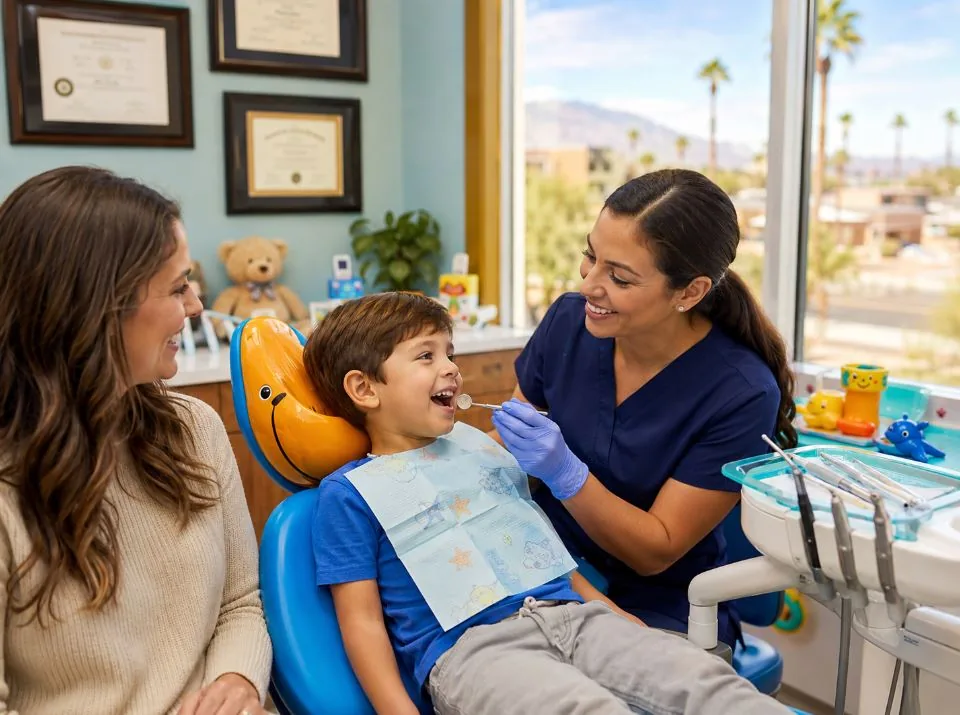
Chandler isn't a small town pretending to be a city anymore. The East Valley of metro Phoenix has been one of the fastest-growing family-heavy submarkets in the U.S. for the better part of two decades, and pediatric dentistry has scaled with it. Smyleee's directory currently lists seven qualified pediatric specialty practices serving Chandler — exceptional density for a metro this size, and meaningfully better provider depth than parents in many comparable cities have to work with. The credential bar in the East Valley is high. The selection problem is real: most parents don't know which markers separate a residency-trained pediatric specialist from a general dentist with a kid-friendly lobby.
This guide walks through what "pediatric dentist" should actually mean in Chandler, how the East Valley's pediatric landscape is structured (Chandler proper, Gilbert next door, Mesa to the north, Tempe to the west), how AHCCCS — Arizona's Medicaid program — actually works for pediatric dental care, what realistic costs look like in 2026, and the questions that surface a Chandler practice's true depth before you commit to a multi-year pediatric relationship. The goal is to give you the local context to evaluate any Chandler-area pediatric practice on the merits, not on the marketing.
What "Pediatric Dentist" Means in Chandler — The Credential Framework
The American Dental Association recognizes pediatric dentistry as one of nine dental specialties. The legitimate path to calling yourself a pediatric dentist requires dental school (DDS or DMD), then a 24- to 36-month accredited pediatric residency that covers child growth and development, behavior management, sedation pharmacology, treatment of patients with special healthcare needs, infant oral health, hospital dentistry, and interceptive orthodontics. A general dentist who treats kids is allowed to do so, but they are not a pediatric specialist in the residency sense, and the depth of training for complex cases is meaningfully different.
Arizona has a deeper pediatric dental training pipeline than most parents realize. A.T. Still University's Arizona School of Dentistry & Oral Health (ATSU-ASDOH) in Mesa — about 15 minutes north of Chandler — runs a pediatric dental residency and a comprehensive pediatric externship rotation through its dental school. Many of the residency-trained pediatric dentists practicing in the East Valley today completed at least part of their training at ATSU-ASDOH or rotated through its pediatric clinic. The local pipeline is one reason the credential density in Chandler is as strong as it is.
The other major training and care infrastructure point in the metro is Phoenix Children's Hospital, a freestanding pediatric tertiary-care hospital roughly 30 miles northwest of Chandler. Phoenix Children's runs a pediatric dental program that handles the most complex cases in the region — children requiring general anesthesia in an OR setting, kids with severe medical comorbidities, and patients whose cases exceed in-office sedation capability. Several of the East Valley's pediatric specialists hold privileges at Phoenix Children's, which means a Chandler-based pediatric practice can route the rare hospital case to a coordinated pathway rather than handing the family off to a stranger.
American Board of Pediatric Dentistry (ABPD) certification is the voluntary peer-reviewed credential beyond the residency. Roughly 65% of practicing pediatric dentists in the U.S. hold board certification. Chandler-area parents should be able to verify this on the ABPD's public lookup tool for any provider claiming the credential.
Hospital privileges at Phoenix Children's — for the small share of cases that require general anesthesia in an OR setting, a pediatric dentist with Phoenix Children's privileges keeps care coordinated. Most kids will never need this. For the ones who do, it's the difference between a smooth referral and a cold-call to an unfamiliar program.
The Pediatric Landscape in Chandler and the East Valley
Chandler is the southeastern corner of metro Phoenix's East Valley. The four submarkets parents end up considering as they search are tightly clustered:
- Chandler proper — population around 280,000, dense pediatric specialty cluster downtown and along the Loop 202 corridor; high family-with-young-children share in newer master-planned neighborhoods (Ocotillo, Sun Lakes-adjacent, Solera).
- Gilbert — adjacent to the east; many Chandler pediatric practices serve Gilbert patients, and several Gilbert-based pediatric specialists are within a 10-minute drive of Chandler central.
- Mesa — to the north, larger population, home to ATSU-ASDOH and the East Valley's largest pool of general dental and pediatric specialty providers.
- Tempe — to the northwest, more young-professional and ASU-adjacent, fewer dedicated pediatric specialty practices but multiple shared providers from the broader Chandler-Mesa-Tempe corridor.
The practical implication for parents: your provider shortlist isn't really "Chandler only." It's "Chandler plus the parts of Gilbert, Mesa, and Tempe within 15-20 minutes of where you actually live." Several East Valley pediatric specialty practices operate satellite locations across two or three of these submarkets, which means the same residency-trained pediatric dentist may be available at the Chandler office one day and the Gilbert office two days later.
Two structural realities shape the local market more than parents typically realize. First, the East Valley's family demographics — high share of households with kids under 18, strong school districts (Chandler Unified, Gilbert Public Schools), continuing in-migration from California and the Pacific Northwest — sustain enough pediatric demand that the specialty practices stay full and the credential bar stays high. Second, AHCCCS (Arizona Medicaid) covers a meaningful share of children in the metro, and provider acceptance varies sharply between the family-private-insurance side of the market and the AHCCCS side. Choosing a practice means understanding which side of that line they sit on.
When to Bring Your Child for the First Visit
The American Academy of Pediatric Dentistry, the American Academy of Pediatrics, and the American Dental Association all converge on the same recommendation: a child's first dental visit should happen by age one, or within six months of the first tooth erupting — whichever comes first. Not when they have all their baby teeth. Not when they "can sit still." By age one.
Most Chandler parents find this earlier than they expected. The reasoning isn't that a one-year-old needs a cleaning per se. It's that early-childhood caries (cavities in baby teeth) is the most common chronic disease of childhood — far more prevalent than asthma — and the patterns that lead to it are set in the first 12-18 months of life. Bottle-to-bed habits, breastfeeding-to-sleep patterns, fluoride exposure questions (Chandler's municipal water is fluoridated to optimal levels, which is helpful but doesn't replace the rest of the conversation), and oral hygiene routines all happen better at age one than at age three when the first cavity is showing up.
A practice that won't see infants under three is signaling that they aren't really set up for early-childhood pediatric care. Several Chandler-area pediatric specialists have built genuine age-1 visit programs and run them as a flagship part of their preventive workflow. For a deeper walkthrough of what actually happens at the first visit and how to prepare, see our first dental visit guide.
Behavior Management — What a Chandler Practice Should Offer
The single biggest difference between a residency-trained pediatric dentist and a general dentist treating children is behavior management — the layered set of techniques that match the child's age, anxiety level, and case complexity. The East Valley's specialty practices typically offer the full spectrum, with the rare hospital-grade case routed through Phoenix Children's:
You won't need every tier for every kid. Most Chandler families will only ever see Tiers 1-2 across their entire pediatric experience. But the practice you choose should be comfortable across the full spectrum, because the moment your kid actually needs something beyond TSD is the worst time to discover the practice doesn't offer it.
What Pediatric Dental Care Costs in Chandler in 2026
Chandler sits in the mid-tier-metro pricing band — meaningfully below NYC, San Francisco, LA, and Boston, comparable to Phoenix proper, slightly above smaller secondary markets. The gap between affordable East Valley practices and the premium end of the local market is real but narrower than coastal-metro spreads. Here's the realistic out-of-pocket range for the most common pediatric services in Chandler in 2026:
| Service | Affordable East Valley | Premium East Valley |
|---|---|---|
| Cleaning + exam (routine recall) | $80 – $140 | $150 – $220 |
| First-visit (age 1) consultation | $50 – $110 | $120 – $180 |
| Bitewing X-rays (set of 2) | $45 – $95 | $95 – $140 |
| Fluoride varnish application | $25 – $50 | $50 – $75 |
| Dental sealant (per tooth) | $40 – $70 | $70 – $110 |
| Composite filling (per tooth) | $130 – $260 | $230 – $380 |
| Stainless-steel crown (primary molar) | $260 – $380 | $360 – $480 |
| Pulpotomy (baby root canal) | $200 – $340 | $320 – $450 |
| Primary tooth extraction | $110 – $220 | $200 – $300 |
| Nitrous oxide (per session) | $50 – $100 | $95 – $150 |
| Oral conscious sedation | $200 – $380 | $360 – $500 |
| IV sedation / OR general anesthesia | $1,500 – $3,200 | $2,800 – $5,000+ |
The clinical work at both ends of the Chandler price spread is essentially the same. The difference reflects practice positioning, office overhead, and case-mix focus, not procedural quality. A residency-trained pediatric dentist at a value-conscious East Valley practice often produces work indistinguishable from the same training profile at a premium-positioned office. Where premium pricing is justified is in case-volume pattern recognition for complex cases, depth of in-office sedation capability, and specific subspecialty experience (special needs, infant oral health, traumatic injury).
Insurance, AHCCCS, and CHIP Reality in Arizona
Pediatric dental coverage in Arizona is meaningfully better than adult dental coverage, and substantially better than parents who haven't navigated it before tend to expect.
Private dental insurance
Most family dental plans in Arizona include comprehensive pediatric coverage with no deductible for preventive services and 50-80% coverage on basic restorative work. Pediatric annual maximums are typically $1,500-2,000, used differently than adults — kids hit the max less often because their procedures are smaller and more preventive-skewed. Sealants and fluoride are commonly fully covered as preventive. Most Chandler-area pediatric specialty practices accept the major Arizona dental carriers (Delta Dental of Arizona, Cigna, MetLife, Aetna, Blue Cross Blue Shield of Arizona, United Concordia).
AHCCCS and KidsCare (Arizona's Medicaid & CHIP)
Arizona's Medicaid program, AHCCCS (Arizona Health Care Cost Containment System, pronounced "access"), provides comprehensive dental coverage for children under 21 through EPSDT (Early and Periodic Screening, Diagnostic, and Treatment) benefits — the federal Medicaid pediatric standard. Coverage includes cleanings, fluoride, sealants, fillings, stainless-steel crowns, pulpotomies, extractions, and (in most cases) sedation when medically necessary.
AHCCCS pediatric dental benefits are administered through dental Managed Care Organizations rather than directly by the state. The dental MCOs serving Chandler-area children include Mercy Care, UnitedHealthcare Community Plan, Banner-University Family Care, and others depending on the AHCCCS health plan a family is enrolled in. Each MCO maintains its own provider network. KidsCare is Arizona's CHIP program, covering children in families above the AHCCCS income threshold but still below the federal CHIP cutoff.
HSA and FSA dollars — pediatric dental care (preventive, restorative, sedation, ortho) is fully eligible for Health Savings Account and Flexible Spending Account spending. For Chandler families on high-deductible plans through their employers, this is meaningful tax savings — effectively 22-32% off the bill in real dollars depending on bracket.
How to Find a Top Pediatric Dentist in Chandler
The East Valley has the credential density to make selection a real choice rather than a default. The framework that consistently produces a strong long-term match:
Neighborhood considerations
The neighborhoods inside Chandler that come up most often for parents searching for a pediatric specialty practice nearby:
- Chandler downtown / Arizona Avenue corridor — most central, dense pediatric specialty cluster, easy access from anywhere in the city.
- Ocotillo / Sun Lakes-adjacent — south Chandler; strong family-with-young-children demographic; some specialty practices have offices specifically positioned for this submarket.
- Sun Lakes — primarily a 55+ retirement community itself, but generates significant grandkid-traffic to Chandler pediatric practices when grandchildren visit; some practices market specifically to multi-generational families.
- Gilbert (next-door) — many Gilbert-based pediatric specialists are within 10-15 minutes of central Chandler; cross-shopping providers across the Chandler-Gilbert border is common and reasonable.
- Tempe-adjacent / north Chandler — closer to ASU and the Tempe corridor; useful for families who work in Tempe and want a school-day-adjacent appointment radius.
Red Flags Specific to Pediatric Shopping in Chandler
The patterns to watch for in the East Valley aren't unique to Chandler, but a few show up here at higher frequency.
Aggressive treatment plans on first visits — a recommendation for stainless-steel crowns on multiple primary molars at a first cleaning visit is an outlier that warrants a second opinion. Some kids genuinely do need extensive early-childhood-caries treatment. But a same-day, full-quadrant treatment plan presented without imaging review, monitoring options, or staged-care alternatives is sales-driven, not clinical-driven.
Practices flagged for predatory AHCCCS or Medicaid billing — there have been multiple Department of Justice settlements and state Medicaid Fraud Control Unit actions nationally against chain pediatric practices that bill aggressively for unnecessary procedures on Medicaid-enrolled kids. Search "[clinic name] Medicaid fraud" or "[clinic name] DOJ settlement" before committing to a practice that primarily serves AHCCCS patients. The specific chains involved change over time; the pattern doesn't.
"Free first visit" with high-pressure same-day treatment — the free consultation is the funnel. The high-pressure same-day plan is the upsell. Pediatric dentistry in Chandler is a multi-year relationship; there's no clinical reason to commit on the first visit.
Refusal to share credentials or board-certification status on request — you should be able to verify that whoever's treating your child is a residency-trained pediatric dentist and ideally ABPD board-certified. Refusal to share is disqualifying. Both the AAPD and ABPD maintain public verification tools.
No clear pathway for hospital-grade sedation — most Chandler pediatric cases never need OR-based general anesthesia. But a practice that can't articulate where those rare cases get routed (Phoenix Children's, a specific licensed surgery center, a specific dental anesthesiology partner) is signaling a depth gap that matters more than it looks.
Cross-Reference — Other Useful Chandler & East Valley Resources
If you want a curated, vetted shortlist instead of working through unfiltered Google search results, these are the most useful starting points:
For the broader pediatric pillar context — what residency-level pediatric dentistry actually means, the full credential framework, and the questions that surface a practice's depth in any market — see the pediatric dentist pillar guide. For specific situations, our companion guides cover when to take your baby for their first dental visit, how to choose a pediatric dentist for a child with special needs, and how to find a pediatric dentist who accepts Medicaid and CHIP (including AHCCCS-specific guidance).
City-level pediatric guides for other major U.S. metros — useful comparison reading if you're relocating to or from Chandler — are available for New York, Brooklyn, San Jose, San Diego, Miami, and Charlotte.
Final Thoughts
Chandler's pediatric dental market is genuinely one of the better ones in the U.S. for parents who know what to look for. The credential density is exceptional for a metro this size, the training pipeline through ATSU-ASDOH is real, the hospital pathway through Phoenix Children's is established, and AHCCCS coverage — once you find a participating specialty practice — is comprehensive. The selection problem isn't lack of options; it's filtering through marketing language to the practices that actually carry residency-level training and the full behavior-management menu.
The dental relationships your kid forms in the first three to five years of regular visits set patterns that hold for decades. Kids who experience competent, calm, age-appropriate dental care in Chandler grow up into adults who actually keep their checkup appointments. Kids who experience the opposite grow up avoiding dentists for years. The pediatric dentist you pick today might still be your kid's dentist when they leave for ASU or NAU. That's the timeframe of the decision.
Take the time. Verify credentials. Ask about the full sedation spectrum. Confirm insurance and AHCCCS acceptance specifically rather than generally. Walk out without committing if anything feels rushed. The East Valley has the depth to make a deliberate choice possible — use it.
Find a Residency-Trained Pediatric Dentist in Chandler
Browse Smyleee's curated, credentials-vetted directory of pediatric dentists across Chandler and the East Valley — with board-certification flags, sedation-capability markers, AHCCCS acceptance, and aggregate parent ratings.
Sources & References
- American Academy of Pediatric Dentistry — Patient Resources & Provider Standards
- American Board of Pediatric Dentistry — Board Certification Standards
- American Academy of Pediatrics — Oral Health Resources
- HealthyChildren.org (AAP) — Pediatric Oral Health Guides
- Centers for Disease Control and Prevention — Children's Oral Health Data
- Arizona AHCCCS — Dental Benefits Overview
- Arizona KidsCare (CHIP) — Coverage Resources
- A.T. Still University Arizona School of Dentistry & Oral Health (Mesa)
- Phoenix Children's Hospital — Pediatric Dental Program
- Medicaid.gov — Pediatric Dental Coverage Under EPSDT