
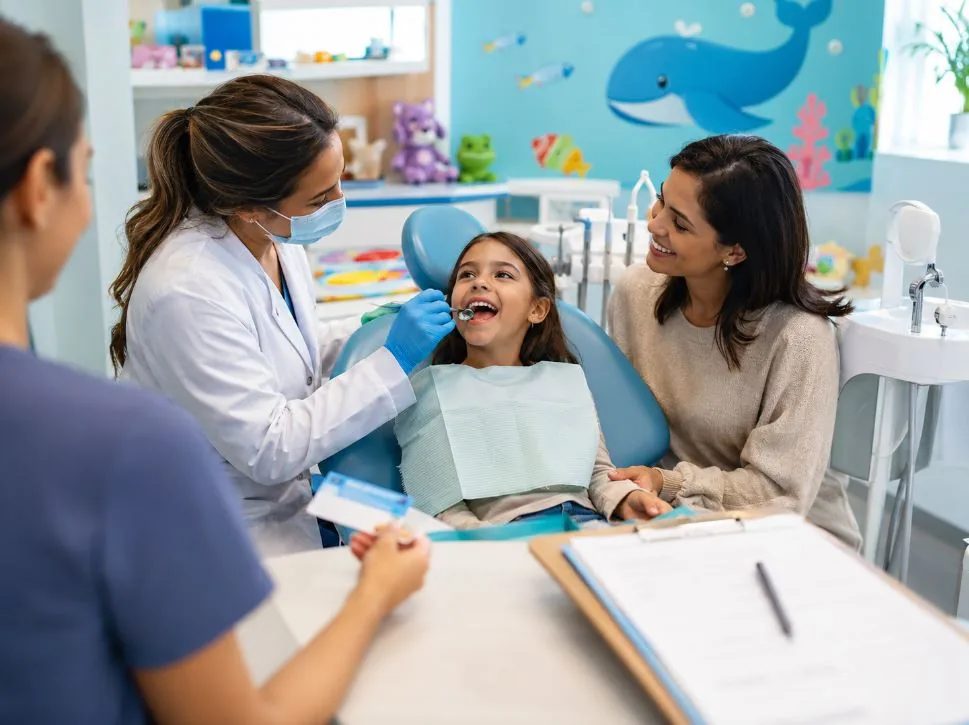
Roughly four in ten U.S. children are covered by Medicaid or the Children's Health Insurance Program (CHIP), and the pediatric dental coverage under those programs is, on paper, comprehensive. The actual challenge isn't whether the coverage exists — it's finding a pediatric specialty practice that participates in the program, has open availability, and treats your child with the same quality and treatment-plan honesty they'd give a privately insured patient. That last piece matters more than parents are usually told. The post you're reading walks through what Medicaid and CHIP actually cover, why participating providers can be hard to find, where to look, and how to spot the chains and individual practices that have run into trouble for predatory billing patterns.
The system is harder to navigate than it should be. Reimbursement rates vary by state and run well below private fee schedules in most of them. Many private pediatric specialty practices either don't take Medicaid at all or cap their Medicaid patient panel at a small share of total volume. The provider shortage is real, especially for the more complex pediatric cases — sedation, hospital dentistry, kids with special healthcare needs. Federally Qualified Health Centers, university dental school clinics, children's hospital dental departments, and a handful of community-oriented private practices fill most of the gap, but the search is still meaningful work.
This guide is for the parent who has Medicaid or CHIP coverage for their child and wants to find a pediatric dentist who'll treat the case well. We cover what the coverage actually includes (more than most parents realize), where to start the search, the five questions to ask any participating practice, the high-level state-by-state landscape, the alternatives when participating private providers are hard to find, and the red flags that have caught families in the past few years. The system has gaps, but it's navigable when you know the terrain.
What Medicaid and CHIP Actually Cover for Pediatric Dental
Pediatric dental coverage under Medicaid is not a stripped-down version of dental care. Federal law requires every state Medicaid program to provide comprehensive dental services to children under 21 through EPSDT — Early and Periodic Screening, Diagnostic, and Treatment. The benefit is medically defined: any service that's medically necessary to diagnose, prevent, or treat a dental condition is covered, regardless of whether the state's Medicaid plan would cover it for an adult.
That's a much wider scope than most families assume. Practically, EPSDT-mandated pediatric dental services include:
- Preventive care — routine cleanings (typically every six months), exams, X-rays, fluoride varnish or treatment, sealants on permanent molars, oral hygiene coaching.
- Restorative care — tooth-colored fillings (composite), pediatric stainless-steel crowns for primary molars, pulpotomies (baby root canals), space maintainers after early tooth loss.
- Surgical care — primary tooth extractions, frenectomy (tongue-tie / lip-tie release), management of dental trauma, extraction of impacted or supernumerary teeth.
- Orthodontics when medically necessary — most state Medicaid plans cover orthodontia for cases that meet medical-necessity criteria (severe malocclusion, cleft lip/palate cases, jaw alignment issues with functional impact). Cosmetic-only orthodontia is generally not covered.
- Sedation when medically necessary — nitrous oxide, oral conscious sedation, IV sedation, all covered under EPSDT when documented as necessary for safe treatment.
- Hospital dentistry under general anesthesia — covered when the child cannot be safely treated chair-side, typical for very young children with extensive caries, children with special healthcare needs, and medically complex patients. The OR fee, anesthesia, and dental work are all covered, often through coordination between the child's medical and dental Medicaid plans.
- Emergency dental care — same-day care for pain, infection, trauma, or acute conditions.
CHIP coverage varies by state but is generally similarly comprehensive. CHIP is administered separately from Medicaid in most states, with its own provider network and sometimes different participating practices. In states where CHIP runs as a Medicaid expansion (rather than a separate program), the coverage and the provider list are essentially identical.
What's NOT covered: purely cosmetic procedures (whitening, veneers), and in most states purely cosmetic orthodontia. If a treatment plan includes elective cosmetic work, that portion will need to be paid out of pocket or skipped.
Why Finding a Participating Provider Is Hard
The honest, structural reason participation is uneven is reimbursement rates. Medicaid pediatric dental fee schedules in most states run 30-60% below typical private dental insurance rates. A practice that does a stainless-steel crown for $400 on a privately insured patient may receive $180-220 from Medicaid for the same procedure. The clinical work is identical; the payment is meaningfully smaller. For a private practice carrying overhead — staff, lab fees, equipment, building lease — the math constrains how many Medicaid patients the practice can absorb without operating at a loss.
States have responded to this differently. A handful of states (Massachusetts, Minnesota, Connecticut, Washington, Oregon, New York, California) have raised reimbursement rates over the past decade and have meaningfully better pediatric Medicaid participation as a result. Other states (Texas, Florida, Georgia, Alabama, several Plains states) have lower rates and consequently thinner participating networks. The geographic variation is real and well documented in Health Affairs and Pew Charitable Trusts research.
The result for parents: in some metros, finding a participating pediatric specialty practice is a phone call or two. In others, the wait list at the few participating practices runs three to nine months for a first appointment, and longer for restorative work. Specialty care for sedation cases or hospital dentistry is usually the tightest bottleneck because fewer providers offer it at any reimbursement rate.
Where to Look
Five reliable starting points, roughly in order of how likely they are to take your child quickly. Work the list top-to-bottom; the alternatives further down are often better than parents realize and shouldn't be skipped.
Five Questions When Calling a Medicaid-Participating Practice
The first phone call to a participating practice does most of the qualifying work. Ask all five of these questions on the first call; a practice that handles them quickly is one that's set up for the work.
The State-by-State Landscape
Pediatric Medicaid dental access is meaningfully different in different states. The variation tracks two things: the state's Medicaid reimbursement rates relative to private fee schedules, and the density of pediatric specialty providers in the state. The combination produces a rough split:
States with stronger access
Massachusetts, Connecticut, Minnesota, Washington, Oregon, Vermont, New York, California, Hawaii, Iowa, North Carolina (selectively), and a handful of others have either raised Medicaid pediatric dental rates significantly over the past decade or built robust FQHC and university-clinic infrastructure that meaningfully closes the gap. In these states, the search for a participating pediatric specialist is harder than the search for a private-pay one, but a routine visit can usually be booked within a few weeks.
States with thinner access
Texas, Florida, Georgia, Alabama, Mississippi, Louisiana, several Plains states, and pockets of other states have lower Medicaid reimbursement rates, lower pediatric specialist density, or both. In these states, the wait for a participating pediatric specialty practice is often months, FQHCs and university clinics carry a heavier share of the volume, and sedation or hospital-level care can be a six-to-twelve-month wait at the few participating providers.
Inside any state, the variation by metro is also significant. Major metros with academic medical centers (Houston, Dallas, Austin, Atlanta, Miami, Tampa, Birmingham, New Orleans) usually have at least one university dental school or children's hospital dental department that participates fully in Medicaid. Smaller metros and rural areas in the lower-access states have the worst availability. For families in those areas, the practical search often involves driving to the nearest metro for specialty care, particularly for sedation or hospital dentistry.
CHIP Specifics
CHIP — the Children's Health Insurance Program — covers families above the Medicaid income threshold but still below private-coverage affordability. Eligibility runs roughly 200-400% of the federal poverty level, varying by state. A family of four in 2026 earning roughly $60,000-$120,000 is in the income range where CHIP eligibility commonly applies, with the exact threshold depending on the state.
CHIP pediatric dental coverage typically matches Medicaid scope: cleanings, fluoride, sealants, fillings, crowns, extractions, orthodontia when medically necessary, sedation when medically necessary, hospital dentistry. The federal portal for CHIP enrollment is InsureKidsNow.gov, which routes to the state-specific application. Some families qualify their child for CHIP without realizing it because the eligibility thresholds are higher than Medicaid's; a quick eligibility check is worthwhile if you're paying out of pocket for pediatric dental care that you might be able to get covered.
The participating-provider question for CHIP is essentially the same as for Medicaid — the network is generally similar in states where CHIP is operated as a Medicaid expansion, and somewhat different in states where CHIP runs as a separate program. The practice's enrollment status with both programs is worth checking on the first call.
Beyond Medicaid: Alternatives When Access Is Tight
If Medicaid-participating providers in your area have long waits, are full, or don't handle the type of care your child needs, several other options exist. None of these is as comprehensive as Medicaid coverage, but for specific situations they fill real gaps.
Sliding-scale FQHC dental programs
For families who lose Medicaid eligibility or who don't qualify in states with restrictive thresholds, FQHCs offer dental services on a sliding fee scale based on income. The fees can be very low — often $25-50 for a routine visit — and the clinical scope is similar to what Medicaid covers. Same HRSA finder tool listed earlier.
University dental school teaching clinics
Pediatric residency clinics are an option for any family, including those without insurance. Fees are typically 40-60% below private-fee schedules, paid out of pocket. The clinical quality is supervised by faculty specialists. Visits are longer; the savings are real.
Charity programs
Mission of Mercy events and Give Kids A Smile day (organized annually by the ADA Foundation in early February) provide free pediatric dental care at scheduled events. State and regional charity-care programs vary; the AAPD's Reach Out and Serve initiative coordinates a national network of pediatric dentists who provide pro bono care for children in financial hardship. These programs cannot replace ongoing care but can fill specific gaps — especially for an acute issue while a family is between coverage windows.
Dental school charity rotations
Beyond the standard teaching clinic, some dental schools run dedicated charity-care rotations for uninsured patients, with services delivered at minimal or no cost. Eligibility is usually income-based and requires application. Worth asking about specifically when calling a dental school clinic.
Red Flags to Watch For
The Medicaid pediatric dental space has had recurring problems with predatory billing and overtreatment at certain chain practices. The Department of Justice and state Medicaid Fraud Control Units have brought multiple cases over the past two decades against practices that systematically overbilled Medicaid for unnecessary procedures on pediatric patients. The specific chains involved have changed over time; the pattern repeats. These flags are worth knowing about specifically because Medicaid families are the target population.
Aggressive treatment plans on first visits, especially crowns and pulpotomies on multiple teeth — a recommendation for stainless-steel crowns on three or four primary molars at a first visit, or pulpotomies presented as routine at the first appointment, is an outlier that warrants a second opinion. Some kids genuinely need that scope of restorative work — early-childhood caries can be severe — but a same-day, multi-quadrant treatment plan presented without imaging review, monitoring options, or staged-care alternatives is sales-driven, not clinical-driven. The pattern is documented in multiple academic studies of overtreatment in Medicaid pediatric populations.
Dramatically different treatment plans for Medicaid versus private-pay patients — if the same practice recommends a watch-and-monitor approach for a privately insured child but a four-crown treatment plan for a similar Medicaid case, something is wrong with the clinical decision-making. The treatment plan should reflect the case, not the payer. This pattern is harder to detect from outside (most parents don't see what's recommended for other children's cases), but second opinions from a different practice are the protective check.
"Free transportation" or "free first visit" with high-pressure same-day treatment — chains that offer transportation to the office and a free initial exam often pair the convenience with high-pressure treatment plans pitched immediately after the exam. The free transportation is the funnel; the same-day treatment is the upsell. Pediatric dentistry is a multi-year relationship; there's no clinical reason to commit to extensive restorative work on the first visit.
Practices that won't let you see the X-rays or treatment plan in writing before scheduling — you should be able to walk out with a copy of the X-rays and a written, itemized treatment plan after the consultation. A practice that presents the plan verbally and pressures same-day scheduling without giving you the documentation is one to step back from.
Refusal to discuss a second opinion — a confident provider welcomes a second-opinion conversation. A defensive reaction ("we're the experts, you should trust the plan") is itself a flag. Second opinions are particularly valuable for Medicaid pediatric cases where the local provider density is low and overtreatment patterns can be hard to verify.
Resources for Parents
National resources for navigating Medicaid and CHIP pediatric dental care, plus state-specific entry points:
- Medicaid.gov — official federal portal, with state Medicaid agency contact information, EPSDT benefit details, and links to state provider directories.
- InsureKidsNow.gov — federal portal for CHIP and children's Medicaid enrollment, with state-by-state application links.
- HRSA "Find a Health Center" — tool to locate Federally Qualified Health Centers near you, including those with dental programs.
- AAPD Find a Pediatric Dentist tool — searchable directory of board-certified pediatric dentists. The tool doesn't always indicate Medicaid participation directly, but the AAPD member directory is the most reliable source for verifying that a dentist is genuinely residency-trained.
- AAPD Reach Out and Serve initiative — coordinates pro bono pediatric dental care for children in financial hardship.
- State Title V Children with Special Health Care Needs programs — every state has case managers who can help families navigate dental access alongside the rest of their child's care.
- 211 — the United Way's local-resource hotline can route families to local sliding-scale dental programs, charity-care options, and case-management resources for Medicaid navigation.
How Smyleee Helps Medicaid Families Find the Right Practice
Smyleee maintains city-level Top 10 pediatric dentistry rankings for major U.S. metros, with each practice vetted on credential signals (residency training, ABPD certification), case-volume markers, sedation capability, special-needs accommodation, and aggregate parent feedback. Each entry flags whether the practice currently accepts Medicaid and CHIP, which removes the first round of cold-calling from the search.
Useful starting points if you want a curated shortlist instead of working through the state Medicaid directory by hand:
- Top 10 Pediatric Dentists in New York City
- Top 10 Pediatric Dentists in Brooklyn
- Top 10 Pediatric Dentists in San Jose
- Top 10 Pediatric Dentists in San Diego
- Top 10 Pediatric Dentists in Miami
- Top 10 Pediatric Dentists in Charlotte
- Top 10 Pediatric Dentists in Chandler
For the broader pediatric framework — credentials, behavior management, costs, the full pediatric dental landscape — see the main pediatric dentist guide. For families whose child has special healthcare needs, the guide to pediatric dentistry for children with special needs covers the additional capability requirements that often overlap with Medicaid coverage. For families just starting out with a young child, the first-dental-visit-by-age-one guide covers what to expect at the first appointment.
Final Thoughts
The pediatric Medicaid dental system in the United States is harder to navigate than it should be. The coverage is comprehensive on paper, but the access depends heavily on where you live, which state you're in, how participating-provider networks have evolved over time, and how much of the work falls on community health centers and university clinics rather than private specialty practices. Families who don't realize how much variation exists end up frustrated with the first three practices they call and assume the system itself doesn't work. It mostly does — it just requires more persistence than middle-class private-insurance care does, which is a structural inequity worth naming.
The advocacy is straightforward: your child has the same right to quality pediatric dental care as any other child, and the EPSDT benefit is the legal expression of that right. The right practice will treat your child with the same care, the same treatment-planning honesty, and the same respect they'd give any other patient — whether the bill goes to Medicaid, CHIP, Aetna, or out-of-pocket. Persistence in finding that practice pays back across years of pediatric care.
Use the FQHCs, the dental schools, the children's hospitals, and the participating private practices in whatever combination works for your situation. Ask the five questions on the first call. Watch for the red flags. Get second opinions on aggressive treatment plans. The system has gaps; it also has solid practices doing good work in every metro. Find them, and stick with them.
Find a Pediatric Dentist Who Accepts Medicaid or CHIP
Browse Smyleee's curated, credentials-vetted directory of pediatric dentists across the U.S. — with Medicaid and CHIP participation flags, sedation-capability markers, and aggregate parent ratings.
Sources & References
- Medicaid.gov — EPSDT and Pediatric Dental Coverage
- InsureKidsNow.gov — CHIP Enrollment and State Resources
- CMS — Medicaid and CHIP Enrollment Data
- HRSA — Find a Federally Qualified Health Center
- American Academy of Pediatric Dentistry — Find a Pediatric Dentist & Reach Out and Serve
- Health Affairs — Medicaid Pediatric Dental Access Research
- Pew Charitable Trusts — Pediatric Dental Access Reports
- U.S. Government Accountability Office — Medicaid Pediatric Dental Reports
- ADA Foundation — Give Kids A Smile Program
- U.S. Department of Justice — Healthcare Fraud Settlements (search Medicaid pediatric dental)