
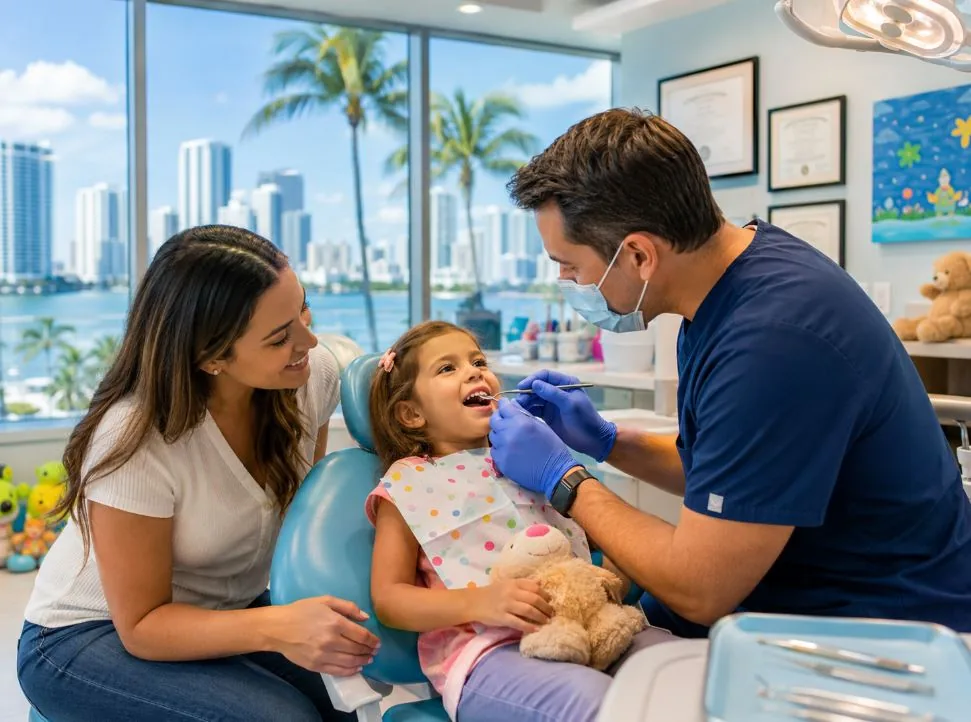
Searching "pediatric dentist Miami" returns the same wall of bright lobbies and cartoon-themed websites every Florida metro produces — and a layer on top of that, in Miami specifically, of bilingual marketing, hospital-affiliated specialty groups, and a handful of high-volume Medicaid pediatric chains. Almost every clinic claims to be "kid-friendly." What "pediatric dentist" should actually mean in Miami is something narrower and more verifiable: a dentist who completed a 2–3 year accredited pediatric residency after dental school, ideally board-certified through the American Board of Pediatric Dentistry, with bilingual capability if you need it and a clear written cost in U.S. dollars before any treatment begins.
Miami is one of the most demographically distinctive pediatric dental markets in the United States. Roughly two-thirds of Miami-Dade County speaks Spanish at home, a meaningful share of pediatric households have a primary parent more comfortable discussing treatment in Spanish, Portuguese, or Haitian Creole than in English, and the share of children covered by Florida Medicaid (Statewide Medicaid Managed Care – Dental) and Florida Healthy Kids CHIP runs above the national average. Layered on top of that, Miami has a serious tertiary-care pediatric infrastructure built around Nicklaus Children's Hospital (formerly Miami Children's), whose pediatric dental program handles the metro's most complex restorative and hospital-OR cases. The result is a market where the difference between a residency-trained pediatric specialty practice and a "family dentist who likes kids" is unusually wide — and where parents who don't know to ask about credentials can end up in either of two failure modes: a Coral Gables boutique pediatric office charging upmarket cosmetic-style premiums for routine care, or a high-volume Medicaid chain that pushes aggressive treatment plans on first visits.
This guide walks the Miami pediatric dentist market the way a careful parent would. We cover what specialty residency training actually involves, how the Nova Southeastern University residency pipeline shapes provider supply in South Florida, the Nicklaus Children's hospital-OR pathway for complex cases, the AAPD age-1 first-visit recommendation and Miami-specific first-visit programs, what behavior management should look like across the full nitrous-through-GA spectrum, what treatment realistically costs across Coral Gables, Brickell, Aventura, Doral, Kendall, Coconut Grove, North Miami, Pinecrest, and Homestead in 2026, the real story on Florida Medicaid and CHIP pediatric coverage, and the red flags that should make you walk out before signing a treatment plan. By the end, you should be able to evaluate any "best pediatric dentist Miami" or "kids dentist Miami FL" claim on the merits, not the lobby decor.
What "Pediatric Dentist" Means in Miami
The credential framework for a real pediatric dentist is the same anywhere in the U.S. — the question is how that framework maps onto Miami's specific provider supply. The American Dental Association recognizes pediatric dentistry as one of nine dental specialties. To call yourself a pediatric dentist legitimately, a clinician must complete dental school (DDS or DMD), then a 24- to 36-month accredited pediatric residency that trains them specifically in child growth and development, behavior management, sedation pharmacology, treatment of patients with special healthcare needs, and the developmental and interceptive work that doesn't apply to adult dentistry. A general dentist who treats kids is allowed to do so under their license, but they're not a "pediatric dentist" in the specialty sense, and the depth of training for complex cases is meaningfully different.
The most common pediatric residency on Miami pediatric dentists' CVs is Nova Southeastern University College of Dental Medicine in Davie, about 35 minutes north of downtown Miami — Florida's largest dental school, with an established accredited pediatric dentistry residency that supplies a significant share of the practicing pediatric specialists across South Florida. You'll also see University of Florida College of Dentistry (Gainesville) on a number of Miami pediatric CVs, and a smaller cluster of out-of-state residencies (NYU, Penn, Boston University, Columbia) in the upmarket Coral Gables, Pinecrest, and Aventura tier. Several of the metro's most-referred pediatric specialists also hold faculty or attending appointments connected to Nicklaus Children's Hospital, whose dedicated pediatric dental program handles hospital-OR cases for the broader South Florida region.
Where Miami diverges from a typical U.S. pediatric market in a way that matters operationally is bilingual capability. A genuinely top pediatric practice in Miami will offer fluent Spanish (and often Portuguese or Haitian Creole) at both the clinical and front-desk level — not just a single bilingual receptionist. Pediatric dentistry is heavily about communication: with a frightened four-year-old, with a parent during informed consent, during a behavior-shaping conversation about why this filling needs to happen today. A practice where the dentist can explain a pulpotomy directly to a Spanish-dominant parent in Spanish is fundamentally different from one where everything routes through a translator. Ask explicitly during the first call.
American Board of Pediatric Dentistry (ABPD) certification is the voluntary peer-reviewed credential beyond the residency. Roughly 65% of practicing pediatric dentists in the U.S. hold board certification — meaningfully higher than ABO certification in orthodontics or AACD in cosmetic dentistry. In Miami specifically, the ABPD-certified share is higher in the upmarket Coral Gables, Pinecrest, and Aventura clusters and somewhat lower in the working-family Hialeah, Kendall, and Homestead corridors.
Hospital privileges at Nicklaus Children's — many board-certified Miami pediatric dentists hold privileges at Nicklaus Children's Hospital for cases that require general anesthesia in an OR setting. Whether your child will ever need that depends on the case, but it's a useful capability to have in the network if you're choosing a long-term pediatric practice for a kid with anxiety, special healthcare needs, or significant treatment scope.
Bilingual capability — fluent Spanish at the clinical level matters in most Miami zip codes. Portuguese capability is common in Aventura, Sunny Isles, and Brickell (Brazilian inflows). Haitian Creole capability is common in North Miami, North Miami Beach, and Little Haiti. A practice that can match the family's preferred treatment-conversation language is meaningfully different from one that can't.
The Miami Pediatric Dental Landscape
Miami's pediatric specialty provider density is high — well above the U.S. metro average — and unevenly distributed across corridors. Coral Gables, Pinecrest, Aventura, and the Coconut Grove corridor concentrate the upmarket pediatric specialty practices, often with multiple board-certified dentists, deeper sedation menus, and higher fee schedules. Doral, Kendall, Hialeah, North Miami, and Homestead concentrate the working-family pediatric practices, which skew higher Medicaid and CHIP acceptance, more bilingual standard, and lower fee schedules but the same residency credential underneath in the better practices. Brickell sits in a middle tier — convenient for downtown professionals, with a mix of boutique pediatric-only offices and pediatric arms of larger dental groups.
The case-mix in Miami is unusual in two ways worth understanding. First, the early-childhood-caries (ECC) burden is meaningfully higher than the U.S. average in several Miami zip codes — driven by a mix of dietary patterns, breastfeeding-to-sleep practices, and historically lower water fluoridation in some county subareas. Pediatric specialty practices in Miami see significant volume of full-mouth restorative work on three-, four-, and five-year-olds, including stainless-steel crowns and pulpotomies on multiple primary molars. That clinical depth is real expertise — and it's why hospital-OR capability matters here more than in many other metros.
Second, the Medicaid pediatric supply-demand gap is uneven across the metro. Some Miami corridors — particularly Hialeah, Homestead, and parts of North Miami — have strong density of pediatric specialty practices that explicitly accept Florida Medicaid Managed Care Dental and Florida Healthy Kids CHIP. Other corridors — particularly Coral Gables, Pinecrest, and Aventura — have very thin Medicaid acceptance among pediatric specialty practices, which means Medicaid-enrolled families often travel across town for specialty care. Federally Qualified Health Centers (FQHCs) and Nicklaus Children's pediatric dental services fill significant gaps in the Medicaid network.
Aventura, Sunny Isles, Bal Harbour — multilingual seasonal-resident clientele (English, Spanish, Portuguese, Russian, Hebrew). Pediatric specialty density is solid; pricing skews high; concierge premium adds without changing clinical outcomes.
Brickell, Downtown — convenient for professional families; mix of boutique pediatric-only and group-practice pediatric arms. Mid-to-upmarket pricing, strong bilingual Spanish/Portuguese standard.
Doral, Kendall, Hialeah, Homestead, North Miami — working-family pediatric practices. Strong bilingual Spanish (and Creole in North Miami) standard, more in-house payment plans, more frequent acceptance of Florida Medicaid for pediatric medically-necessary cases. Composite filling typically $150–$280; cleaning and exam $90–$160.
Hospital-affiliated pediatric specialty programs — Nicklaus Children's Hospital pediatric dental services and the Nova Southeastern faculty practice in Davie are the regional anchors for the most complex cases (hospital-OR general anesthesia, multidisciplinary craniofacial, special healthcare needs requiring full medical-dental integration).
One Miami-specific quirk worth knowing for parents: the "kids dental chain" tier — multi-location, often-corporate pediatric practices that advertise heavily on Spanish-language radio and television, accept Medicaid broadly, and serve high patient volumes. Some of these chains are clinically fine and fill a real access gap. Others have been the subject of state Medicaid Fraud Control Unit investigations or DOJ settlements over aggressive billing patterns and unnecessary procedures on Medicaid-enrolled children. Before choosing any large chain, search the specific clinic name plus "Medicaid fraud" or "DOJ settlement." The chains involved change over time; the pattern doesn't.
Why the Age-1 First Visit Matters in Miami Specifically
The American Academy of Pediatric Dentistry, the American Academy of Pediatrics, and the American Dental Association all converge on the same recommendation: a child's first dental visit should happen by age one, or within six months of the first tooth erupting — whichever comes first. Not when they have all their baby teeth. Not when they "can sit still." By age one. The reasoning isn't that a one-year-old needs a dental cleaning per se. It's that early-childhood caries is the most common chronic disease of childhood — far more prevalent than asthma — and the patterns that lead to it are set in the first 12–18 months of life.
This recommendation matters in Miami specifically because the metro has elevated early-childhood-caries rates in several corridors, and because the cultural pattern in many Miami families — particularly first- and second-generation Latin American households — is to wait until age three or four for the first visit, often after a visible cavity has already shown up. By that point, the patterns that produced the cavity are entrenched, and the first dental experience the child has is associated with a filling rather than with a benign relationship visit. That's exactly the failure mode the age-1 recommendation is designed to prevent.
Both Nicklaus Children's Hospital and the Nova Southeastern faculty pediatric practice run first-visit programs structured around the age-1 standard. Many Miami pediatric specialty practices in Coral Gables, Pinecrest, Aventura, Doral, Kendall, and elsewhere offer a discounted or fixed-fee first-visit consultation specifically for infants and toddlers, designed to be a relationship visit and parent-education session rather than a clinical procedure. Ask explicitly when you call: "Do you do age-1 first visits, and what does the visit look like?" A practice that handles this well will describe a 20–30 minute appointment focused on counting teeth, examining eruption pattern, talking through feeding habits and home care, and getting the child comfortable in the environment before there's anything anxiety-producing happening.
Behavior Management: What Should Be on the Menu in Miami
The single biggest practical difference between a residency-trained pediatric dentist and a general dentist seeing children is behavior management. Pediatric residency dedicates substantial time to a layered set of techniques that match the child's age, anxiety level, and case complexity. A Miami practice should be comfortable across most of these tiers, not stuck at the simplest one — and for the most complex cases, the practice should have a clear pathway through Nicklaus Children's Hospital for general-anesthesia treatment in an OR setting.
You won't need every tier for every kid. Most children will only ever see Tiers 1–2 across their entire pediatric dental experience. But the practice you choose should be comfortable across the full spectrum, because the moment your kid actually needs something beyond TSD is the worst time to discover the practice doesn't offer it — or doesn't have a hospital pathway when one is needed.
What Pediatric Dental Care Costs in Miami in 2026
Pediatric dentistry pricing in Miami follows the metro's broader pattern: a meaningful spread between the affordable working-family corridors (Hialeah, Doral, Kendall, North Miami, Homestead) and the upmarket pediatric specialty tier (Coral Gables, Pinecrest, Aventura, Brickell). The clinical work in residency-trained pediatric specialty practices is essentially identical at both ends of the spread; the price difference largely reflects the zip code, the lobby, and the fee schedule — not clinical outcomes.
| Service | Affordable Range (Miami) | Premium Range (Coral Gables / Brickell / Pinecrest) |
|---|---|---|
| Cleaning + exam (routine recall visit) | $90 – $160 | $130 – $220 |
| First-visit (age 1) consultation | $60 – $130 | $100 – $180 |
| Bitewing X-rays (set of 2) | $55 – $110 | $80 – $150 |
| Fluoride varnish application | $30 – $55 | $45 – $75 |
| Dental sealant (per tooth) | $45 – $75 | $65 – $100 |
| Composite filling (per tooth) | $150 – $280 | $260 – $420 |
| Stainless-steel crown (primary molar) | $280 – $480 | $420 – $620 |
| Pulpotomy (baby root canal) | $220 – $400 | $380 – $520 |
| Primary tooth extraction | $120 – $260 | $220 – $360 |
| Nitrous oxide (per session) | $60 – $130 | $110 – $180 |
| Oral conscious sedation | $220 – $450 | $400 – $600 |
| IV sedation / general anesthesia (Nicklaus Children's hospital case) | $1,800 – $5,500+ (hospital and anesthesia fees billed separately from dentist fee) | |
Two patterns to call out for parents shopping the Miami pediatric market. First, the affordable Miami range on routine pediatric services sits roughly in line with the U.S. average, while the premium Coral Gables/Pinecrest/Brickell tier sits noticeably above it. The clinical outcome from a Doral or Kendall residency-trained pediatric specialist is functionally identical to the Coral Gables version on routine work; the difference is largely lobby finishes and zip code. Second, hospital-OR pediatric dental cases at Nicklaus Children's are billed across multiple line items (dentist fee, anesthesiologist fee, hospital facility fee), and the total can easily land in the $4,000–$6,000+ range even with insurance — make sure you understand the full structure before scheduling.
Insurance, Florida Medicaid, and Florida Healthy Kids CHIP
Pediatric dental coverage in Florida is meaningfully better than adult dental coverage, particularly for Medicaid-enrolled and CHIP-enrolled children. The harder problem isn't whether services are covered — it's finding pediatric specialty practices in Miami that accept the program, and understanding what the network actually looks like.
Private dental insurance
Most Florida family dental plans (Delta Dental of Florida, Cigna, MetLife, Florida Blue, Humana, Aetna) include comprehensive pediatric coverage with no deductible for preventive services and 50–80% coverage on basic restorative work. Pediatric annual maximums are typically the same as adult ($1,500–2,000) but used differently — kids hit the max less often because their procedures are smaller and more preventive-skewed. Sealants and fluoride are commonly fully covered as preventive. ACA-compliant family plans on the Florida marketplace include pediatric dental as an essential health benefit, often integrated into the medical plan or sold as a standalone child-only dental rider.
Florida Medicaid (Statewide Medicaid Managed Care – Dental)
Florida Medicaid provides comprehensive dental coverage for children under 21 through EPSDT (Early and Periodic Screening, Diagnostic, and Treatment) benefits, delivered through the Statewide Medicaid Managed Care – Dental program. Covered services include cleanings, exams, fluoride, sealants, fillings, stainless-steel crowns, pulpotomies, extractions, and (when medically necessary) sedation and hospital-OR general anesthesia. Three managed-care dental plans — DentaQuest, MCNA Dental, and Liberty Dental — cover most of the Florida Medicaid pediatric population.
Florida Healthy Kids CHIP
Families with incomes above Medicaid thresholds but below 200–215% of the federal poverty line generally qualify for Florida Healthy Kids, the state's CHIP program. Healthy Kids includes dental coverage for enrolled children, with a similar covered-services list to Medicaid. The premium structure is sliding-scale and modest — for many working Miami families this is genuinely affordable pediatric dental insurance for kids whose parents don't have employer dental coverage.
HSA and FSA dollars — pediatric dental care (preventive, restorative, sedation, ortho) is fully eligible for Health Savings Account and Flexible Spending Account spending. For Miami families paying out-of-pocket on a high-deductible plan, this is meaningful tax savings (effectively 22–32% off the bill in real dollars).
How to Find a Top Pediatric Dentist in Miami
The hard part isn't finding pediatric dentists in Miami — there are hundreds of practices marketing themselves to parents. The hard part is filtering past the lobby decor and the Spanish-language radio buys to identify the residency-trained specialty practices that match your case type, your insurance situation, and your language preference. Here's the playbook calibrated to this metro specifically.
Red Flags in the Miami Pediatric Market
The national pediatric dental red flags all apply in Miami — corporate kids-dental chains with no named pediatric dentist, aggressive same-day treatment plans, refusal to share credentials. A few patterns are particularly common in the Miami market and worth flagging specifically.
Aggressive treatment plans on first visits — particularly for Medicaid-enrolled families — a recommendation for stainless-steel crowns on multiple primary molars at a first cleaning visit, presented without imaging review, monitoring options, or staged-care alternatives, is sales-driven not clinical-driven. Some kids genuinely do need extensive ECC treatment, particularly in Miami's higher-burden corridors. But a same-day, full-quadrant treatment plan should always trigger a second opinion, especially if the practice serves a heavily Medicaid clientele.
Pediatric practices flagged for predatory Medicaid billing — search "[clinic name] Florida Medicaid fraud" and "[clinic name] DOJ settlement" before committing to any large pediatric chain that primarily serves Medicaid patients. Multiple chains operating in Florida have been subject to these actions over the past decade. The specific names change; the pattern doesn't.
"Free first visit" with high-pressure same-day commitment — common across both upmarket Coral Gables boutiques and high-volume Hialeah Medicaid practices, in different forms. The free consultation is real; the same-day pressure is the upsell. Pediatric dentistry is a multi-year relationship; there's no clinical reason to commit on the first visit.
Refusal to share credentials, ABPD status, or hospital privilege information on request — you should be able to verify that whoever's treating your child is a residency-trained pediatric dentist and ideally ABPD board-certified, and that the practice has a clear pathway for any hospital-OR case. Refusal to share is disqualifying. Both AAPD and ABPD maintain public verification tools.
Sedation provided by anyone other than the dentist or a credentialed dental anesthesiologist — pediatric sedation has specific safety requirements. The American Academy of Pediatrics and AAPD have published joint sedation safety guidelines covering pre-sedation assessment, monitoring, recovery protocols, and rescue equipment. A Miami practice using sedation should follow them publicly and transparently. Particularly worth flagging on any office offering oral conscious or IV sedation outside of a properly licensed and equipped facility.
Related Reading and Cross-Links
For broader context on what "pediatric dentist" should mean nationally, our pillar guide on pediatric dentistry covers the full credential framework, the AAPD age-1 first-visit recommendation, the behavior management spectrum, the national price landscape, and the questions to ask any pediatric practice before committing.
For comparable major-metro pediatric guides, see our city pages for New York, Brooklyn, San Jose, San Diego, and Chandler, Arizona. For the Charlotte comparison — a fast-growing Sunbelt pediatric market with a very different Medicaid landscape than Florida's — see our Charlotte pediatric dentist guide.
For specific situations — your baby's first dental visit, a child with special healthcare needs, finding a pediatric practice that takes Medicaid — we publish dedicated guides covering when to take your baby for their first dental visit, how to choose a pediatric dentist for a child with special needs, and how to find a pediatric dentist who accepts Medicaid and CHIP.
Final Thoughts
"Best pediatric dentist Miami" is one of the more saturated dental search phrases in Florida, and the marketing layer here — bilingual radio, hospital affiliations stamped on every banner, "kid-friendly" repeated until it stops meaning anything — is unusually thick. The good news is that the markers that actually matter are public and verifiable: residency at a real program (often Nova Southeastern, sometimes UF or out-of-state), optional ABPD certification, hospital privilege at Nicklaus Children's for the cases that need it, fluent bilingual capability if your family needs it, the full sedation spectrum including a clear pathway to hospital-OR general anesthesia, and pricing transparency in U.S. dollars before commitment. A Miami pediatric dentist who hits those marks is genuinely top-tier whether or not their Coral Gables billboard says so. A provider who scores low on those markers is exactly the kind of practice the term "kid-friendly" was invented to disguise.
Spend the extra hour on the consultation phase. Verify residency and ABPD status independently. Confirm bilingual capability matches what the marketing implies. Get the cost in writing with sedation and add-ons separated. Ask about the Nicklaus Children's pathway for any case that might need it. Walk out without committing if anything feels rushed. The pediatric dentist you pick today might still be your kid's dentist when they leave for college. That's the timeframe of the decision — in Miami as much as anywhere.
Find a Residency-Trained Pediatric Dentist in Miami
Browse Smyleee's curated Miami pediatric shortlist — credentials-vetted, with ABPD board-certification flags, sedation-capability markers, Florida Medicaid and Healthy Kids CHIP acceptance, and bilingual-capability indicators across Coral Gables, Brickell, Aventura, Doral, Kendall, Pinecrest, Homestead, and beyond.
Sources & References
- American Academy of Pediatric Dentistry — Patient Resources & Provider Standards
- American Board of Pediatric Dentistry — Board Certification Standards
- American Academy of Pediatrics — Oral Health Resources
- Nova Southeastern University College of Dental Medicine — Pediatric Residency
- Nicklaus Children's Hospital — Pediatric Dental Program
- Florida Agency for Health Care Administration — Statewide Medicaid Managed Care Dental
- Florida Healthy Kids — CHIP Coverage
- Centers for Disease Control and Prevention — Children's Oral Health Data
- U.S. Census Bureau — Miami-Dade County Language & Demographics
- American Dental Association Health Policy Institute — Pediatric Cost & Access Data
- IRS Publication 502 — Medical and Dental Expenses (HSA / FSA Eligibility)