
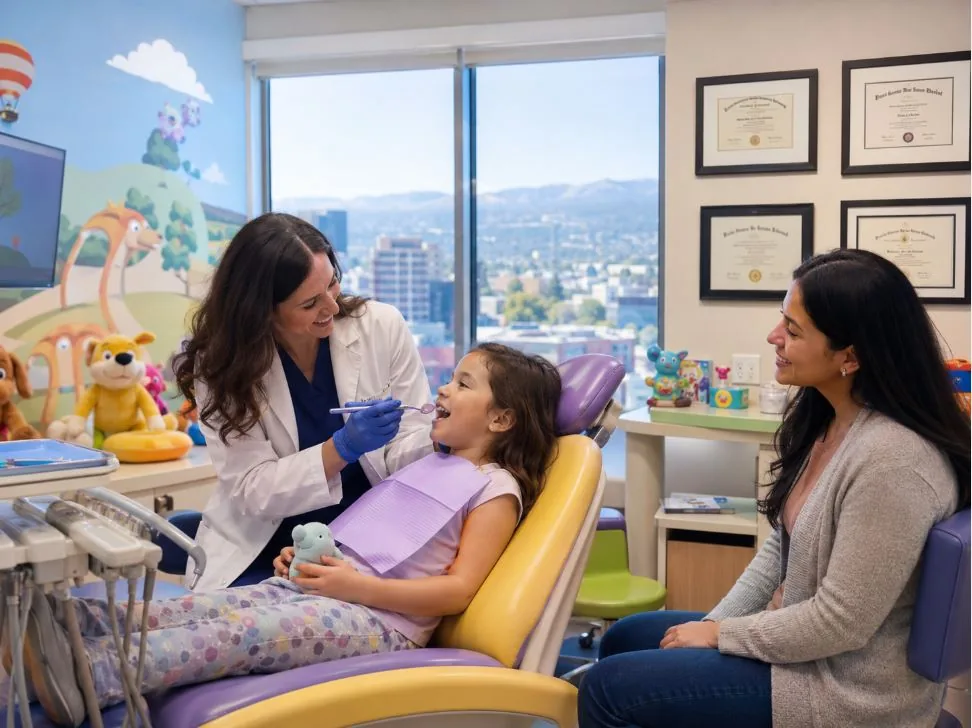
Search "pediatric dentist san jose" and the first page of Google looks like every clinic in Silicon Valley is the obvious choice — bright lobbies, "kid-friendly" banners, and identical promises about gentle care. The real San Jose market is more interesting: a heavily tech-employed family base with unusually strong dental insurance benefits, a high concentration of dual-income households comparing options carefully, and a meaningful price spread between premium West Valley and Cupertino-adjacent practices and equally credentialed offices in East San Jose, Berryessa, and the Almaden corridor. What "pediatric dentist" should actually mean in San Jose — and what a lot of parents don't know to look for — is concrete: a residency-trained pediatric dentist with verifiable credentials, ideally board-certified through the American Board of Pediatric Dentistry, with the full behavior-management spectrum from tell-show-do through hospital sedation when a case genuinely needs it.
Pediatric dentistry is its own ADA-recognized specialty, and a general dentist who is friendly with kids is not the same as a residency-trained pediatric dentist. That distinction is easy to miss because Bay Area family-dentistry marketing language often borrows the same vocabulary — "we love kids," "kid-friendly office," "specialized in pediatric care" — without the underlying credential. In a market as saturated and well-resourced as Silicon Valley, parents have the rare luxury of being able to hold out for the actual specialty credential without sacrificing convenience or wait times.
This guide is built for the San Jose parent doing real diligence. We cover what residency training actually involves, the credential framework localized to the Bay Area (UCSF School of Dentistry up the peninsula, Stanford-affiliated pediatric dental options), how the local provider landscape breaks down by sub-market, the AAPD age-1 first visit recommendation, the behavior management spectrum you should expect, real 2026 pricing across Silicon Valley premium and East San Jose value tiers, the Medi-Cal Dental (Denti-Cal) reality for families using the program, the consultation questions that surface quality, and the red flags that should make you walk out. No upsell, no manufactured urgency, no specific clinic ratings cited.
What "Pediatric Dentist" Actually Means in San Jose
The phrase gets used loosely in marketing across the South Bay, so it's worth setting a clean baseline. A genuine pediatric dentist in San Jose is not the general-dentistry office with the friendliest decor on Stevens Creek Boulevard. The real markers are a different set of things, and most are verifiable in two minutes through public directories.
American Board of Pediatric Dentistry (ABPD) certification — voluntary peer-reviewed certification beyond the basic California license. Roughly 65% of practicing pediatric dentists nationwide hold it; the Bay Area's rate runs slightly above that, partly because UCSF graduates pursue board certification at higher rates. Not having it does not automatically disqualify a provider, but having it is a real signal of additional case-quality scrutiny.
Hospital privileges and sedation depth — many board-certified pediatric dentists in the South Bay hold hospital privileges for OR-based cases, with hospital pediatric dentistry typically routing through Stanford Children's Health (Lucile Packard Children's Hospital in Palo Alto) for complex cases. Whether your child will ever need OR-based care depends on the case, but it is a useful capability to know exists.
Pricing transparency before any treatment — you should leave the consultation with a written, itemized fee schedule, not a sales pitch. Itemization matters in San Jose because the spread between Cupertino-adjacent premium offices and East San Jose value tier on the same restorative work routinely runs 30–40%.
None of these markers is a single make-or-break filter. The pattern matters more than any one item. A practice hitting all four in Berryessa or Evergreen is meaningfully different from one hitting one or two in a flashier address, regardless of which lobby looks more polished. For a curated shortlist, see Smyleee's Top 10 Best Pediatric Dentists in San Jose.
The Pediatric Dental Landscape in San Jose
San Jose is the third-largest city in California and the population center of Silicon Valley, with an unusually high share of tech-employed parents — Apple in Cupertino, Google's south-bay footprint, Adobe headquartered downtown, Cisco in north San Jose, and the long list of mid-cap and startup tech firms scattered through the corridor. The practical effect on pediatric dentistry is that the local family base skews toward dual-income, employer-sponsored PPO dental insurance with strong pediatric benefits, and parents who do real research before picking providers. Medicaid demand is genuinely lower here than in most other large California metros, but it is not zero — and the city has a substantial East San Jose, Alum Rock, and South County family base that relies on Medi-Cal Dental coverage.
The provider landscape splits into a few recognizable sub-markets:
If you are searching specifically for the "best pediatric dentist san jose" or simply a "kids dentist san jose" with a residency-trained provider, both Top 10 Pediatric Dentists in San Jose and Top 10 Kids Dentist in San Jose filter the list by credential signals rather than ad spend.
When to Bring Your Child for the First Visit
The American Academy of Pediatric Dentistry, the American Academy of Pediatrics, and the American Dental Association all converge on the same recommendation: a child's first dental visit should happen by age one, or within six months of the first tooth erupting — whichever comes first. Not when they have all their baby teeth. Not when they "can sit still." By age one. The pillar guide on your baby's first dental visit covers the framework in more detail; the local note for San Jose is that both Stanford Children's Health (Lucile Packard) and the major South Bay multi-doctor pediatric specialty groups have well-developed age-1 patient programs designed specifically for this kind of relationship-first first visit.
Parents are often surprised by how early age one is. The reasoning is not that a one-year-old needs a dental cleaning per se. It is that early-childhood caries — cavities in baby teeth — is the most common chronic disease of childhood, far more prevalent than asthma, and the patterns that lead to it are set in the first 12-18 months of life. Bottle-to-bed habits, breastfeeding-to-sleep patterns, fluoride exposure, oral hygiene routines, and risk assessment all happen better at age one than at age three when the first cavity is already showing up on a bitewing.
The first visit is mostly a relationship visit. The dentist counts teeth, looks at the eruption pattern, talks with the parent about feeding habits and home care, and gets the child comfortable being in the chair before there is anything anxiety-producing happening. By the time the kid actually needs a filling at age four or five, they have already been there several times and the office is familiar territory. That is the entire point of starting early — and in a market like San Jose where appointment availability at top specialty offices can run several months out, getting your child into the system early also locks in scheduling flexibility for the years ahead.
Behavior Management: What Should Be on the Menu
The single biggest difference between a residency-trained pediatric dentist and a general dentist seeing children is behavior management. Pediatric residency dedicates substantial time to a layered set of techniques that match the child's age, anxiety level, and case complexity. A San Jose practice should be comfortable across most of these tiers, not stuck at the simplest one. Both Stanford Children's Health and the major Bay Area pediatric specialty groups are full-spectrum from tell-show-do through OR-based general anesthesia.
You will not need every tier for every kid. Most San Jose children will only ever experience tiers 1 and 2 across their entire pediatric dental experience. But the practice you choose should be comfortable across the full spectrum, because the moment your kid actually needs something beyond tell-show-do is the worst time to discover that the practice doesn't offer it and you're starting from scratch with a new provider.
What Pediatric Dental Care Actually Costs in San Jose, 2026
Pricing varies meaningfully by sub-market, by provider tier, by case complexity, and by whether your child has dental insurance, Medi-Cal Dental, or no coverage. Here is the realistic 2026 San Jose range across common services, broken into the East San Jose / Berryessa value tier and the Cupertino-adjacent / West Valley premium tier. These are out-of-pocket numbers before insurance contribution.
| Service | East SJ / Berryessa / Almaden Value | Cupertino / West Valley Premium |
|---|---|---|
| First-visit (age 1) consultation | $80 – $160 | $120 – $220 |
| Cleaning + exam (routine recall visit) | $100 – $200 | $160 – $280 |
| Bitewing X-rays (set of 2) | $60 – $130 | $90 – $180 |
| Fluoride varnish application | $30 – $65 | $45 – $90 |
| Dental sealant (per tooth) | $45 – $85 | $65 – $120 |
| Composite filling (per tooth) | $200 – $380 | $350 – $550 |
| Stainless-steel crown (primary molar) | $300 – $500 | $400 – $600 |
| Pulpotomy (baby root canal) | $220 – $420 | $320 – $550 |
| Primary tooth extraction | $120 – $260 | $180 – $380 |
| Nitrous oxide (per session) | $60 – $130 | $90 – $180 |
| Oral conscious sedation | $220 – $480 | $350 – $650 |
| IV sedation (in-office) | $650 – $1,200 | $900 – $1,800 |
| Hospital OR / general anesthesia | $1,800 – $4,500+ | $2,500 – $6,000+ |
The clinical work is essentially identical at both ends of the price spread. A composite filling placed by an ABPD board-certified pediatric dentist in Evergreen is the same composite filling, with the same materials, placed by an equally-credentialed provider in Cupertino — the geography, commercial rent, and case-mix loading set the price, not the clinical outcome. The same pattern holds across the rest of the menu.
The high end of the West Valley premium tier overlaps meaningfully with San Francisco peninsula pricing, which is in turn one of the highest pediatric pricing tiers in the country. If you are West Valley-anchored and the quotes feel high, a single drive to Almaden, Cambrian, or East San Jose for a second consult typically surfaces a 25–35% lower itemized total at a comparably trained provider.
Insurance, Medi-Cal Dental, and HSA/FSA Reality
Pediatric dental coverage is meaningfully better than adult dental coverage in the U.S., which is good news for San Jose families because tech-employer-sponsored plans typically include comprehensive pediatric benefits and California's Medicaid program covers pediatric dental for eligible families through age 20.
Private dental insurance — Bay Area carrier mix
The most common dental carriers in the San Jose employer mix are Delta Dental of California (the dominant carrier for many large tech employers and the UC system), Cigna, MetLife, Aetna, Guardian, Anthem Blue Cross of California, and Kaiser Permanente Dental (HMO model with restricted provider network). Most family dental plans include comprehensive pediatric coverage with no deductible for preventive services and 50–80% coverage on basic restorative work. Pediatric annual maximums are typically the same as adult ($1,500–2,500 in Bay Area employer plans) but used differently — kids hit the max less often because their procedures are smaller and more preventive-skewed. Sealants and fluoride are commonly fully covered as preventive.
Medi-Cal Dental (Denti-Cal) for San Jose families
California's Medicaid dental program — branded Medi-Cal Dental, historically called Denti-Cal — provides comprehensive pediatric dental coverage for eligible children ages 0–20 through the EPSDT (Early and Periodic Screening, Diagnostic, and Treatment) benefit. Covered services include cleanings, fluoride, sealants, fillings, stainless-steel crowns, pulpotomies, extractions, and (when medically necessary) sedation. The program has been substantially modernized over the past decade with rate increases that improved provider acceptance.
HSA and FSA dollars — pediatric dental care (preventive, restorative, sedation, ortho) is fully eligible for Health Savings Account and Flexible Spending Account spending. For Bay Area families on high-deductible health plans, this is meaningful tax savings — California's 9.3–13.3% state income tax on top of federal means HSA-funded pediatric dental can effectively lower the all-in cost by roughly 30–40% for households in the higher Bay Area marginal brackets.
How to Find a Top Pediatric Dentist in San Jose
Knowing the price spread, the credential framework, and the sub-market split is half the battle. The other half is running a disciplined comparison process across the South Bay. Here's the playbook.
Five Questions to Ask Before You Pick a Practice
These questions move the conversation past the lobby decor and into actual clinical depth. A confident San Jose provider welcomes them; a less-confident one finds them inconvenient.
Red Flags That Should Stop You in San Jose
The Bay Area pediatric dental market has a few well-known traps. Most are easy to spot once you know what they are.
Aggressive treatment plans on first visits — a recommendation for stainless-steel crowns on multiple primary molars at a first cleaning visit is an outlier that warrants a second opinion. Some kids genuinely do need extensive early-childhood-caries treatment. But a same-day, full-quadrant treatment plan presented without imaging, monitoring options, or staged-care alternatives is sales-driven, not clinical-driven. This pattern shows up disproportionately at high-volume practices billing heavily to Medi-Cal — and several DOJ and state-level Medicaid Fraud Control Unit settlements over the past decade have specifically targeted chains running this pattern. Search "[clinic name] Medicaid fraud" or "[clinic name] DOJ settlement" before committing.
"Free first visit" with high-pressure same-day treatment — the free consultation is the funnel. The high-pressure same-day plan is the upsell. Pediatric dentistry is a multi-year relationship; there is no clinical reason to commit on the first visit, especially in a market as provider-dense as San Jose where second opinions are easy to schedule.
Refusal to share credentials or board-certification status on request — you should be able to verify that whoever is treating your child is a residency-trained pediatric dentist and ideally ABPD board-certified. The AAPD, ABPD, and California Dental Board all maintain public verification tools. Refusal to share is disqualifying.
Sedation provided by anyone other than the pediatric dentist or a credentialed dental anesthesiologist — pediatric sedation has specific safety requirements. The American Academy of Pediatrics and AAPD have published joint sedation safety guidelines covering pre-sedation assessment, monitoring, recovery protocols, and rescue equipment. A San Jose practice using sedation should follow them publicly and transparently.
"This Cupertino price is only good if you commit today" pressure — comprehensive pediatric restorative cases, especially those involving sedation, are not impulse purchases. Any provider pressuring same-day commitment in the Bay Area is using a sales tactic, not a clinical one.
Related Reading and Cross-City Context
If you're comparing San Jose pediatric pricing or credential depth to other major U.S. metros — particularly if you have family in another city or you're considering a cross-country move — our companion guides are useful. New York runs roughly comparable to the West Valley premium tier; see our pediatric dentist New York guide and the Brooklyn-specific guide. Florida pricing runs 25–35% below the Bay Area; see our Miami pediatric dentist guide. For context on lower-cost Sun Belt markets, see Charlotte and Chandler, Arizona. For California-context elsewhere in the state, see our San Diego pediatric dentist guide.
For specific situations — your baby's first dental visit, a child with special healthcare needs, or finding a pediatric practice that takes Medi-Cal Dental — we publish dedicated guides on your baby's first dental visit, choosing a pediatric dentist for a child with special needs, and finding a pediatric dentist who accepts Medicaid and CHIP. The full national credential framework lives in our pediatric dentist pillar guide.
When the Cheaper San Jose Option Is Actually More Expensive
The math on pediatric dentistry gets counter-intuitive when you stretch the time horizon. A bait-priced full-mouth treatment plan from a corporate chain that ends in poorly-placed stainless-steel crowns, mismanaged behavior on a sedation case, or a child who now refuses to enter a dental office for the next decade costs you the original number plus the second-opinion redo plus the years of avoidance and decay buildup that follow. A properly-planned restorative case at an ABPD-certified specialty office in Almaden or Berryessa, with a real recall cadence, age-appropriate behavior management, and a transparent fee schedule, costs more on the day but vastly less over the arc of childhood.
The variables that genuinely affect long-term success — residency-level training, board certification on complex cases, full behavior-management menu, transparent fee schedules, and the practice's willingness to use the same restorative protocols whether the family pays cash, PPO, or Medi-Cal — are not where to cut corners. The variables that don't affect outcomes — Stevens Creek Boulevard rent, lobby finishes, premium marketing — are where the real San Jose savings live.
Done well, a top pediatric dentist in San Jose working out of Berryessa, Evergreen, or Almaden delivers the same clinical outcome as the West Valley premium concierge practice, just without the Cupertino markup. That's the version of "best pediatric dentist san jose" worth searching for — not the most-advertised number, but the residency-trained, ABPD-certified specialist whose overhead and case philosophy match what your kid actually needs over the next 18 years.
Final Thoughts
San Jose is one of the better U.S. markets to find a high-credentials pediatric dentist if you do real diligence. The combination of UCSF's residency pipeline up the peninsula, Stanford Children's Health as the regional hospital pediatric dental hub, an unusually deep employer-sponsored insurance base, and a heavily comparison-shopping family demographic produces a market where credential transparency genuinely exists for parents willing to make a few phone calls and read a few directories. The trade-off is saturation — the West Valley specifically is one of the higher-priced pediatric tiers in the country, and it can take a meaningful drive across town to find the same clinical work at a 30% lower number.
If you're looking for a "kids dentist san jose" or "pediatric dentist accepting medi-cal" path that holds up over the long arc of your child's care, the framework is consistent: get two itemized quotes from across sub-markets; verify the pediatric dentist's California license, residency school, and ABPD status; ask the five consultation questions; insist on the full behavior-management menu being available even if your child won't need it today; and don't sign at the first visit. The dental relationships your kid forms over the next few years set patterns that hold for decades — kids who experience competent, calm, age-appropriate dental care grow into adults who keep their checkup appointments. Kids who experience the opposite grow into adults who avoid dentists for years.
The cartoon mural in the lobby is nice. It is not the thing that matters. The residency-trained specialist with a transparent fee schedule, the full sedation menu, and the willingness to walk you through every option is the version of "pediatric dentist san jose" worth picking — and the Bay Area has more of those than almost any other U.S. metro, if you're willing to look past the first page of search results.
Find a Residency-Trained Pediatric Dentist in San Jose
Browse Smyleee's curated, credentials-vetted San Jose pediatric directory — with board-certification flags, sedation-capability markers, Medi-Cal Dental acceptance, and aggregate parent ratings.
Sources & References
- American Academy of Pediatric Dentistry — Patient Resources & Provider Standards
- American Board of Pediatric Dentistry — Board Certification Standards
- American Academy of Pediatrics — Oral Health Resources
- Dental Board of California — License Verification
- UCSF School of Dentistry — Patient Care & Pediatric Clinic
- Stanford Children's Health (Lucile Packard Children's Hospital) — Pediatric Dental Program
- Centers for Disease Control and Prevention — Children's Oral Health Data
- Medi-Cal Dental (Denti-Cal) — California Pediatric Dental Coverage
- Medicaid.gov — Pediatric Dental Coverage Under EPSDT
- American Dental Association Health Policy Institute — Pediatric Cost & Access Data
- IRS Publication 502 — Medical and Dental Expenses (HSA / FSA Eligibility)