
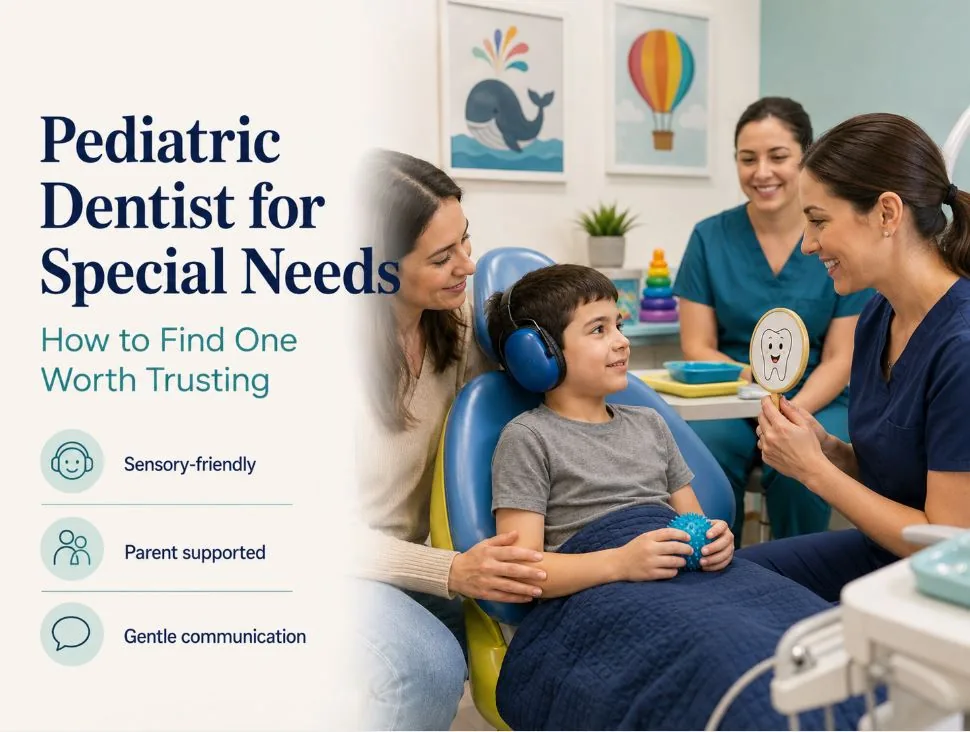
If your child has autism, Down syndrome, cerebral palsy, a sensory processing difference, a complex medical history, or significant dental anxiety, you already know that "find a pediatric dentist near me" is a search that doesn't quite fit. Pediatric dental capability for special-needs families is a specific cluster of training, accommodations, and clinical infrastructure — not a vibe in the lobby — and the practices that genuinely have it are not always the ones marketing themselves the loudest. The post you're reading lays out what to actually look for, what to ask, and how to tell the difference between a practice that says it welcomes special-needs patients and one that's truly equipped to treat them.
The hardest part isn't usually the dental work itself. It's everything around the dental work — the unfamiliar room, the bright overhead light, the sound of suction, the latex glove smell, the stranger leaning into a child's personal space. For a neurotypical child without significant anxiety, those things are mildly novel. For a child with sensory processing differences, severe anxiety, or a developmental disability, they can be a five-alarm fire that ends the appointment before it begins. A pediatric dentist trained in special healthcare needs knows this and builds the visit around it. A pediatric dentist who isn't simply tries to push the same standard appointment harder until something gives.
This guide is written for the parent who's been to one or two visits that didn't go well, who's been told their child is "uncooperative" by a practice that wasn't equipped to do the work, or who's about to schedule a first visit and wants to get the right practice on the first try instead of the third. We walk through what special-needs pediatric dentistry actually involves, why residency training matters here more than anywhere else in pediatric care, the behavior-management spectrum and where sedation and hospital dentistry fit, the five questions that surface a practice's real capability, the practical accommodations to look for, and how Medicaid, CHIP, and private insurance handle the higher-acuity care that some families need.
What Special-Needs Pediatric Dentistry Actually Covers
"Special needs" in a pediatric dental context is a wide tent. It includes children on the autism spectrum, children with intellectual or developmental disabilities, children with neurological conditions like cerebral palsy or epilepsy, children with chromosomal differences such as Down syndrome, children with sensory processing differences, children with severe anxiety regardless of diagnosis, and children who are medically complex — kids with a G-tube, a tracheostomy, ventilator dependence, congenital heart disease, immunocompromise, or rare genetic conditions where dental work has to be coordinated with the rest of their medical care.
A practice that can serve this whole range is doing meaningfully more than the standard pediatric clinic. The clinical and operational pieces look something like this:
Sensory accommodation
Quieter rooms or quiet appointment slots, dimmable lights, the option to turn off overhead music, weighted blankets, sunglasses for the patient, noise-reducing headphones, the ability to play familiar audio or video on a tablet, the option to skip the standard prophy ("polishing") if the texture or noise is intolerable, and a willingness to start with the smallest possible exam and build up across visits rather than insisting on a full standard cleaning at the first appointment.
Communication supports
Visual schedules so the child can see what's coming next, social stories distributed before the visit so families can preview the experience at home, picture cards or AAC (augmentative and alternative communication) device support for non-speaking patients, plain-language scripts that match the child's receptive language level, and a clinical staff that knows how to address the child directly rather than only speaking to the parent.
Behavior management beyond standard tell-show-do
Tell-show-do (TSD) is the foundation of all pediatric behavior management, but a special-needs-equipped practice doesn't stop there. Pre-visit desensitization appointments, where the child comes in just to sit in the chair without any clinical work happening, are standard. Stepwise exposure across multiple short visits before any restorative work begins is common. Knee-to-knee exam positioning for younger children or older children who feel safer with a parent's body contact is offered routinely.
Sedation when chair-side care isn't possible
Some children, with or without sedation, simply cannot tolerate a chair-side visit safely or productively. A practice equipped for special needs has a layered sedation menu — nitrous oxide if the child can tolerate the nasal mask, oral conscious sedation for moderate cases, IV sedation in-office or in a surgery center for deeper cases, and general anesthesia in a hospital OR for the most complex situations. Importantly, the same practice can usually offer all of these or has tight referral relationships with the providers who do.
Coordination with the medical team
Children with congenital heart disease may need antibiotic prophylaxis before invasive dental work. Children on certain seizure medications have specific oral health considerations. Children with Down syndrome have higher rates of periodontal disease and specific anatomic features that affect treatment. Children with G-tubes, central lines, or ventilator support require pre-procedural medical coordination. A special-needs-fluent pediatric dentist routinely communicates with the child's pediatrician, neurologist, cardiologist, geneticist, or specialist team, rather than treating the dental visit as an isolated event.
Residency-Trained Pediatric Dentists vs General Practice for Special Needs
This is the credential question that matters most for special-needs families. Pediatric dentistry is a recognized ADA specialty with its own 24-to-36-month accredited residency. That residency includes specific, structured training in the treatment of patients with special healthcare needs — sedation pharmacology and protocols, behavior management for non-verbal patients, hospital dentistry under general anesthesia, accommodation strategies for sensory and developmental differences, and coordination with the patient's medical team. None of this is in standard general-dentistry curriculum at the same depth.
A general dentist who's friendly with kids and willing to "try" with a special-needs child is not an equivalent provider. The general dentist may be excellent at routine adult restorative work and reasonable at neurotypical pediatric care, but the depth of training for an autistic seven-year-old who's non-speaking and has a strong sensory aversion to dental tools, or a fifteen-year-old with severe cerebral palsy who needs a full-mouth restoration under general anesthesia, isn't there. The mismatch shows up most painfully in the cases that need it most.
For most special-needs pediatric dental cases — autism spectrum, intellectual disability, significant medical complexity, severe anxiety, sedation-required care, hospital dentistry — a residency-trained pediatric dentist is the standard of care. Ideally one who is board-certified through the American Board of Pediatric Dentistry (ABPD) and ideally one with documented case volume in the type of special-needs care your child requires.
Hospital privileges matter for any family whose child may eventually need treatment under general anesthesia. A pediatric dentist with hospital privileges can do a full-mouth case in the OR setting; one without privileges has to refer out, which means a different dentist your child has never met will be doing the work. For long-term care, the practice that holds privileges in a children's hospital nearby is meaningfully more flexible.
"Special care dentistry" fellowship is a separate, post-residency fellowship some pediatric dentists complete specifically to deepen their training in patients with developmental disabilities and medical complexity. It is not common, but if you find a practice where the dentist holds this fellowship, the depth signal is real.
The Behavior Management Spectrum, Applied to Special Needs
The pediatric behavior management framework runs as a layered spectrum, and a special-needs-equipped practice is comfortable across the full range. The right approach is the lightest one that works for the specific patient on the specific day. A practice that defaults to sedation for every special-needs child is overusing sedation; a practice that refuses to consider sedation at all is underusing it. The right answer is calibrated.
The single most important word in this list is "calibrated." A good special-needs pediatric dentist starts at the lowest tier that's likely to work and escalates only if needed, with parent input at each step. A practice that pushes immediate IV sedation or GA on every special-needs child without first attempting desensitization is overusing the most intensive options and missing the cases where Tiers 1-3 would have worked. The reverse mistake — refusing to consider sedation when it's clearly needed — is rarer but happens, usually at practices not equipped to deliver it.
Five Questions to Ask Before Picking a Special-Needs Pediatric Practice
The practice's answers to these five questions surface real capability versus marketing language. Ask all five, and listen for specifics rather than reassurance.
Practical Accommodations to Look For
Beyond the credential and the workflow questions, the practice's day-to-day accommodations are what determine whether the visit goes well or doesn't. Some of these will be on the practice's website; many will only show up when you ask. They should be available without negotiation.
- Quiet appointment slots — the first slot of the morning before the waiting room fills, or the last slot of the day after it empties. Reduces sensory load substantially for a child who finds crowds and noise overwhelming.
- No waiting-room time — the child is taken directly back to the operatory on arrival. The waiting room is often the worst part of the visit for a sensory-sensitive child.
- Sensory tools available — weighted blankets or lap pads, sunglasses for the overhead light, noise-reducing headphones, fidgets, the option to play familiar audio or video on a tablet during the visit.
- Dim or adjustable lighting — many operatories have intensity-adjustable overhead lights now. The dentist should be willing to use the minimum needed.
- Parent in the treatment room — this should be the default for special-needs cases, not an exception. A practice that requires the parent to wait outside for special-needs visits is operating on an outdated model.
- Permission to skip standard cleanings if intolerable — if your child cannot tolerate the polishing step, the dentist should be willing to do a hand-scaling exam, fluoride application, and skip the prophy that visit. Forcing the standard cleaning is counterproductive.
- Flexibility on visit length — some special-needs visits run very short (10 minutes for a fast exam and out) and some run long (45 minutes of slow desensitization for a single restoration). The practice schedule should accommodate both.
- Continuity of staff — the same dental assistant whenever possible. Familiarity matters for a child with autism or developmental disability; rotating new faces every visit increases stress.
- Distraction options — overhead TV, tablet with the child's preferred content, music, or whatever is the established calming input for that child. Bring-your-own is fine; the practice should welcome it.
None of these are exotic asks. A practice that handles meaningful volume of special-needs patients has them in the routine. A practice that doesn't, won't.
Hospital Dentistry and General Anesthesia
For some children, chair-side care is genuinely not feasible even with sedation. A non-verbal child with significant developmental disability and a mouth full of cavities cannot be productively treated across a series of in-chair visits. A medically complex child with a high airway risk cannot safely undergo office-based IV sedation. A child with severe behavioral barriers who has not responded to extended desensitization is not going to start responding on the day of a five-tooth restorative case. For these cases, hospital dentistry under general anesthesia is the appropriate path — not the "last resort" that some marketing language frames it as, but the right tool for the case.
The setup is straightforward in principle. The pediatric dentist holds hospital privileges. The case is scheduled in a hospital operating room. A pediatric anesthesiologist manages the airway and the anesthetic. The pediatric dentist performs the dental work — typically a full-mouth treatment plan completed in a single sitting because the patient is asleep, including cleanings, X-rays, sealants, fillings, crowns, pulpotomies, and any extractions needed. The child wakes up in recovery, goes home the same day in most cases, and the entire treatment plan is done.
Costs in 2026 for a hospital GA case typically run $1,500-$5,000+ for the OR fee and facility, plus the anesthesiologist's fee, plus the dentist's professional fee (which is usually billed separately and at a different rate from in-office work). The total all-in is meaningful, but for medically necessary cases — which most special-needs hospital dentistry is — Medicaid, CHIP, and most private insurance cover the work substantially when the medical necessity is documented.
Insurance, Medicaid, and CHIP for Special-Needs Pediatric Dental
Coverage for special-needs pediatric dental care is generally better than coverage for routine pediatric dental care, because the medical necessity documentation is more robust. This counter-intuitive fact is worth understanding.
Medicaid and CHIP
Every state Medicaid program covers comprehensive pediatric dental services through EPSDT (Early and Periodic Screening, Diagnostic, and Treatment) for children under 21. EPSDT explicitly covers sedation and hospital dentistry when documented as medically necessary, which for special-needs cases is usually straightforward to document. CHIP coverage in most states mirrors Medicaid scope. Practically, the family-cost burden for a Medicaid-covered hospital GA case for a special-needs child is often near zero, even when the gross cost is several thousand dollars. The harder problem is finding a participating pediatric dentist with hospital privileges; the coverage itself is generally there.
Private dental insurance
Most private pediatric dental plans cover sedation and hospital dentistry when documented as medically necessary, though the documentation requirements vary by carrier. Coverage usually splits between the medical plan (for the OR facility and anesthesia) and the dental plan (for the dental work itself), which means two separate claims with two separate documentation packages. The practice's office staff should handle the coordination; if they don't, that's a workflow gap worth knowing about.
ABLE accounts
For children eligible as disability beneficiaries, ABLE (Achieving a Better Life Experience) accounts can be used to pay for qualified disability expenses, which include dental care directly related to the disability. Contributions are tax-advantaged (similar to HSA structure) and the account doesn't count against SSI asset limits up to certain thresholds. For families with significant out-of-pocket dental expenses for a disabled child, ABLE accounts are worth understanding alongside the standard insurance pathway.
Smyleee's directory flags pediatric practices that specifically accept Medicaid and CHIP, hold hospital privileges, and treat meaningful special-needs volume — so the search starts narrower instead of dialing dozens of practices to check basic capability.
Red Flags to Watch For
The pediatric dental market has specific failure modes that hit special-needs families harder than they hit neurotypical families. Most are easy to spot once you know what they look like.
Refusal to allow a parent in the treatment room for special-needs cases — some practices still operate on the older "separate the child at the door" model. For special-needs cases, this is a hard mismatch. A non-verbal child cannot communicate distress to a stranger; a child with sensory differences can be calmed by a familiar adult's presence. A practice that requires parent separation for special-needs visits is operating on a workflow that doesn't fit the population.
Pushing immediate sedation or GA without trying desensitization first — the inverse mistake. Some practices, particularly chains that are paid more for sedation cases, default to recommending sedation or hospital GA at the first visit before any attempt at chair-side desensitization. A residency-trained pediatric dentist starts at Tier 1 and escalates as needed; a practice that jumps to Tier 5 or 6 immediately is over-treating and overbilling.
Vague or evasive answers about specific accommodations — when you ask "what sensory accommodations do you offer" and the answer is a generic "we work with all our patients," the practice doesn't have a real workflow. A capable practice can name the specific accommodations as a list, because they're standardized.
No coordination with medical team for medically complex children — a practice that won't call your child's pediatrician or specialist before doing sedation work on a medically complex child is taking on more risk than it should. The pre-procedural medical clearance conversation is standard for these cases; refusing it is disqualifying.
"Special needs" branding without named pediatric dentist credentials — corporate chains sometimes market "special-needs friendly" locations without a residency-trained pediatric dentist actually on staff. You should know the name and credentials of the dentist treating your child before scheduling. "We have specialists who rotate through" is not enough information.
Resources for Parents
Several national organizations maintain solid, parent-facing resources for special-needs pediatric dental care. These are worth bookmarking before, during, and after the search for the right practice.
- American Academy of Pediatric Dentistry (AAPD) — maintains a "Find a Pediatric Dentist" tool that lets you filter by special-needs experience, plus a published clinical practice guideline on management of dental patients with special healthcare needs.
- NIDCR (National Institute of Dental and Craniofacial Research) — publishes "Practical Oral Care for People With Developmental Disabilities," a free resource series with condition-specific guidance for parents and caregivers.
- Autism Speaks dental tool kit — free downloadable visual schedules, social stories, and parent guides specifically built for autism-spectrum patients preparing for a dental visit.
- Special Olympics Special Smiles — provides free dental screenings at Special Olympics events and maintains a network of providers experienced with athletes who have intellectual disabilities.
- Parent Training and Information Centers (PTI) — every state has a federally funded PTI center that maintains local provider networks for medical and dental care for children with disabilities.
- State Title V Children with Special Health Care Needs programs — every state runs a CSHCN program with case managers who can help families navigate dental care alongside the rest of their child's care.
How Smyleee Helps Special-Needs Families Find the Right Practice
Smyleee maintains city-level Top 10 pediatric dentistry rankings for major U.S. metros, with clinics vetted on credential signals (residency training, ABPD certification), case-volume markers, sedation capability, special-needs accommodation, and aggregate parent feedback. Each entry flags whether the practice handles meaningful special-needs volume, offers the full sedation spectrum, and accepts Medicaid/CHIP — the three filters that matter most to a special-needs family.
Useful starting points if you want a curated shortlist instead of working through general Google search results:
- Top 10 Pediatric Dentists in New York City
- Top 10 Pediatric Dentists in Brooklyn
- Top 10 Pediatric Dentists in San Jose
- Top 10 Pediatric Dentists in San Diego
- Top 10 Pediatric Dentists in Miami
- Top 10 Pediatric Dentists in Charlotte
- Top 10 Pediatric Dentists in Chandler
For the broader pediatric framework — credentials, behavior management, costs, the full pediatric dental landscape — see the main pediatric dentist guide. For families navigating Medicaid or CHIP coverage specifically, the guide to pediatric dentists who accept Medicaid and CHIP covers the access landscape state by state. For families just starting out with a young child, the first-dental-visit-by-age-one guide covers what to expect at the first appointment.
Final Thoughts
The right pediatric dental practice transforms what families remember as a months-long ordeal into a routine, manageable visit. We hear this from special-needs families repeatedly: the difference between a practice that's set up for the work and one that isn't is night-and-day. The same child who melted down at three failed appointments at a non-equipped practice will sit calmly through a full exam at a practice that runs the right workflow — quiet slot, parent in the room, dim light, headphones, slow start, no surprises.
The search is harder than it should be. Marketing language doesn't reliably reveal capability, and the practices that do this work well are not always the ones marketing themselves the loudest. The questions in this guide are designed to surface real workflow versus reassurance. Ask them, listen carefully to the specifics, and move on if the answers feel improvised. The practice you find will be your child's dental home for years — possibly all the way through their teens — and the time spent finding the right one pays back across every visit afterward.
None of this is about lowering standards. Children with special healthcare needs deserve the same quality of dental care as any other child, delivered through the accommodations and clinical depth their case requires. The practices that genuinely understand that are out there. They're worth the time it takes to find them.
Find a Pediatric Dentist Equipped for Special Needs
Browse Smyleee's curated, credentials-vetted directory of pediatric dentists across the U.S. — with special-needs capability flags, sedation-spectrum markers, hospital-privilege status, and Medicaid/CHIP acceptance.
Sources & References
- American Academy of Pediatric Dentistry — Clinical Practice Guideline on Management of Dental Patients with Special Health Care Needs
- American Dental Association — Special Care Dentistry Resources
- American Academy of Pediatrics — Children with Disabilities & Oral Health
- CDC — Developmental Disabilities Prevalence Data
- NIDCR — Practical Oral Care for People With Developmental Disabilities
- Medicaid.gov — EPSDT and Pediatric Dental Coverage
- American Board of Pediatric Dentistry — Board Certification Standards
- Autism Speaks — Dental Guide and Visual Tools
- ABLE National Resource Center — ABLE Account Eligibility and Use
- Special Olympics Special Smiles — Free Screenings and Provider Network