
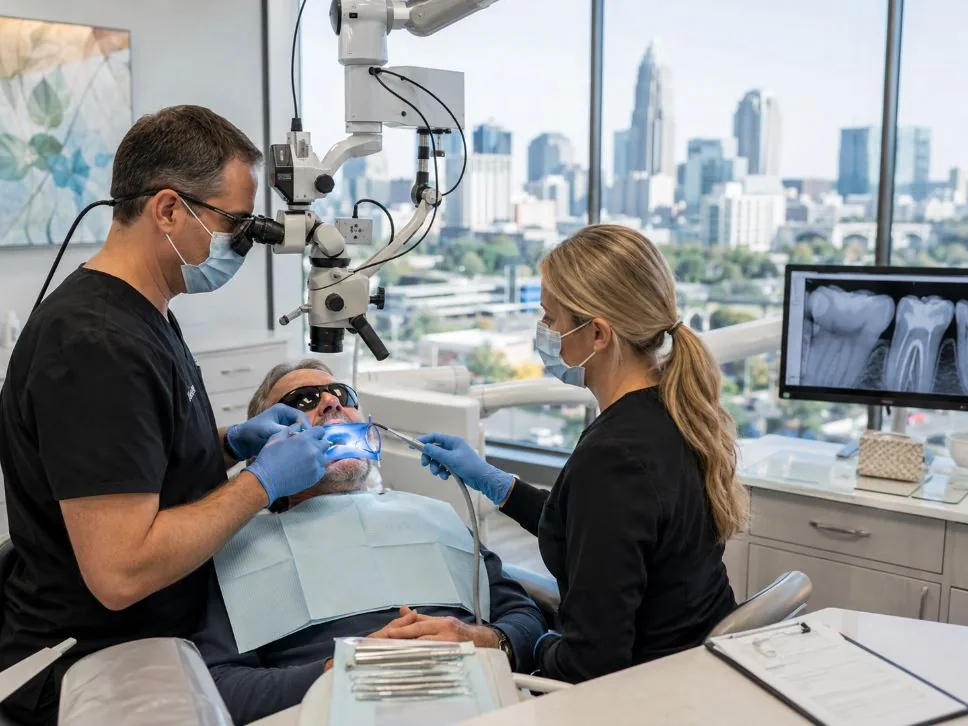
Charlotte is a mid-tier endodontic market with stronger clinical talent than its size would predict, fed by two North Carolina dental schools — the UNC Adams School of Dentistry in Chapel Hill and the ECU School of Dental Medicine in Greenville — and supported by the two large hospital systems anchoring the metro, Atrium Health and Novant Health. What that adds up to is a root canal market with proper specialist depth, mid-tier U.S. pricing, and meaningfully shorter waiting times for an endodontist consultation than Miami, NYC, or LA — without the corresponding quality compromise that "less expensive" suggests in many markets. A molar root canal that runs $2,200–$2,800 at a Manhattan endodontist commonly lands at $1,400–$1,900 at a comparably credentialed Charlotte specialist running the same microscope-and-CBCT workflow.
This guide walks through what a root canal charlotte nc patient should actually expect — when an endodontist matters versus when a competent general dentist is fine, the local specialist landscape across SouthPark, Ballantyne, Dilworth, Uptown, NoDa, Matthews, Concord, and Huntersville, the realistic 2026 cost ranges, what insurance and financing actually cover, and the red flags worth walking away from. The goal is to give you the language and questions to evaluate any "endodontist charlotte" claim on the merits, not on the marketing.
One piece of context worth setting up front. Charlotte itself does not have an in-city dental school. UNC Chapel Hill is roughly 2 hours northeast; ECU is roughly 3 hours east in Greenville. Both run accredited endodontic residency programs that produce most of the specialist talent practicing in the metro, and both feed graduates into Charlotte private practices in steady numbers. The clinical training baseline is strong; what's different from Miami or NYC is local market dynamics — lower overhead, a more value-conscious clientele, less marketing intensity, and a specialist supply that has expanded alongside the metro's population growth rather than lagging it. For a patient who wants a microscope-driven, CBCT-supported endodontic workflow without the New York or LA price ceiling, Charlotte is one of the better Sunbelt markets in which to have a root canal done.
What a Root Canal Actually Is, Quickly
A root canal — what dentists call endodontic treatment — removes infected or inflamed pulp tissue from inside a tooth, disinfects the canal system that runs from the crown down through the roots, and seals the space against bacterial re-entry. The procedure preserves the tooth's external structure (the part you chew with) by removing the source of infection inside it. Most root-canaled teeth, properly restored with a crown afterward, function for decades.
Once bacterial infection reaches the pulp, the inflammation has nowhere to drain. Unlike an infection in soft tissue elsewhere in the body, a pulpal infection is enclosed in hard tissue (dentin and enamel) on all sides. Pressure builds, blood supply is compromised, the pulp tissue dies, and the infection then progresses through the root tip into surrounding bone, where it produces an abscess. This is why deep cavities cause severe throbbing pain, and why an untreated pulp infection becomes a serious medical issue. Root canal treatment resolves the source.
For the broader clinical context — the procedure step by step, modern success rates, the science vs. the myths — our pillar guide on root canal treatment covers everything in detail. This post focuses specifically on what a Charlotte patient navigating the local specialist landscape needs to know.
Endodontist or General Dentist in Charlotte?
Both can perform root canals legally in North Carolina, and both do. The decision should depend on case complexity, your specific tooth, and the dentist's experience with similar work. Charlotte has unusually clear specialist supply for a metro of its size — endodontist density per capita sits roughly at the national average, with concentration in SouthPark, Ballantyne, and Uptown — so referral pathways are short and consultation waits are typically a week or two rather than a month or more.
| Best fit for general dentist | Best fit for endodontist (specialist) |
|---|---|
| Single-canal anterior teeth | Multi-canal molars (especially upper second molars) |
| Straightforward premolars on a healthy patient | Curved, calcified, or unusual canal anatomy |
| Routine cases without complicating findings | Retreatment of a previously failed root canal |
| Patients without significant medical complexity | Surgical apicoectomy (root-end surgery) |
| Cases your general dentist specifically does well | Trauma cases, hot teeth, sedation requirements |
Long-term outcome studies in the Journal of Endodontics and Cochrane Reviews consistently show small but measurable advantages for endodontist-treated cases on complex teeth — primarily because endodontists operate exclusively under microscopes, use specialty-tier instrumentation, and see complex cases in volume. For straightforward single-canal cases, outcomes are similar. The question to ask your Charlotte general dentist is not "can you do this," it's "given the specific anatomy and complexity of my tooth, would you refer it to an endodontist if it were yours?" An honest provider answers that question accurately.
The Endodontic Landscape Across Charlotte
Charlotte's endodontic provider density is solid — well distributed across the metro and growing fastest in the SouthPark, Ballantyne, and northern suburb (Huntersville, Cornelius) corridors. The provider mix splits into roughly three tiers: a SouthPark-anchored upmarket specialist tier, a strong Dilworth / Uptown / Ballantyne mid-upper tier, and a value-tier suburban pool across Matthews, Concord, NoDa, and the outer ring. Quality variance does not track price one-to-one. A Matthews or Concord general dentist with strong endodontic continuing education, a microscope, and a working CBCT referral relationship routinely produces outcomes that hold up against a SouthPark concierge specialist charging 30–40% more on a routine case.
Charlotte's endodontic market also benefits from the proximity of two major hospital systems. Atrium Health (anchored by Carolinas Medical Center in Dilworth) and Novant Health (anchored by Presbyterian Medical Center in Elizabeth) both run dental and oral-surgery referral relationships with local specialty practices, and both handle hospital-based cases requiring sedation, medical complexity, or post-operative monitoring. This matters for a small subset of patients — medically compromised, severely anxious, or pediatric — but it's a structural strength of the Charlotte market that smaller metros don't have.
Ballantyne — newer-development upmarket corridor in south Charlotte, family-oriented affluent clientele, growing residency-trained specialist pool. Molar root canal $1,400–$1,900. In-house payment plans common.
Dilworth / Myers Park — historic neighborhoods near Uptown, mature mid-upper general and specialist practices, mix of established and newer providers. Mid-tier pricing with selective premium pockets. Molar root canal $1,400–$1,900.
Uptown / Center City — concentrated downtown practices, convenient for relocating professionals, mid-to-upper pricing, mix of GP and specialist endodontic capability. Molar root canal $1,300–$1,800.
NoDa / Plaza Midwood — emerging arts-district neighborhoods, mid-tier pricing, fewer specialty endodontic offices but strong referral pathways to nearby Dilworth specialists. Molar root canal $1,200–$1,600 in GP, $1,400–$1,900 in nearby specialty.
University Area — northern Charlotte near UNC-Charlotte campus, value-tier general dentistry, smaller specialist density. Best treated as a referral-out market for complex molar cases. Molar root canal $1,100–$1,600 in GP.
Matthews / Pineville — established southeast Charlotte suburbs with family-practice density, value-tier root canal pricing, strong residency-trained capability for routine cases. Molar root canal $1,100–$1,600 in GP, with nearby specialist referral.
Concord — northeast suburb (Cabarrus County), affordable tier, family-friendly practice mix, smaller specialty pool. Molar root canal $1,100–$1,500 in GP. Plan on driving into the city for retreatment or apicoectomy.
Huntersville / Cornelius / Davidson — northern Lake Norman corridor, fast-growing affluent suburbs, mid-tier pricing, growing specialist pool. Molar root canal $1,300–$1,800 in GP, $1,400–$1,900 in specialty.
Cross-tier comparison is genuinely useful in Charlotte because the price spread, while narrower than Miami's or LA's, is still meaningful. A 25-minute drive from SouthPark to Matthews can save $400–$700 on a molar root canal at clinically comparable quality for a routine case. The trade-off is convenience and parking, not clinical outcome. For complex retreatments and apicoectomies, however, the calculation shifts — those cases concentrate in SouthPark, Ballantyne, and Dilworth specialty practices where the case volume is highest, and the $200–$500 zip-code premium is usually worth the depth of experience.
What the Procedure Looks Like at a Charlotte Specialist Practice
Modern endodontic treatment is highly procedurally standardized. At a Charlotte specialist or a well-equipped general practice, the steps are consistent. Whether your case takes one or two visits depends on complexity and the dentist's preference.
Total chair time at a Charlotte specialist is typically 60–90 minutes for a single-canal anterior tooth, and 90–120 minutes for a multi-canal molar. Two-visit cases add a 1–2 week interval between visits when the canal needs additional disinfection time before obturation. Most Charlotte general dentists doing routine cases run similar timing; some run shorter visits with less microscope time, which is usually fine on simple anatomy and inadequate on complex anatomy.
Real Cost Ranges for a Root Canal in Charlotte in 2026
Charlotte pricing is genuinely a tier below the East Coast metros (NYC, Boston, DC) and roughly comparable to other mid-tier Sunbelt metros (Raleigh, Nashville, Atlanta). The affordable tier (Matthews, Concord, NoDa, parts of Huntersville) sits modestly below the U.S. average. The premium tier (SouthPark, Ballantyne) sits at or slightly above the U.S. average. The combined effect is that Charlotte's root canal pricing comes in noticeably below Miami's or NYC's at every tier, even on apples-to-apples specialist work.
| Treatment | Charlotte General Dentist | Charlotte Endodontist (Specialist) |
|---|---|---|
| Anterior (front) tooth root canal | $600 – $1,150 | $800 – $1,400 |
| Premolar root canal | $800 – $1,400 | $1,000 – $1,700 |
| Molar root canal | $1,100 – $1,800 | $1,300 – $2,100 |
| Endodontic retreatment (failed prior canal) | $1,000 – $1,700 | $1,300 – $2,400 |
| Apicoectomy (per root, surgical) | — | $900 – $2,200 |
| CBCT (3D scan, when needed) | $175 – $400 | $175 – $400 |
| Crown after root canal (separate cost) | $900 – $2,200 | — |
Two patterns to call out. First, Charlotte's affordable-tier molar root canal ($1,100–$1,800 at GP) sits noticeably below the U.S. national average and meaningfully below NYC, Boston, or LA. That's not because Charlotte's clinical talent is weaker — it's because the metro's overhead, rent, and clientele expectations are lower. Same residency-trained dentists, lower zip-code premium. Second, the gap between Charlotte's GP and specialist tier on the same molar case ($1,400 versus $1,700 at the midpoints) is real but narrower than in concierge metros. For a complex retreatment, the specialty premium is worth it; for a routine first-time root canal, a competent GP at the lower end of the range is often the right call.
Crown costs are separate. A Charlotte molar root canal followed by a permanent crown realistically totals $2,200–$3,800 at the GP tier and $2,400–$4,300 at the specialist tier (root canal at the specialist plus crown back at the GP). Budget for both. Leaving a posterior tooth without a crown roughly halves the long-term success rate, so this is not an optional add-on.
Insurance, Financing, HSA / FSA — The Honest Picture
Root canal treatment is generally covered by dental insurance as a "major" procedure at 50–80% up to the annual maximum (typically $1,500–$2,000 in North Carolina dental policies — Delta Dental of NC, BCBS NC, Cigna, MetLife, Humana, Aetna). Most policies treat anterior, premolar, and molar root canals identically as covered procedures, with the specialist surcharge sometimes only partially reimbursed. The post-treatment crown is usually covered at the same percentage. Endodontic retreatment is typically covered at the same rate as initial treatment; some policies have a 24-month exclusion period after an initial root canal before retreatment is covered, which is worth checking before scheduling.
Annual maximum exhaustion
The single most common Charlotte insurance pitfall on root canal cases is annual maximum exhaustion. A molar root canal plus crown can total $3,000–$4,000 at the specialist tier, which alone exceeds many policy maximums. If you have other dental work planned for the year (a cleaning, a filling, a separate restoration), sequencing matters. Several Charlotte practices will phase the root canal and crown across calendar years to capture two years of insurance benefit if your timeline is flexible. Ask explicitly.
HSA and FSA dollars
The IRS treats endodontic treatment as a qualifying medical expense for HSA and FSA purposes (per IRS Publication 502), including the procedure itself, CBCT imaging, the post-treatment crown, and out-of-pocket portions not covered by insurance. Charlotte's relocating-professional patient base often has both accounts available through employers — worth checking which you have. Typical federal income tax savings on the qualifying portion run 22–32% depending on bracket.
In-house payment plans and CareCredit
Almost every Charlotte endodontic practice offers some form of in-house payment plan, typically 6–12 months no-interest if paid within the treatment window. CareCredit is widely accepted and offers 6, 12, 18, or 24-month no-interest promotional periods on amounts above $200, with the standard caveat that missing the promotional deadline triggers backdated interest at high rates. The in-house plans are usually the better deal when available. Ask explicitly even if not advertised.
Specialist surcharge and reasonable-and-customary
Some North Carolina dental policies pay only up to a "reasonable and customary" amount that's calibrated to GP fees, leaving the specialist surcharge as out-of-pocket. A Charlotte endodontist's office can pre-verify your specific policy and produce a written estimate of your share before treatment. Ask for the pre-verified estimate, not the gross fee — the difference can be $200–$600 on a molar case.
Five Questions to Ask a Charlotte Provider Before Treatment
These five questions move the consultation from quote to clinical planning. A confident Charlotte provider welcomes them; a defensive one finds them inconvenient. The discomfort itself is informative.
None of these five questions is unusual. A confident Charlotte endodontist or general dentist welcomes them. A defensive reaction is itself the answer, and it's worth taking a second consultation before committing.
Red Flags Specific to the Charlotte Market
The national endodontic red flags all apply in Charlotte — same-day pressure without proper imaging, refusal to refer complex cases, "root canals are toxic" framings selling extraction-and-implant instead. A few patterns are particularly worth flagging in this metro specifically.
No rubber dam isolation — non-negotiable per AAE standards. A Charlotte practice not using rubber dam isolation on root canals is working below the standard of care.
Same-day root canal recommendation without imaging — endodontic treatment requires a periapical X-ray at minimum and often a CBCT for complex anatomy. A Charlotte walk-in same-day treatment plan without proper imaging is rushing the diagnostic phase.
General-dentist insistence on doing a complex retreatment in-house — Charlotte has good specialist supply with short consultation waits. A Charlotte GP who pressures you to stay in-practice on a retreatment or curved-canal molar — rather than referring to a board-certified endodontist — is being protective of revenue, not patient outcome. The retreatment success rate at a specialist with microscope and CBCT is meaningfully higher than at a GP without them.
Quotes that don't include the crown — a Charlotte root canal quote that omits the post-treatment crown is incomplete. The combined cost is what you'll actually pay. Get both line items in writing before scheduling either procedure.
"We don't usually take CBCT — the X-ray is enough" on a complex case — for routine anterior or single-canal premolar cases, a periapical X-ray is often sufficient. For multi-canal molars, retreatments, or any case with unusual anatomy, CBCT meaningfully reduces missed canals and unexpected anatomy. A Charlotte practice that won't refer for CBCT on a case that warrants it is working below the diagnostic standard.
"Free root canal consultation" with same-day treatment pressure — less common in Charlotte than in some metros but still worth flagging. The free consultation is real; the same-day commitment pressure is a sales tactic. A root canal is a decision worth 24–48 hours of consideration when there's no acute infection driving urgency.
When a Root Canal Fails: What Charlotte Patients Should Know
Roughly 5–15% of root canals will eventually fail, depending on case complexity, restoration quality, and time horizon. When that happens — confirmed by symptoms, X-ray evidence of new or persistent infection, or a tooth that becomes painful again months or years later — Charlotte patients have three primary options, with reasonable specialist supply for each.
Endodontic retreatment is usually the first option when the original treatment likely missed a canal or had bacterial leakage. Charlotte SouthPark and Ballantyne endodontists do retreatments routinely; expect $1,300–$2,400 at the specialist tier. Surgical apicoectomy is the next option when retreatment isn't viable (existing crown still functional, post in canal, persistent infection at root tip). Apicoectomy success rates are 75–90% with modern microsurgical technique; Charlotte specialty practices in SouthPark and Dilworth handle these cases regularly. Extraction and implant replacement is the final option, appropriate for vertical root fracture or repeated failures despite competent retreatment and surgery.
The decision between retreatment, apicoectomy, and extraction is case-specific and benefits from a second-opinion consultation with a Charlotte endodontist who can evaluate the imaging and the specific failure mode. Don't accept a same-day extraction recommendation on a previously treated tooth without first consulting an endodontist about whether retreatment or surgery is viable. Our deep-dives on what to do when a root canal fails and choosing between apicoectomy and retreatment walk through the framework.
How to Find a Top Endodontist or Root Canal Provider in Charlotte
The hard part isn't finding root canal providers in Charlotte — there are plenty. The hard part is identifying the practices that match your case complexity and budget and confirming residency-trained credentials with appropriate technology (microscope, rubber dam, CBCT access). Here's the playbook calibrated to this metro specifically.
Ballantyne — newer-development upmarket corridor, growing residency-trained specialist pool, in-house payment plans common, slightly less mature than SouthPark but increasingly competitive. Good for routine specialist work and most retreatments.
Dilworth / Myers Park — historic neighborhoods near Uptown, mid-upper pricing, mix of established and newer providers. Often a good starting point for patients who want the SouthPark quality without the SouthPark zip code premium.
Uptown / Center City — convenient for relocating professionals working downtown, mid-to-upper pricing, mix of GP and specialist endodontic capability. Verify microscope and rubber dam workflow specifically.
NoDa / Plaza Midwood — emerging arts-district neighborhoods, mid-tier pricing, fewer dedicated endodontic specialty offices but strong referral pathways. Good GP option for routine root canals; refer out for retreatment.
Matthews / Pineville — southeast suburb, family-practice density, value-tier pricing, strong residency-trained capability. A 25-minute drive from SouthPark and routinely $400–$700 cheaper on a routine molar root canal at clinically comparable quality.
Concord — northeast suburb in Cabarrus County, affordable cosmetic dentistry tier, smaller endodontic specialist pool. Plan on driving to SouthPark or Ballantyne for retreatment or apicoectomy.
Huntersville / Cornelius / Davidson — fast-growing Lake Norman corridor, mid-tier pricing, growing specialist pool. Particularly convenient for Lake Norman residents who don't want to drive into the city for routine cases.
Cross-tier comparison is one of the better uses of your time in Charlotte specifically. A SouthPark specialist consultation plus a Matthews GP consultation routinely surfaces a $400–$800 price spread on the same routine molar case, with clinically comparable outcomes at well-equipped practices. For a complex retreatment or apicoectomy, the specialty premium is worth it; for a routine first-time anterior or premolar root canal, a competent GP at the lower end of the range is often the right call.
For a vetted shortlist instead of working through Google search results, our curated Top 10 Root Canal Specialists in Charlotte flags credentials, microscope-and-CBCT workflow markers, retreatment-experience flags, and aggregate patient ratings across SouthPark, Ballantyne, Dilworth, Uptown, NoDa, Matthews, Concord, and Huntersville.
Related Reading and Cross-Links
For broader context on what a root canal actually involves nationally — the procedure step by step, modern success rates, the science vs. the myths, and the questions to ask any provider — our pillar guide on root canal treatment is the deeper reference. For the most-googled question of all, what root canal pain actually feels like in 2026 separates the modern procedure from its outdated reputation. For complications and decision-making, see what to do when a root canal fails, choosing between apicoectomy and retreatment, the science behind root canal safety, and when to save the tooth versus replace it.
For comparable major metros, see our city root canal guides for Brooklyn, Los Angeles, San Diego, and Miami.
Final Thoughts
Charlotte is genuinely one of the better Sunbelt metros to have a root canal done in, for a research-driven patient. The clinical talent is strong — UNC and ECU feed residency-trained graduates and endodontic specialists into the metro in steady numbers, the specialty bench in SouthPark and Ballantyne is solid, and Atrium and Novant Health systems anchor the medically complex case pathway. The price ceiling is meaningfully lower than NYC, Boston, or LA. The marketing layer is thinner. Specialist consultation waits are short. For a procedure where the differences between providers come down to technology (microscope, CBCT, rubber dam), case-volume-driven skill, and whether the case is referred when it should be, those structural advantages compound.
What separates a satisfied Charlotte root canal patient from a regretted one is almost never the price tier or the neighborhood. It's the workflow. Microscope and rubber dam always. CBCT for complex anatomy. Honest referral to an endodontist when the case warrants it. Properly placed crown afterward. Itemized cost in writing before scheduling. Charlotte's mid-tier and upmarket markets both have practices that do all of that well, and the cross-tier price spread means you can find specialty-grade quality at a wide range of budgets across the metro.
Take the time. Ask the five questions. Get the imaging if your case warrants it. Get the cost in writing — root canal plus crown, both. Don't accept the framings that have nothing to do with the actual evidence. The tooth you keep today is the one you don't have to replace tomorrow.
Find a Vetted Root Canal Specialist in Charlotte
Browse Smyleee's curated Charlotte root canal shortlist — credentials-vetted, with microscope-and-CBCT workflow flags, retreatment-experience markers, and aggregate patient ratings across SouthPark, Ballantyne, Dilworth, Uptown, NoDa, Matthews, Concord, and Huntersville.
Sources & References
- American Association of Endodontists — Position Statements & Treatment Standards
- American Association of Endodontists — Clinical Resources Library
- American Board of Endodontics — Board Certification Standards
- American Dental Association — Endodontics Oral Health Topic
- UNC Adams School of Dentistry — Endodontic Programs and Residencies
- East Carolina University School of Dental Medicine
- Atrium Health — Carolinas Medical Center Dental and Oral Surgery Pathway
- Novant Health — Charlotte Dental and Oral Surgery Referral Network
- Cochrane Reviews — Endodontic Treatment Outcome Systematic Reviews
- Journal of Endodontics — Peer-Reviewed Research on Treatment Outcomes
- U.S. Census Bureau — Mecklenburg County / Charlotte Demographics
- MetLife Oral Fitness Library — Root Canal Cost Reference
- GoodRx — Root Canal Cost Guide
- CareCredit — Root Canal Treatment Financing
- American Dental Association MouthHealthy — Patient Guide to Root Canals
- IRS Publication 502 — Medical and Dental Expenses (HSA / FSA Eligibility)