
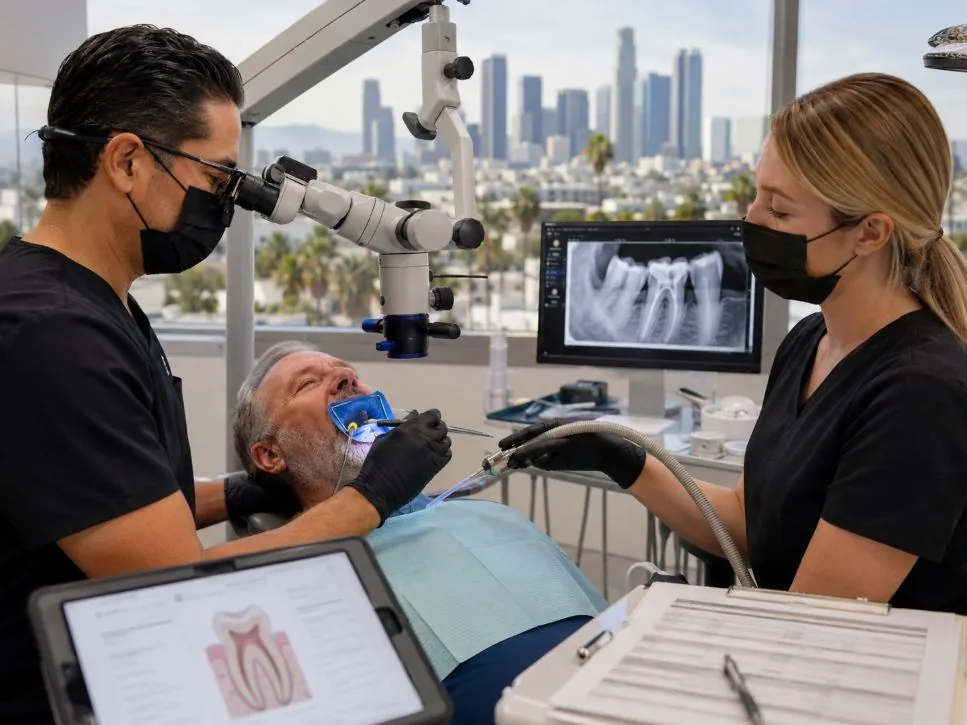
If you need a root canal in Los Angeles, the geography of where you live in the basin will affect your bill more than almost any other variable. The same molar treated in Beverly Hills can run $2,400 with the West Side specialist premium attached; the same case in Glendale or Long Beach lands closer to $1,500 with a comparably credentialed endodontist doing the work. The clinical procedure is identical. The address, the overhead, and the marketing budget are different. What's also true: Los Angeles has two top-tier endodontic residency programs in the city — at USC's Herman Ostrow School of Dentistry and UCLA School of Dentistry — and the resulting specialist supply is excellent. The trick is matching the right provider tier to your case without overpaying for the zip code.
This guide walks you through what root canal treatment actually involves, the honest pain reality (almost certainly less than you've been led to expect), what it costs in 2026 across LA's premium and value corridors, the credentialing markers that matter, when to insist on a specialist referral versus letting your general dentist handle it, and the red flags that should make you walk out of any LA endodontic consultation. Sources at the bottom — American Association of Endodontists position papers, American Board of Endodontics certification standards, peer-reviewed Journal of Endodontics outcome data, Cochrane systematic reviews, MetLife and GoodRx cost data, and the AAE patient pain surveys. Every clinical claim is sourced.
If you're in active pain as you read this — a tooth throbbing, a dull pressure that won't quit, sleep disrupted — the short version is: do not wait. A pulpal infection that's keeping you up at night is on a clock. The longer version, the rest of this guide, is about how to choose your provider so the procedure gets done right the first time, at a fair LA price, with a long-term outcome that means you don't deal with this tooth again.
What "Root Canal" Actually Means in Los Angeles
The procedure is the same procedure performed in every U.S. endodontic specialty practice — what changes city to city is provider density, technology baseline, and price. Los Angeles is unusual in that it concentrates two ADA-accredited endodontic residency programs inside the metro: USC's Herman Ostrow School of Dentistry, on the eastern edge of downtown, and the UCLA School of Dentistry, on the West Side. Both feed graduates into private practice across the basin every year. The credentialing depth in LA's specialist tier is genuinely high.
Inside every tooth is a small chamber containing soft tissue — pulp — composed of nerves, blood vessels, and connective tissue. The pulp runs from the center of the crown down through narrow channels (root canals) to the tip of each root. When that pulp becomes infected — typically because deep decay has reached it, or because trauma has disrupted its blood supply, or because a crack has opened a pathway for bacteria — your tooth has two paths forward: extraction, or endodontic treatment — what patients usually call a root canal — to remove the infected pulp, clean and disinfect the canal system, and seal the space.
Endodontics is one of nine specialties recognized by the American Dental Association. The specialist is called an endodontist — a dentist who completed dental school and then a 2- to 3-year accredited endodontic residency focused exclusively on diagnosing and treating diseases of the dental pulp and periapical tissues. General dentists also perform root canals — and in LA, where general-dentist root canal volume is high, many GPs do straightforward cases competently. Endodontists handle the complex cases (curved roots, calcified canals, retreatments, surgical apicoectomies) that exceed routine general-dentistry scope.
The Endodontic Landscape Across Los Angeles
LA's endodontic provider population is geographically uneven, and the price spread between corridors is large. Knowing the corridors tells you a lot about where the value is — and where you're paying for the address.
The practical implication: in LA, the same root canal can vary by 50% in price depending on where you cross the basin. Specialist density is good across all corridors, so you don't have to take the West Side quote at face value. Smyleee's curated Top 10 root canal specialists in Los Angeles filters across the basin on credential signals (residency training, ABE certification, AAE membership), microscope use, and aggregate patient feedback rather than raw review counts.
What the Procedure Actually Looks Like in an LA Specialty Practice
Modern root canal treatment is highly procedurally standardized. Whether your case takes one or two visits depends on complexity and the dentist's preference, but the steps are consistent across any well-equipped LA specialty practice — Beverly Hills, Glendale, Pasadena, or Long Beach alike.
Total chair time for a routine single-tooth root canal in LA is typically 60-90 minutes for a single-canal anterior tooth, and 90-120 minutes for a multi-canal molar. Two-visit cases add a 1-2 week interval between visits when the canal needs additional disinfection time before obturation.
The Pain Reality — What It Actually Feels Like
This is the question patients are most afraid to ask, and the answer is the most reassuring part of the whole procedure. The reputation of root canals as exceptionally painful is rooted in the procedure as it was performed 40-50 years ago — without microscopes, without modern rotary instrumentation, without nickel-titanium files, and often without adequate anesthesia for inflamed pulp. The procedure performed in 2026 in any competent LA specialty practice is fundamentally different.
Multiple peer-reviewed studies measuring intra-procedural pain on Visual Analog Scale (VAS) ratings have found that pain scores during modern endodontic treatment are statistically equivalent to or lower than pain scores during routine fillings — once adequate anesthesia is established. The American Association of Endodontists publishes patient-survey data showing the majority of patients describe the experience as no more uncomfortable than a filling.
If you're scared of root canals, the modern procedure is genuinely different from what your parents experienced. Most of the cultural fear around endodontic treatment is generational — your parents had a specific, often-traumatic memory of a 1970s-era root canal, and they communicated that fear to you. The procedure your parents had is not the procedure you will have.
What you'll actually experience: about 15 seconds of pinch from the anesthetic injection, a few minutes of pressure as the dentist confirms numbness, then 60-120 minutes of mild pressure sensations and the sound of instruments. Post-operative discomfort for 24-48 hours afterward is normal — typically managed with over-the-counter ibuprofen, sometimes briefly with a stronger prescription. Severe post-op pain is uncommon and usually signals a complication that should be addressed promptly.
The pain people associate with "root canals" is almost always the pain of the infection that led them to need the root canal in the first place. The procedure resolves that pain. By 24-48 hours after treatment, most patients report substantially less discomfort than before they walked into the office.
Real Cost Ranges in Los Angeles, 2026
Cost varies dramatically by region within LA, by tooth type, and by provider tier. Anterior teeth are simpler than molars; endodontists charge specialty rates that are typically 20-40% higher than general dentists in any given corridor; West Side specialty practices price 25-50% above the LA mid-tier on the same procedure. Here are the realistic Los Angeles ranges in 2026, broken into the LA mid-tier (Valley, East Side, South Bay) and the West Side premium corridor.
| Tooth Type | LA Mid-Tier (Valley/East/South Bay) | LA West Side Premium |
|---|---|---|
| Anterior, general dentist | $800 – $1,400 | $1,100 – $1,700 |
| Anterior, endodontist | $1,000 – $1,700 | $1,400 – $2,200 |
| Premolar, general dentist | $900 – $1,600 | $1,300 – $2,100 |
| Premolar, endodontist | $1,200 – $2,000 | $1,600 – $2,600 |
| Molar, general dentist | $1,300 – $2,100 | $1,700 – $2,700 |
| Molar, endodontist | $1,500 – $2,500 | $2,000 – $3,400 |
| Endodontic retreatment | $1,500 – $2,800 | $2,200 – $3,800 |
| Apicoectomy (per root) | $1,200 – $2,400 | $1,800 – $3,200 |
| Crown after root canal | $1,200 – $2,400 | $1,800 – $3,500 |
The crown is a separate cost and is essential for posterior teeth — leaving a root-canaled molar without a crown roughly halves its long-term success rate per peer-reviewed outcome studies. Budget for both. The West Side premium reflects rent and concierge service overhead; the clinical work, when both providers are residency-trained and microscope-equipped, is comparable to the mid-tier.
Insurance and Financing in California
Most California dental insurance plans cover endodontic treatment as a "major" procedure at 50-80% up to the annual maximum, which typically caps at $1,500-2,000. Common insurers in the LA market include Delta Dental of California (the dominant carrier statewide), Anthem Blue Cross, Cigna, MetLife, Guardian, and Aetna. State employees and many California municipal employees use Delta Dental PPO or Premier plans. UC and CSU faculty and staff frequently sit on Delta Dental coverage as well.
The annual maximum is the critical number. A West Side molar root canal plus crown can run $4,500-6,000 — far above any standard plan annual max. Plans that allow you to split treatment across two calendar years can effectively double your coverage. If you're approaching the end of a calendar year, ask whether the root canal can be done in December and the crown in January — most LA specialty practices know how to time treatment around plan-year resets.
Denti-Cal (Medi-Cal Dental) covers endodontic treatment for adults under specific circumstances, with broader coverage for children. Coverage on molars is more limited than on anterior teeth. For uninsured patients with budget constraints, the USC and UCLA dental school clinics offer significantly reduced-cost root canal treatment performed by endodontic residents under faculty supervision. CareCredit financing combined with practice payment plans is the typical path for cases above the annual max. Health Savings Account (HSA) and Flexible Spending Account (FSA) dollars are eligible for endodontic treatment per IRS Publication 502.
Endodontist or General Dentist? When to Insist on Referral in LA
Both can perform root canals legally in California. The decision should depend on case complexity, your dentist's experience with similar cases, and the specific anatomy of the tooth being treated. LA's specialist density across the West Side, Valley, East Side, and South Bay means that referral, when warranted, is genuinely available without crossing the basin twice.
| Best fit for general dentist | Best fit for endodontist |
|---|---|
| Single-canal anterior teeth | Multi-canal molars (especially upper second molars) |
| Straightforward premolars | Curved or calcified canals |
| Routine cases without complicating anatomy | Retreatment of previously failed root canals |
| Patients without significant medical complexity | Surgical cases (apicoectomy) |
| Cases your dentist has done many of, well | Trauma cases, immature roots, sedation requirements |
Long-term outcome studies in the Journal of Endodontics consistently show small but measurable advantages for endodontist-treated cases on complex teeth — primarily because endodontists operate exclusively under microscopes, use specialty-tier instrumentation, and see complex cases in volume. For straightforward single-canal cases, outcomes are similar. The American Association of Endodontists maintains a public referral directory and a board-certification verification tool through the American Board of Endodontics; both work nationally and let you verify any LA provider's credentials in under a minute.
In practice, many LA general dentists have established referral relationships with West Side specialty practices in Beverly Hills or Westwood, or — increasingly — with mid-tier specialty practices in Glendale, Pasadena, Long Beach, or Santa Monica. The West Side endodontic specialists handle a meaningful share of Beverly Hills and Westside-GP referrals. If your general dentist is recommending an in-house root canal on a curved-canal molar without offering an endodontist option, ask explicitly: "Would this case be better treated by an endodontist?" The answer to that question is one of the cleanest tells of provider quality you'll get.
Five Questions to Ask Before Treatment in LA
Red Flags That Should Stop You
No rubber dam isolation — non-negotiable per AAE standards. A practice not using rubber dam isolation is working below the standard of care.
Same-day root canal recommendation without imaging — endodontic treatment requires an X-ray at minimum and often a CBCT. A walk-in same-day treatment plan without proper imaging is rushing the diagnostic phase.
West Side pricing without West Side credentials — a $2,800 anterior root canal quote in Beverly Hills, from a general dentist who isn't board-certified and isn't using a microscope, is the worst-of-both-worlds combination. Mid-tier pricing for the same case from a board-certified endodontist in Glendale or Long Beach is a substantially better deal on every metric.
Pressure to commit before consulting an endodontist on a complex case — particularly retreatments or curved-canal molars. A confident LA general dentist will refer the case if it exceeds their skill set; one who pressures you to stay in-practice on a complex case is being protective of revenue, not patient outcome.
"Root canals always fail" / "Just extract and get an implant" framing — sales language disguised as clinical advice. Modern root canals have 86-98% long-term success rates per peer-reviewed outcome studies. Implants have ~95% 10-year survival rates. Neither is "always" anything. The right answer depends on your specific case, not on the practice's preferred procedure mix.
When a Root Canal Fails — Your Options
Roughly 5-15% of root canals will eventually fail, depending on case complexity, restoration quality, and time horizon. When that happens — confirmed by symptoms, X-ray evidence of new or persisting infection, or a tooth that becomes painful again months or years later — you have three options. In LA, with the basin's specialist density, all three options are within reach.
The first is non-surgical retreatment, in which an endodontist removes the previous filling material, re-cleans the canal system, and re-seals. Long-term success runs 70-85% and this is the appropriate first option when the original treatment likely missed a canal or had a leak. The second is surgical apicoectomy, which accesses the root tip through the gum and seals the root end with a biocompatible material. Used when retreatment isn't appropriate. Success runs 75-90% with modern microsurgical technique. The third is extraction and replacement (implant or bridge), which is appropriate for vertical root fractures, severe structural loss, or repeated failures. Don't accept a same-day extraction recommendation on a previously treated tooth without first consulting an LA endodontist about whether retreatment or surgery is viable — once the tooth is gone, your options narrow permanently.
Cross-Reference: Related Reading
If you want the full pillar on the topic — the scientific evidence base, the focal-infection-theory pseudoscience, the long-term outcome data — the complete Smyleee root canal guide covers it in depth. For specific situations, dedicated guides cover what root canal pain actually feels like, what to do when a root canal fails, choosing between apicoectomy and retreatment, the science behind root canal safety, and when to save the tooth versus replace it. For city-level shortlists in nearby major California metros, see the San Diego guide.
Final Thoughts
If you're reading this with a tooth in active pain, the priority is getting in front of an endodontist or root-canal-experienced general dentist this week. LA's provider supply makes that genuinely possible across every corridor of the basin. If you're processing a root canal recommendation and weighing the price tag, the priority is choosing the right provider tier for your case — and not paying West Side overhead for clinical work that's available 25-40% cheaper across the 405 or up the 101.
The procedure is not the procedure your parents had. The pain reputation is decades stale. The pseudoscience around root canal "toxicity" is rejected by every mainstream dental research body and has been since the 1950s. What separates a great outcome from a regretted one is almost never whether the procedure was a root canal versus something else — it's whether the right provider used the right technique on the right case. Endodontist for complex cases. Microscope and rubber dam always. CBCT for difficult anatomy. Proper crown afterward. Honest second opinion when something doesn't add up.
In a market where an identical molar root canal can run $1,500 in Glendale or $3,000 in Beverly Hills, the second-opinion habit is worth more in LA than almost anywhere else. Get the imaging. Ask the questions. Compare the quotes. The tooth you keep today is the one you don't have to replace tomorrow.
Find a Vetted Los Angeles Root Canal Specialist
Smyleee's curated Top 10 list of root canal specialists in Los Angeles vets providers on residency training, ABE certification, microscope use, and aggregate patient feedback — across both the West Side and the Valley/East value belt.
Sources & References
- American Association of Endodontists — Position Statements (Endodontic Treatment Is Safe; Treatment Standards; Rubber Dam Isolation)
- American Association of Endodontists — Clinical Resources Library & Treatment Standards
- American Board of Endodontics — Board Certification Standards & Specialist Verification
- American Dental Association — Endodontics Oral Health Topic & Council on Scientific Affairs Statement
- Cochrane Reviews — Endodontic Treatment Outcome Systematic Reviews
- Journal of Endodontics — Peer-Reviewed Research on Treatment Outcomes & Pain
- AAE — Endodontic Treatment Is Safe (Patient Resource & Position Paper)
- USC Herman Ostrow School of Dentistry — Advanced Program in Endodontics
- UCLA School of Dentistry — Postgraduate Program in Endodontics
- PubMed / NCBI — Primary Literature on Endodontic Outcomes & VAS Pain Studies
- MetLife Oral Fitness Library — Root Canal Cost Reference
- GoodRx — Root Canal Cost Guide
- CareCredit — Root Canal Treatment Financing
- California Department of Health Care Services — Medi-Cal Dental (Denti-Cal) Coverage
- IRS Publication 502 — Medical and Dental Expenses (HSA / FSA Eligibility)