
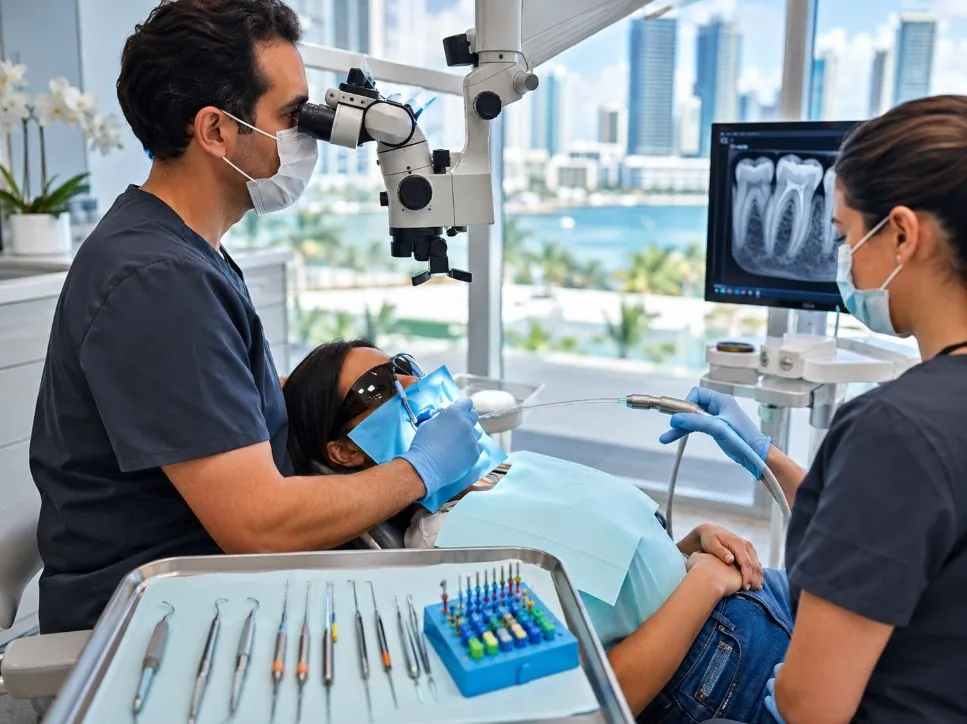
A root canal in Miami runs into two local realities that complicate the decision more than in most U.S. metros. The first is insurance: most adult dental plans in Florida cap annual maximums tightly, and Florida Medicaid covers endodontic treatment for children but generally not for adults — meaning a meaningful share of Miami patients are paying out of pocket for a procedure that's covered elsewhere. The second is provider-mix variance: bilingual Spanish and Portuguese specialty practices coexist with a heavy medical-tourism volume layer, and the clinical standard between them is genuinely uneven. Finding an endodontist Miami patients can actually trust requires filtering past both realities, not just picking the closest office to Brickell.
This guide walks you through what a root canal Miami patient should actually expect: what the procedure is and why teeth need them, the local endodontic landscape across Coral Gables, Brickell, Doral, Kendall, Hialeah, and Homestead, the 2026 cost ranges across general dentists and specialists, the Florida insurance and Medicaid picture, when to escalate from a general dentist to a specialist, and the red flags that are particularly common in this metro. Every clinical claim is anchored to peer-reviewed sources or the major specialty bodies — the American Association of Endodontists, the American Dental Association, Cochrane systematic reviews, the Journal of Endodontics — listed at the end of the post.
One framing point up front. The root canal pain Miami patients are most afraid of is almost always the pain of the infection they already have, not the procedure that resolves it. Modern endodontic treatment is a long filling appointment with adequate anesthesia and a rubber dam — closer to dull pressure than to acute pain. The cultural reputation reflects the procedure as it was performed half a century ago, before microscopes, nickel-titanium files, and current irrigation protocols. The procedure performed in 2026 is fundamentally different, and the chair-side conversation rarely has time to walk you through the difference.
What a Root Canal Actually Is
Inside every tooth is a small chamber containing soft tissue — pulp — made up of nerves, blood vessels, and connective tissue. The pulp runs from the center of the crown down through narrow channels (root canals) to the tip of each root. When that pulp becomes infected — typically because deep decay has reached it, because trauma has disrupted its blood supply, or because a crack has opened a pathway for bacteria — the tooth has two paths forward: extract it, or treat the infection by removing the pulp, cleaning and disinfecting the canal system, and sealing the space.
The second path is what dentists call endodontic treatment — what Miami patients usually call a "root canal." The procedure preserves the tooth's external structure (the part you chew with) by removing the source of infection inside it. Most root-canaled teeth, properly restored with a crown afterward, function for decades.
Endodontics is one of nine specialties recognized by the American Dental Association. The specialist is called an endodontist — a dentist who completed dental school and then a 2- to 3-year accredited endodontic residency focused exclusively on diagnosing and treating diseases of the dental pulp and periapical tissues. General dentists also perform root canals legally, particularly on simpler cases (single-canal anterior teeth, straightforward premolars), but endodontists handle the complex cases (curved roots, calcified canals, retreatments, surgical apicoectomies) that exceed routine general-dentistry scope.
The Miami Endodontic Landscape
Miami's specialty supply is deep but unevenly distributed. The provider mix splits roughly into three tiers, mapping cleanly onto the metro's geography. Quality variance does not track price one-to-one — a residency-trained endodontist in Hialeah or Kendall running a microscope-driven workflow routinely produces outcomes indistinguishable from a Brickell concierge specialty practice charging 50% more for the same case.
The closest dental school is Nova Southeastern University College of Dental Medicine in Davie, about 35 minutes north of downtown Miami, which runs an accredited postgraduate endodontic residency and feeds residency-trained graduates into specialty practices throughout Miami-Dade and Broward. The University of Florida College of Dentistry (Gainesville) is the state's other major program, sending graduates south in steady numbers. Brickell and Coral Gables specialty practices also carry an above-average share of out-of-state residency CVs from NYU, Penn, and Columbia.
Aventura / Sunny Isles upmarket tier — multilingual specialty footprint serving seasonal-resident clientele and Latin American medical-tourism inflows. Spanish, Portuguese, Russian, Hebrew. Pricing skews premium; quality is generally strong when residency credentials are verified.
Doral / Kendall mid-tier — bilingual Spanish standard, working-professional clientele, mature residency-trained specialty practices, in-house payment plans common. Often the best value-for-quality corridor for routine and moderately complex cases. Mid-pricing, strong insurance-network density.
Hialeah / Homestead value tier — Spanish-first practices, working-family clientele, lowest fee schedule in the metro, mix of GP-with-referral and visiting endodontist models. Verify residency credentials before committing on complex cases; the value tier here has wider quality variance than the upmarket tiers.
Miami Beach / South Beach — high marketing intensity, premium pricing, mix of mockup-driven specialty practices and volume-tier walk-in models. Verify rubber-dam protocol and microscope use specifically.
Two Miami-specific quirks worth flagging. First, bilingual Spanish capability is functionally required across most of the metro — roughly 65% of Miami-Dade households speak Spanish at home — and Portuguese capability is common in Brickell and Aventura. Confirm the language match before booking; explaining symptoms accurately to your endodontist matters for diagnosis. Second, the metro's heavy medical-tourism inflow has shaped some volume-tier practices around package pricing and compressed timelines. That model fits cosmetic dentistry better than endodontics — a root canal doesn't benefit from a 48-hour timeline, and "same-week" treatment without imaging is rushing the diagnostic phase.
What the Procedure Actually Looks Like
Modern root canal treatment is highly procedurally standardized. Whether your case takes one or two visits depends on the complexity and the dentist's preference, but the steps are consistent across well-run practices anywhere in Miami.
Total chair time for a routine single-tooth root canal is typically 60–90 minutes for a single-canal anterior tooth, and 90–120 minutes for a multi-canal molar. Two-visit cases add a 1–2 week interval between visits when the canal needs additional disinfection time before obturation.
What It Actually Feels Like — The Root Canal Pain Miami Reality
This is the question Miami patients are most afraid to ask, and the answer is the most reassuring part of the whole procedure. The reputation of root canals as exceptionally painful is rooted in the procedure as it was performed 40–50 years ago — without microscopes, without modern rotary instrumentation, without nickel-titanium files, and often without adequate anesthesia for inflamed pulp. The procedure performed in 2026 by a competent endodontist or general dentist is fundamentally different.
Multiple peer-reviewed studies measuring intra-procedural pain on Visual Analog Scale (VAS) ratings have found that pain scores during modern endodontic treatment are statistically equivalent to or lower than pain scores during routine fillings — once adequate anesthesia is established. The American Association of Endodontists publishes patient-survey data showing the majority of patients describe the experience as no more uncomfortable than a filling.
What you'll actually experience: about 15 seconds of pinch from the anesthetic injection, a few minutes of pressure as the dentist confirms numbness, then 60–120 minutes of mild pressure sensations and the sound of instruments. Post-operative discomfort for 24–48 hours afterward is normal — typically managed with over-the-counter ibuprofen, sometimes briefly with a stronger prescription. Severe post-op pain is uncommon and usually signals a complication that should be addressed promptly.
The pain people associate with "root canals" is almost always the pain of the infection that led them to need a root canal in the first place. The procedure resolves that pain. By 24–48 hours after treatment, most Miami patients report substantially less discomfort than they had before walking into the office. If you've been postponing treatment because the cultural reputation has made you anxious, the actual experience is meaningfully closer to a long filling appointment than to the dentistry you've seen on television.
What a Root Canal Miami Cost Looks Like in 2026
Miami pricing splits along two axes — anterior versus molar (molars are more complex and cost more), and general dentist versus endodontist (specialists charge 20–40% more than GPs). Layered onto that is the neighborhood premium: Brickell, Coral Gables, and Aventura carry a clear lobby-and-location surcharge above the metro average; Hialeah, Homestead, and parts of Kendall run notably below it. The ranges below reflect the actual Miami market in 2026, not the U.S. national average — which Miami sits slightly above.
| Tooth Type | Miami General Dentist | Miami Endodontist |
|---|---|---|
| Anterior (front) tooth | $700 – $1,300 | $900 – $1,500 |
| Premolar (bicuspid) | $850 – $1,500 | $1,100 – $1,900 |
| Molar (back tooth) | $1,200 – $2,000 | $1,400 – $2,300 |
| Endodontic retreatment | $1,100 – $1,800 | $1,500 – $2,800 |
| Apicoectomy (per root) | — | $1,100 – $2,500 |
| CBCT (3D scan) | $200 – $400 | $200 – $400 |
| Crown (after root canal) | $1,100 – $2,500 | — |
The crown is a separate cost and is essential for posterior teeth. Leaving a root-canaled molar without a crown roughly halves the long-term success rate, per long-term outcome studies in the Journal of Endodontics. Budget for both. A reasonable all-in Miami cost for a molar root canal plus crown by an endodontist plus your follow-up GP runs in the $3,000–$4,800 range; the same case at a Hialeah or Kendall GP doing both phases in-house can land at $2,300–$3,200. The clinical outcome doesn't have to scale with that price gap.
Insurance, Medicaid, Financing — The Honest Florida Picture
Florida adult dental insurance
Most Florida PPO plans (Delta Dental of Florida, Cigna, MetLife, Florida Blue, Humana, Aetna) cover endodontic treatment as a "major" procedure at 50–80% up to the annual maximum, typically $1,000–$2,000 per calendar year. Crowns are similarly covered as a major procedure. The annual maximum is the binding constraint — a Miami molar root canal plus crown can easily clear the cap in a single calendar year, with the rest billed out of pocket.
Miami practices vary widely in their PPO network participation. Some Brickell and Coral Gables specialty practices are entirely out-of-network, billing patients full fee and providing claim documentation for partial reimbursement. Others, particularly in Doral, Kendall, and Hialeah, are in-network with most major Florida PPOs and bill directly. The in-network distinction can swing your out-of-pocket cost by $300–$700 on the same case — confirm explicitly before the consultation.
Florida Medicaid for adults
Florida Medicaid covers endodontic treatment for children (under 21) but generally does not cover root canals for adult Medicaid recipients. Limited adult dental benefits exist for emergency extractions and some restorative work, but routine adult endodontics is typically not covered — meaning a meaningful share of Miami's lower-income adult population is paying out of pocket for a procedure that's covered for the same demographic in many other states. This is one of the more significant local cost realities for the metro and shapes which corridors run cash-pay-friendly pricing models. Hialeah, Homestead, and parts of Doral carry some of the lowest cash-pay GP root canal fees in the metro precisely because their patient base skews uninsured or Medicaid-uncovered.
Out-of-pocket and financing
Many Miami practices offer in-house payment plans at 0% interest for 6–12 months on treatment of $1,500+. CareCredit is widely accepted, but its promotional period interest rules are punishing if you miss the payoff date — read the in-house plan terms first. HSA and FSA dollars are eligible for endodontic treatment because the IRS treats it as a medically necessary procedure (unlike cosmetic work), which effectively gives you a 22–32% federal-tax discount on the cost.
For uninsured patients, dental school clinics at Nova Southeastern University and the University of Florida offer endodontic treatment at meaningfully reduced rates (typically 30–50% below private practice), with treatment performed by supervised residents. The wait time is longer and the appointments take longer, but the clinical outcome is equivalent to private specialty practice for routine cases.
Endodontist or General Dentist?
Both can perform root canals legally. The decision should depend on case complexity, your dentist's experience with similar cases, and the specific anatomy of the tooth being treated. In Miami specifically, the endodontist supply is deep enough that a referral is rarely a logistical problem — the question is whether your case warrants the specialist fee.
| Best fit for general dentist | Best fit for endodontist |
|---|---|
| Single-canal anterior teeth | Multi-canal molars (especially upper second molars) |
| Straightforward premolars | Curved or calcified canals |
| Routine cases without complicating anatomy | Retreatment of previously failed root canals |
| Patients without significant medical complexity | Surgical cases (apicoectomy) |
| Cases your dentist specifically does well | Trauma cases, immature roots, special-needs sedation |
Long-term outcome studies in the Journal of Endodontics consistently show small but measurable advantages for endodontist-treated cases on complex teeth — primarily because endodontists operate exclusively under microscopes, use specialty-tier instrumentation, and see complex cases in volume. For straightforward single-canal cases, outcomes between GP and specialist are similar. The American Association of Endodontists maintains a public referral directory, and the American Board of Endodontics provides a verification tool for board certification.
Five Questions to Ask Before Treatment
Red Flags Specific to the Miami Market
"Same-day root canal" in a tourist-friendly office without imaging — particularly common in the South Beach and parts of Brickell volume tier, marketed heavily to medical-tourism inflows. Endodontic treatment requires periapical X-ray at minimum and often a CBCT. A walk-in same-day treatment plan without proper imaging is rushing the diagnostic phase.
No rubber dam isolation — non-negotiable per AAE standards. A Miami practice not using rubber dam isolation during root canals is working below the standard of care.
"Root canals are toxic" or "root canals cause cancer" framing — this is the focal-infection-theory pseudoscience that traces back to Weston Price's discredited 1920s research. The AAE position paper "Endodontic Treatment Is Safe" and multiple large peer-reviewed cohort studies have found no link between endodontic treatment and systemic disease. A Miami provider citing this material as a reason to extract a viable tooth is operating outside mainstream evidence-based dentistry. Walk away.
"Package pricing" that bundles multiple unrelated procedures — common at some Miami volume-tier practices marketed to international patients. Veneers + root canal + whitening as a single bundled total can obscure whether you're being charged for treatments you don't actually need. Ask for itemized line pricing per procedure before signing.
Pressure to commit before consulting an endodontist on a complex case — particularly retreatments, curved-canal molars, and previously-crowned teeth. A confident Miami GP will refer the case if it exceeds their skill set; one who pressures you to stay in-practice on a complex case is being protective of revenue, not of patient outcome.
Unusually low quotes that omit the crown — a $700 root canal "special" on a molar is sometimes structured to omit the essential crown that follows it. Posterior root canals without crowns fail at much higher rates. Get the all-in cost (root canal + buildup + crown) before comparing quotes across practices.
How to Find an Endodontist Miami Patients Can Trust
The hard part isn't finding endodontists in Miami — there are dozens of credentialed specialists across the metro. The hard part is filtering past the marketing layer and identifying practices that match your case complexity, language preference, and budget. Cross-corridor comparison is worth your time here specifically because the price spread is wide. A 25-minute drive from Brickell out to Doral or Kendall can save $400–$900 on a molar case at clinically comparable quality.
For a vetted shortlist instead of working through Google search results, our curated Miami list flags credentials, microscope and CBCT use, language capability, and case-similar experience: Top 10 Root Canal Specialists in Miami.
For specific clinical situations, dedicated guides cover what root canal pain actually feels like, what to do when a root canal fails, the choice between apicoectomy and retreatment, the science behind root canal safety, and when to save the tooth versus replace it with an implant.
For comparable major metros, see our city root canal guides for Brooklyn, Los Angeles, San Diego, and Charlotte. The broader pillar guide on root canal treatment covers the procedure science, success rates, and myth-versus-evidence picture in detail.
Final Thoughts
A root canal in Miami is solvable, but it requires more filtering than the same procedure in most U.S. metros. The endodontic supply across Miami-Dade is deep, the clinical standard among credentialed specialists is high, and the imaging and microscope infrastructure is well-distributed across the upmarket and mid-tier corridors. What makes the Miami decision harder is the volume-tier marketing layer, the wide price spread between Brickell and Hialeah on the same case, and the Florida adult Medicaid coverage gap that pushes a meaningful share of patients into cash-pay decisions on procedures that are insurance-covered elsewhere.
The fix is the same as everywhere else, just applied with more rigor. Imaging before drilling. Rubber dam during. Microscope on complex cases. Crown after. Endodontist referral when the anatomy warrants it. Itemized quote up front. Bilingual capability if you want to discuss symptoms in your first language. The price spread between Brickell and Kendall on a molar root canal is real and not subtle — but the clinical outcome between those corridors usually is not. The tier choice is yours; the outcome doesn't have to scale with the zip code.
Take the time. Ask the five questions. Get the imaging. Confirm the rubber-dam protocol. Walk out without committing if anything feels rushed. The tooth you keep today is the one you don't have to replace tomorrow with a $5,500 implant.
Find a Vetted Endodontist in Miami
Browse Smyleee's curated Miami root canal directory — credential-vetted, with microscope and CBCT use markers, language-capability flags, and aggregate patient feedback across Brickell, Coral Gables, Aventura, Doral, Kendall, Hialeah, Homestead, Coconut Grove, and Miami Beach.
Sources & References
- American Association of Endodontists — Position Statements (Endodontic Treatment Is Safe; Treatment Standards)
- American Association of Endodontists — Clinical Resources Library & Treatment Standards
- American Board of Endodontics — Board Certification Standards & Specialist Verification
- American Dental Association — Endodontics Oral Health Topic & Council on Scientific Affairs Statement
- Cochrane Reviews — Endodontic Treatment Outcome Systematic Reviews
- Journal of Endodontics — Peer-Reviewed Research on Treatment Outcomes & Pain
- Nova Southeastern University College of Dental Medicine — Postgraduate Endodontic Residency
- Florida Agency for Health Care Administration — Medicaid Adult Dental Coverage
- U.S. Census Bureau — Miami-Dade County Language & Demographics
- MetLife Oral Fitness Library — Root Canal Cost Reference
- GoodRx — Root Canal Cost Guide
- CareCredit — Root Canal Treatment Financing
- American Dental Association MouthHealthy — Patient Guide to Root Canals
- IRS Publication 502 — Medical and Dental Expenses (HSA / FSA Eligibility)