
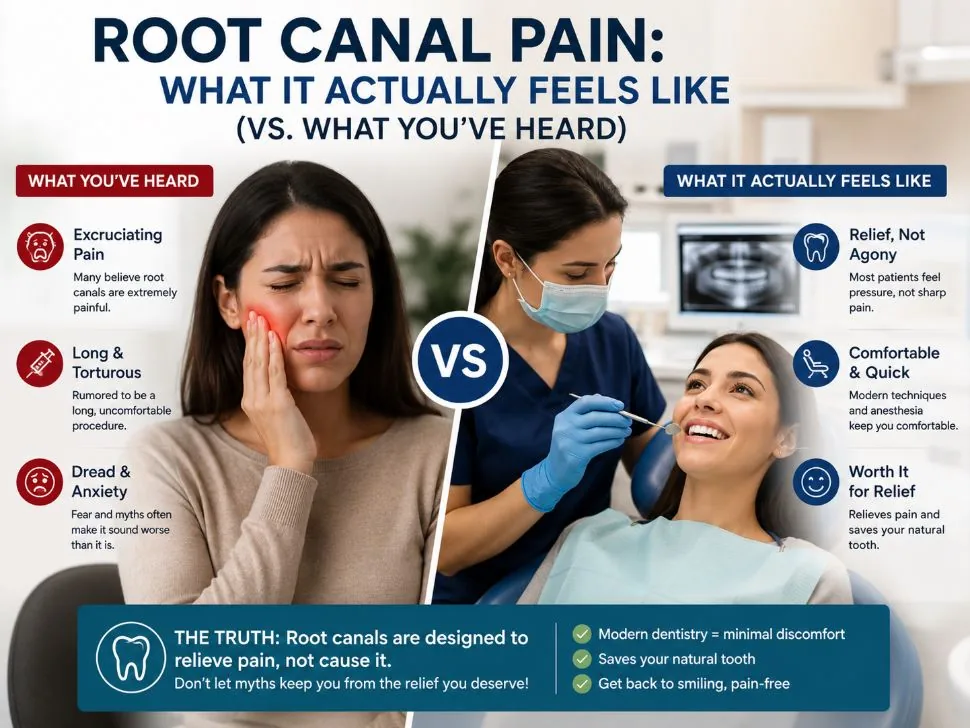
"Does a root canal hurt?" is the single most-googled question in endodontics, and the honest answer is more reassuring than the reputation suggests — but it requires separating three different pains that patients almost always conflate. The pain that brings someone to a root canal appointment is severe; the pain during a competently performed modern root canal is minimal; the pain afterward is mild and short-lived. The cultural shorthand "I'd rather have a root canal" survives because the procedure as it was performed 40–50 years ago was genuinely difficult, and because the toothache that led to a root canal was extreme and is now misremembered as the procedure itself. Modern endodontic treatment, performed by a competent provider with adequate anesthesia, a rubber dam, and a microscope, is closer to a routine filling than to the procedure of a generation ago.
This guide separates the three pains, walks through the peer-reviewed evidence on what modern root canals actually feel like (with VAS pain scores from Journal of Endodontics and Cochrane Review data), explains why some patients still report severe pain and how to avoid being one of them, and ends with five questions to ask your dentist about pain management before treatment. The goal is to give you the actual evidence-based answer to the most-feared dental procedure question — the one your dentist's chair-side conversation rarely has time for.
One thing worth saying up front: this isn't a reassurance piece. The "root canals don't hurt at all" line you'll see in some marketing-driven content is also an oversimplification. The real answer is that with the right provider, the right anesthesia protocol, and the right diagnostic workup, the actual procedure feels like a long filling — and that the pain you bring in usually disappears 24–48 hours after treatment. With the wrong provider, an incomplete anesthesia protocol, or a rushed diagnostic phase, root canals can hurt — not because the procedure is inherently painful, but because the workflow that controls pain wasn't followed. The reality is closer to "here's how to avoid the avoidable pain" than to either "it doesn't hurt" or "it's terrible." This post is the does a root canal hurt question answered with evidence, honestly.
The Three Pains People Conflate
The single most useful thing to do before answering "does a root canal hurt" is to separate three completely different pains that patients merge into one. They have different causes, different intensities, different durations, and different solutions. Conflating them is what makes the procedure sound terrifying. Separating them is what makes the actual experience navigable.
Once you separate these three pains, the original question becomes much clearer. "Does a root canal hurt" isn't a single yes-or-no — it's three different questions with three different answers. The pre-treatment pain is severe; the during-treatment pain under proper anesthesia is minimal; the post-treatment pain is mild and short-lived. The cultural reputation conflates all three into "root canals are terrible," and that conflation is the source of most of the fear.
Why the Reputation Is So Out of Date
Root canals 30–50 years ago were genuinely difficult. The reputation didn't come from nowhere. Stainless steel hand files instead of nickel-titanium rotaries meant longer instrumentation, more friction, and more procedure-related discomfort. No surgical operating microscope meant clinicians worked by feel rather than direct vision, missing canals more often and producing higher post-op flare-up rates. Less effective irrigation protocols meant more residual bacteria, more reinfection, more secondary pain. Anesthesia protocols often relied on a single inferior alveolar nerve block without escalation when it was incomplete, leaving patients partially numb during instrumentation. The combination produced procedures that lasted 2–3 hours, had higher complication rates, and routinely generated the patient stories that became the cultural reputation.
Modern endodontics is fundamentally different. The 21st-century root canal is performed under a surgical operating microscope at 4–25× magnification, with rubber dam isolation, with rotary or reciprocating nickel-titanium files that shape canals in minutes rather than tens of minutes, with multi-step irrigation protocols using sodium hypochlorite and supplementary irrigants that disinfect the canal walls beyond what mechanical instrumentation alone achieves, and with anesthesia protocols that escalate to intraligamentary, intraosseous, or intrapulpal techniques when standard injection is incomplete. A peer-reviewed comparison of modern endodontic treatment to procedures from the 1970s would essentially be a comparison of two different procedures sharing only the name.
Multiple studies in the Journal of Endodontics and Cochrane systematic reviews have measured intra-procedural pain during modern root canal treatment using validated VAS rating instruments. The findings are consistent: pain scores during the procedure, once adequate anesthesia is established, are statistically equivalent to or lower than pain scores during routine fillings. The American Association of Endodontists publishes patient-survey data showing the majority of patients describe the experience as no more uncomfortable than a filling, and that 85%+ report the actual experience as less painful than they expected. The disconnect between the reputation and the evidence is one of the largest in mainstream dentistry.
The Anesthesia Question — Why Root Canals Are Sometimes Harder to Numb
The single most important variable in whether a root canal is painful during the procedure is the quality of anesthesia. And the inconvenient truth that few practices explain to patients is that inflamed pulp tissue is genuinely harder to anesthetize than healthy tissue. The reason involves the chemistry of local anesthetics: lidocaine and similar agents work most effectively at physiological pH (around 7.4). Inflamed and infected tissue is more acidic — pH can drop to 6.0–6.5 in active pulpitis — which reduces the proportion of anesthetic in the molecular form that crosses nerve membranes to block sodium channels. The result is that the standard inferior alveolar nerve block, which produces predictable numbness in healthy lower molars, is often incomplete in lower molars with active pulpitis. Studies in the Journal of Endodontics have measured incomplete-numbness rates of 20–40% on hot teeth with standard injection alone.
The solution is not to push through the procedure on an inadequately numb tooth. The solution is for the dentist to escalate to supplementary anesthesia techniques. Skilled endodontists use intraligamentary injections (anesthetic delivered into the periodontal ligament around the tooth), intraosseous injections (anesthetic delivered directly into the bone adjacent to the tooth, through a small access hole drilled in the cortical plate), and in extreme cases intrapulpal injections (anesthetic delivered directly into the pulp chamber once access is gained). When properly executed, these supplementary techniques resolve almost all incomplete-numbness situations. A practice that has these tools and uses them when standard injection isn't enough is the kind of practice that produces the "felt like a filling" patient stories. A practice that doesn't escalate — that says "you should be numb enough, let's keep going" when the patient is reporting sharp pain — is the source of "root canals hurt during the procedure" stories.
This is the question to ask before treatment, and the answer matters more than any other single piece of information about a provider. A confident endodontist or general dentist describes the escalation protocol clearly, talks about cold-test confirmation of numbness before instrumentation begins, and assures you that the procedure will be paused and additional anesthesia added if you signal pain. A defensive answer — "you'll be fine, don't worry about it" — is itself the answer. Pain control during a root canal is a workflow question, not a luck question.
What You'll Actually Feel During the Procedure
A minute-by-minute walkthrough of a competently performed modern root canal, from a patient perspective:
Total chair time for a single-canal anterior tooth is typically 60–90 minutes; for a multi-canal molar, 90–120 minutes. Two-visit cases add a second appointment 1–2 weeks later for the final obturation in cases requiring additional disinfection time. Throughout the procedure, the dominant sensations are pressure and sound, not pain.
Post-Operative Pain — What's Normal vs. What's a Complication
Mild soreness for 24–48 hours after a root canal is normal and expected. The tooth has been instrumented, the surrounding tissues have been mildly inflamed by the procedure, and the bite may feel slightly different until the temporary restoration settles. Knowing what's normal and what's not is the difference between unnecessary worry and missing an actual complication.
| Normal post-op course | Warrants a call to the dentist |
|---|---|
| Mild soreness, 1–3 on VAS, intermittent | Severe pain, 6+ on VAS, persistent |
| Tenderness on biting that improves daily | Sharp pain on biting that worsens after 72 hours |
| Mild gum tenderness near the tooth | Visible swelling of the face, gum, or jaw |
| Resolves within 24–48 hours | Pain not improving by day 3–4, or worsening |
| Controlled by OTC ibuprofen 400–600 mg | OTC pain relief insufficient |
| No fever, no systemic symptoms | Fever, malaise, or facial swelling — call immediately |
Roughly 1–3% of root canals develop a post-operative "flare-up" — a transient inflammatory reaction in the days after treatment that produces more discomfort than the typical post-op course. Most flare-ups resolve within a week with NSAIDs and sometimes a short antibiotic course. A small fraction reflect a real complication — a missed canal, a residual infection, or a fracture — that requires diagnostic re-evaluation. Either way, the right response is to call the office, not to push through. A practice with a clear post-op contact protocol — what number to call, after-hours coverage, when to come in for an urgent re-evaluation — is the kind of practice you want.
Why Some Patients Still Report Severe Pain — and How to Avoid Being One of Them
The peer-reviewed evidence on modern root canal pain is reassuring at the median, but the median is not the experience of every patient. A meaningful minority of patients still report severe pain during or after the procedure, and the reasons cluster into a few specific patterns that are largely preventable with the right provider.
Inadequate anesthesia from a provider who doesn't escalate. The single most common cause of "root canals hurt" stories. Standard inferior alveolar block is incomplete on hot lower molars in 20–40% of cases per published studies. A provider with the supplementary techniques (intraligamentary, intraosseous, intrapulpal) and the willingness to use them when standard injection isn't enough resolves almost all of these cases without significant pain. A provider who doesn't escalate is the source of the patient stories.
"Hot tooth" cases requiring different protocols. Severe active pulpitis is harder to anesthetize than less acute pulp inflammation. A skilled provider identifies a hot tooth before treatment, premedicates with NSAIDs to reduce pulp inflammation, sometimes prescribes a 24-hour antibiotic course in abscess cases, and modifies the anesthesia protocol upfront. A provider who treats every case with the same default protocol misses the cases that need extra preparation.
Patient anxiety amplifying perception. Anxiety substantially affects pain perception, and root canals trigger anxiety in many patients because of the cultural reputation. Practices that recognize this and address it — clear pre-treatment explanation, oral or nitrous oxide sedation when appropriate, a slow and unhurried approach — produce meaningfully better-tolerated procedures than practices that don't. If pre-treatment anxiety is high for you, ask about sedation options before scheduling.
Post-op flare-ups in 1–3% of cases. A transient inflammatory reaction in the days after treatment, usually resolving with NSAIDs and time. Hard to prevent entirely, but a provider with a clear post-op contact protocol and willingness to see you back quickly minimizes the experience.
Missed canals causing residual infection. A missed canal — anatomy that wasn't identified during the original procedure and remains uncleaned — can produce persistent low-grade infection and pain that doesn't resolve. CBCT imaging and microscope use during the original procedure dramatically reduce this. A practice without those tools, on a complex multi-canal molar, has a meaningfully higher missed-canal rate. This is the most common reason patients with persistent post-treatment pain end up in retreatment or apicoectomy consultations down the road.
Each of these is preventable or treatable with the right provider. The "root canals hurt" reputation is largely the cumulative experience of cases where one or more of these factors went unaddressed. The "root canals don't hurt anymore" reality is the experience of cases where the provider, the protocol, and the technology are all aligned. Choosing the provider is the single highest-leverage decision you make on this question.
Five Questions to Ask Your Dentist About Pain Management Before Treatment
These five questions surface whether the practice has thought carefully about pain control or is operating on default protocols that fail on a meaningful share of cases. A confident provider answers each clearly and specifically.
Red Flags in Pain-Management Workflow
Practices that skip CBCT on complex cases — for routine single-canal anterior teeth, a periapical X-ray is often sufficient. For multi-canal molars, retreatments, or any case with unusual anatomy, CBCT meaningfully reduces missed canals, which are the most common cause of persistent post-treatment pain. A practice that won't refer for CBCT on a case that warrants it is working with less information than the case requires.
Practices that pressure same-day treatment without proper diagnostic workup — endodontic treatment requires at minimum a periapical X-ray, often a CBCT, a thorough cold and percussion test of the tooth and adjacent teeth, and an honest discussion of treatment options. A practice that pushes you into the chair within an hour of walking in, without proper diagnostics, is rushing the phase of the workflow that matters most for predicting and preventing pain.
Providers who dismiss pain reports during the procedure — if you signal sharp pain during instrumentation, the appropriate response is to pause and add anesthesia. A provider who says "that's just pressure, you should be numb enough, let's keep going" is the source of "my root canal was traumatic" patient stories. The signaling protocol is non-negotiable; if a provider won't commit to it, that's information.
"It might hurt a little, just push through" — never the right answer. Modern endodontic anesthesia protocols can produce essentially complete numbness in nearly all cases when properly executed. A provider who frames intra-procedural pain as something the patient should tolerate isn't using the available tools.
Related Reading and Cross-Links
For broader context on what a root canal actually involves nationally — the procedure step by step, modern success rates, the science vs. the myths, the cost landscape, and the questions to ask any provider — our pillar guide on root canal treatment is the deeper reference. For situations where post-treatment pain doesn't resolve, see what to do when a root canal fails and choosing between apicoectomy and retreatment. For the broader questions patients often ask alongside the pain question, see the science behind root canal safety and when to save the tooth versus replace it.
For city-specific guides on finding microscope-and-CBCT-equipped providers with strong anesthesia protocols, see our root canal city guides: Brooklyn, Los Angeles, San Diego, Miami, and Charlotte. Curated provider shortlists are available through our Top 10 root canal lists for Brooklyn, Los Angeles, San Diego, Miami, and Charlotte.
Final Thoughts
The honest answer to "does a root canal hurt" — the answer the peer-reviewed evidence supports and the answer most patients receiving competent modern care actually report — is that the procedure itself, performed with adequate anesthesia, rubber dam isolation, and microscope-and-CBCT diagnostics, feels like a long filling. The pain people remember as "the root canal" is almost always the toothache that brought them in, which the procedure resolves. The post-treatment soreness is mild, short-lived, and managed with over-the-counter ibuprofen in most cases. The modern root canal pain reality is fundamentally different from the procedure's reputation, which reflects the work as it was done a generation ago.
What separates a comfortable root canal from a regretted one is almost never the procedure itself — it's the workflow around it. Adequate anesthesia with willingness to escalate. Rubber dam isolation always. CBCT for complex anatomy. Microscope use for multi-canal cases. Cold-test confirmation of numbness before instrumentation. Clear signaling protocol during the procedure. Specific post-op pain expectations and contact pathway. Each of these is a workflow choice, not a luck variable. Choosing a provider who has thought carefully about each is the single highest-leverage decision you make on this question.
Ask the five questions. Get the answers in plain language. If a provider can't describe their anesthesia escalation protocol, their CBCT availability, their cold-testing routine, or their post-op contact procedure, that's information. The provider who answers each clearly is the provider who is operating the workflow that produces the "felt like a filling" patient stories — and that's the workflow you want for yourself.
Find a Vetted Root Canal Specialist
Browse Smyleee's curated, credential-vetted directory of endodontists and general dentists experienced in root canal treatment — with microscope-and-CBCT workflow flags, AAE-aligned protocol markers, and aggregate patient ratings.
Sources & References
- American Association of Endodontists — Position Statements & Treatment Standards
- American Association of Endodontists — Clinical Resources Library & Pain Management Guidelines
- American Association of Endodontists — Patient Resources & Pain Survey Data
- American Board of Endodontics — Board Certification Standards
- American Dental Association — Endodontics Oral Health Topic & Pain Management Guidelines
- American Dental Association — Anesthesia and Sedation Resources
- Cochrane Reviews — Local Anesthesia and Endodontic Pain Systematic Reviews
- Journal of Endodontics — Peer-Reviewed Research on Endodontic Pain & Anesthesia
- PubMed / NCBI — Primary Literature on Endodontic Pain, Hot Tooth Anesthesia, and Post-Op Outcomes
- U.S. Food and Drug Administration — Local Anesthetic Safety Information
- Centers for Disease Control and Prevention — Oral Health & Infection Control Resources
- American Dental Association MouthHealthy — Patient Guide to Root Canals
- AAE — Endodontic Treatment Is Safe (Patient Resource & Position Paper)
- National Institute of Dental and Craniofacial Research — Oral Pain Research
- StatPearls — Endodontic Anesthesia Techniques (Peer-Reviewed Reference)