
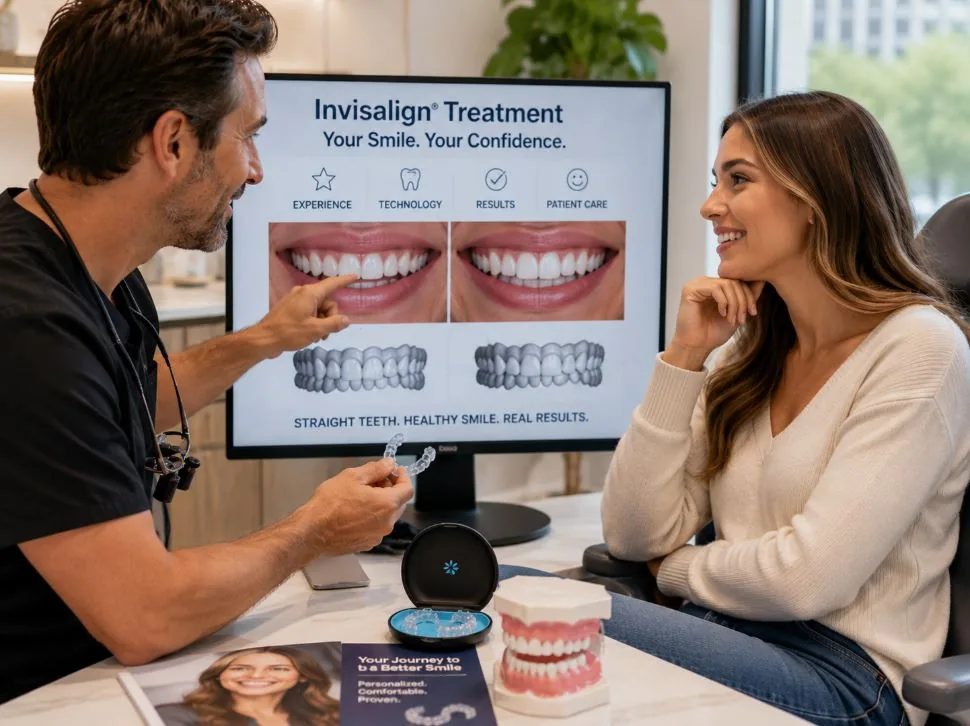
Search "top rated Invisalign provider near me" and you'll see clinics throwing around the words "Diamond," "Platinum," and "elite" as if they all mean the same thing. They don't. Invisalign provider tier is a volume-based loyalty program — not a measure of clinical quality — and confusing the two is how patients end up with the wrong doctor for their case. The post you're reading explains exactly what each tier means, why a Premier orthodontist may be a better choice than a Diamond Plus general dentist, and the five questions that actually surface whether a provider is right for your treatment.
Invisalign is the most-marketed orthodontic product in the world. The brand spent over a decade building a tiered provider system — Diamond Plus, Diamond, Platinum Plus, Platinum, Premier, and standard Provider — and trained patients to associate the higher tiers with "better doctors." That association is partly true and largely misleading. The tier reflects how many cases a practice submits to Align Technology each year, nothing more. It does not measure outcome quality, training depth, complexity skill, or whether the provider is even an orthodontist.
If you're trying to find a top-rated Invisalign provider — also known as the best Invisalign doctor for your specific case — you need to read past the lobby plaque. This guide walks through the actual tier system, the orthodontist-versus-general-dentist gap that the tiers obscure, how case complexity should drive your provider choice, the five Invisalign-specific questions to ask at a consultation, what the treatment really costs, and the red flags that have hit a lot of patients in the last few years. By the end you'll be able to walk into any Invisalign consultation and judge the provider on their merits, not their decal.
What Invisalign Tier Actually Tells You
Align Technology, the company that makes Invisalign, ranks providers based on how many cases they start each year. The tiers reset annually. They are recognition badges for case volume — a customer-loyalty system from the manufacturer's point of view. Here's how they map out:
| Tier | Annual Case Volume | What It Honestly Signals |
|---|---|---|
| Diamond Plus | 200+ cases per year | Top 1% by volume in the U.S.; very high throughput |
| Diamond | 150+ cases per year | High-volume Invisalign-focused practice |
| Platinum Plus | 75+ cases per year | Above-average volume, strong familiarity |
| Platinum | 50+ cases per year | Solid volume; one Invisalign case per week |
| Premier | 25+ cases per year | Moderate volume; comfortable with the system |
| Provider | Under 25 per year | Lower volume; may still be a strong clinician |
The volume signal is real. A Diamond Plus practice has placed 200+ cases this year alone; that's pattern-recognition you can't fake. They've seen most of the typical case types many times over and have refined their treatment-planning workflow. For straightforward cases, a high-tier provider is often a good bet on predictability.
What the tier does not tell you: training depth, residency, board certification, or whether the dentist is even capable of recognizing when a case is too complex for aligners. A general dentist who runs a high-throughput Invisalign-only practice can hit Diamond Plus while a residency-trained orthodontist with a balanced practice (braces, aligners, surgical-ortho coordination) sits at Premier. The Diamond Plus dentist has more aligner volume; the Premier orthodontist has dramatically more training depth. For a complex case, the Premier orthodontist is the better choice almost every time.
Orthodontist vs. General Dentist for Invisalign
This is the gap the tier system papers over. Invisalign is sold to two very different professional audiences — orthodontists and general dentists — and the training depth between them is significant. Patients usually don't realize the difference exists until something in their treatment goes sideways.
An orthodontist completed a 4-year DDS or DMD program and then a 2-3 year accredited orthodontic residency. The residency is full-time, hands-on training in tooth movement biomechanics, growth modification, complex case planning, and the surgical-orthodontic coordination required for severe malocclusions. By the time an orthodontist finishes residency, they've planned and executed hundreds of cases under faculty supervision, including the difficult ones that aligners can't fix on their own.
A general dentist with Invisalign certification completed dental school and then took an Invisalign training course. The standard Align certification is a weekend or short multi-day program, plus continuing-education modules. It teaches the workflow — taking the scan, submitting the case, communicating with Align's planning team, monitoring aligner progression. It does not teach orthodontic biomechanics from first principles. A general dentist who does additional CE in orthodontics can absolutely become competent at mild cases, but the depth gap on complex cases is real.
For a mild cosmetic alignment case — the kind where you want straighter front teeth, no bite issues, no rotations beyond modest — the gap matters less. A competent general dentist with hundreds of mild Invisalign cases under their belt can do excellent work on a cosmetic case. For moderate cases (rotations, mild bite issues, minor crowding correction), the gap starts to matter. For complex cases (significant overbite, underbite, crossbite, deep skeletal discrepancy, surgical candidates), the gap is the difference between a good outcome and a re-do.
| Provider Type | Training | Best For |
|---|---|---|
| General Dentist + Invisalign cert | DDS/DMD + weekend Invisalign course | Mild cosmetic alignment cases only |
| General Dentist + extensive ortho CE | DDS/DMD + multi-year continuing education | Mild-to-moderate cases; verify case volume |
| Orthodontist (residency-trained) | DDS/DMD + 2-3 year ortho residency | Full range of Invisalign cases |
| Board-Certified Orthodontist (ABO) | Above + voluntary ABO certification | Same scope; signals additional case-quality scrutiny |
The honest summary: Invisalign as a tool can be wielded well by both orthodontists and well-trained general dentists, but the floor is much higher with an orthodontist. If your case is complex, or you're not certain how complex it is, an orthodontist is the safer pick regardless of Invisalign tier.
Match the Provider to Your Case Complexity
The single most useful question to ask yourself before booking a consultation is: how complex is my case, honestly? Most patients don't know, and most providers don't volunteer the answer because the higher-complexity diagnosis is harder to sell as a quick aligner case. Here's a rough self-classification framework you can use as a starting point.
Mild — cosmetic alignment
Mild crowding (a few teeth slightly overlapping), small spacing gaps, modest cosmetic alignment of front teeth, mild relapse from old orthodontic work. No significant bite issues, no skeletal discrepancy, no severe rotations. Treatment usually takes 6-12 months with Invisalign Express or Lite product variants. A high-volume general dentist with Invisalign certification can absolutely handle this tier. Roughly half of adult cosmetic cases fall here.
Moderate — rotations, mild bite issues
More significant crowding, noticeable rotations on one or more teeth, mild overbite or underbite, mild crossbite, modest open-bite. Cases that require attachments (small composite bumps bonded to teeth that the aligner uses for leverage) and possibly elastics. Treatment is typically 12-20 months. Comprehensive Invisalign product. A residency-trained orthodontist or a general dentist with substantial extra ortho training is the right fit. Most adult Invisalign cases sit here.
Complex — significant skeletal or bite issues
Severe overbite or underbite, true skeletal class II or III, significant crossbite, severe rotations, impacted teeth, surgical-orthodontic candidates (jaw surgery + ortho), severe deep bite, severe open bite, cases involving missing teeth requiring orthodontic space management for future implants. These cases often genuinely need braces, hybrid braces-then-Invisalign treatment, or surgical-orthodontic coordination. An orthodontist — ideally board-certified, ideally with surgical-ortho experience for the most complex variants — is the right choice. A general dentist offering "Invisalign for everything" on a case in this tier is a red flag.
If you're uncertain which tier you fall into, the safest move is to consult with at least one orthodontist. They'll classify the case honestly, often free at the initial consultation, and the diagnosis itself is useful information regardless of which provider you ultimately choose.
Five Consultation Questions Specific to Invisalign
The general "top rated" questions for any orthodontist apply here, but five Invisalign-specific questions surface the things the consultation script tends to skip. Ask all five plainly.
None of these questions are aggressive. A confident provider welcomes them — these are the things a thoughtful patient should be asking. A defensive or rushed reaction to any of the five is itself the answer.
What Invisalign Actually Costs in 2026
Pricing is set by the practice, not by Align Technology. The U.S. range is wide because case complexity, geography, and provider tier all affect the number. Here's the realistic 2026 range across the common scenarios.
| Treatment Scenario | Typical U.S. Range |
|---|---|
| Invisalign Express / Lite (mild cases, 6-12 months) | $2,500 – $4,500 |
| Invisalign Comprehensive (full case, 12-24 months) | $4,000 – $8,500 |
| Invisalign Teen (age-appropriate, includes compliance indicators) | $3,500 – $7,500 |
| Refinement round (additional aligners mid-treatment) | $500 – $1,500 |
| Retainers (per arch, Vivera or essix, post-treatment) | $300 – $700 |
| Replacement aligners (lost or broken, per tray) | $80 – $250 |
The top of the range sits in NYC, LA, San Francisco, and Boston. The lower end shows up in smaller metros — Charlotte, Phoenix, Jacksonville, Birmingham. The treatment outcome is essentially the same; geography drives the price. A Diamond Plus practice in a tier-1 metro often charges more than a Premier practice in a tier-2 metro because they can — not because the case is better.
Same orthodontic insurance lifetime maximum applies that we covered in the main top-rated orthodontist guide. Most dental plans treat Invisalign exactly like braces: $1,500 to $3,000 lifetime ortho max per insured patient, often a 50/50 split. The lifetime max is per person, not per treatment — once it's used, no more ortho coverage on that policy for that patient regardless of what kind of treatment is involved.
Insurance, Financing, and Payment Plans
Almost every Invisalign practice offers in-house monthly payment plans. The standard structure: $500-1,500 down at start of treatment, then $150-300/month for the duration (12-24 months for most cases). No interest if paid within the treatment window. This is usually a better deal than reaching for CareCredit or LendingClub because there's no interest exposure if you stay current.
HSA and FSA dollars cover Invisalign in full — orthodontic care is an eligible expense under both. If you have either account, contribute the IRS maximum the year before your planned start. The federal tax savings on a $5,500 Invisalign case run $1,200-1,750 depending on your bracket. That's real money that materially changes the all-in cost.
Red Flags Specific to Invisalign Shopping
The Invisalign market has its own particular traps, separate from general orthodontic red flags. Some are obvious in hindsight, some have caught a lot of patients in the past few years.
Bait pricing on "starter packages" — advertised prices like "$1,999 Invisalign" or "$2,499 short-term aligners" almost always cover Express or Lite product on a mild case, exclude refinements, exclude retainers, and exclude any attachments or IPR the case needs. The all-in cost ends up matching or exceeding a normally-priced full case. Always ask: is this number the all-in cost including refinements and retainers?
Providers who only offer Invisalign and refuse to recommend braces — some practices have invested so heavily in being an aligner-focused practice that they recommend Invisalign for every case, including cases that genuinely need braces or hybrid treatment. A complex case with significant rotations, severe overbite, or skeletal discrepancy may have a meaningfully better outcome with braces or a hybrid plan. A practice that won't even discuss those options is selling the tool, not treating the case.
"Diamond Plus" used as the only quality claim — the tier is real, but a provider who leans on it without also being able to articulate their training, residency, board status, or case-specific experience is signaling that volume is the entire pitch. Volume on simple cases isn't the same as competence on yours.
Refusal to share the orthodontist's name at corporate aligner chains — some chains rotate dentists across locations or use remote-supervision models. You should know the name and credentials of the person planning your treatment before signing a contract. "We'll assign someone" is not an acceptable answer.
"Lock in today's price" pressure at the consultation — Invisalign treatment is a 12-to-24-month commitment costing thousands of dollars. It is not an impulse purchase. Any provider pressuring same-day commitment is using a sales tactic, not a clinical one. Walk out, take a few days, evaluate the quote against at least one second opinion.
How Smyleee's Directory Helps
Smyleee maintains city-level Top 10 rankings specifically for Invisalign in major U.S. metros, separate from our general orthodontist rankings. Each clinic is vetted on credentials (residency, board certification), Invisalign tier, case volume signals, and aggregate patient feedback rather than raw review counts. Our rankings flag whether the provider is an orthodontist or a general dentist with Invisalign certification, so you can match provider depth to case complexity.
Useful starting points if you want a curated Invisalign-specific shortlist:
- Top 10 Invisalign Providers in Los Angeles
- Top 10 Invisalign Providers in San Francisco
- Top 10 Invisalign Providers in Miami
- Top 10 Invisalign Providers in Phoenix
- Top 10 Invisalign Providers in Charlotte
- Top 10 Invisalign Providers in Brooklyn
If your case is on the more complex end, or you want to start from the broader orthodontist directory and filter from there, our city orthodontist lists are also a good starting point: New York City, Los Angeles, Miami, Phoenix, and Charlotte.
For state-level overviews, see our California and Florida orthodontist guides. If you're an adult patient considering Invisalign as part of a broader treatment decision, the adult orthodontist guide covers the life-stage considerations that compound on top of the provider-tier question.
Final Thoughts
"Top rated Invisalign provider" sounds like a single thing. It isn't. It's the intersection of provider credentials (orthodontist versus general dentist), case-specific experience (have they treated cases like yours), Invisalign tier (volume signal), and pricing transparency (do they itemize and stand behind a written quote). The Diamond Plus dentist next door may genuinely be the best Invisalign doctor for your case — or they may be the wrong choice entirely, and the residency-trained Premier orthodontist a mile away is the right one. You can't tell from the lobby plaque.
Spend an extra hour on the consultation phase. Ask the five questions. Get the all-in cost in writing including refinement policy and retainers. Ask for case-similar before-and-afters. Walk out without committing if anything feels off. Invisalign is a 12-to-24-month commitment costing $4,000-$8,500 — the consultation hour is the cheapest part of the whole project and the one with the highest leverage on the outcome.
Find a Genuinely Top-Rated Invisalign Provider
Browse Smyleee's curated, credentials-vetted directory of orthodontists and Invisalign providers across the U.S. — with tier flags, board-certification markers, and aggregate ratings.
Sources & References
- Invisalign — Treatment Process Overview
- Invisalign — Provider Locator and Tier System
- American Association of Orthodontists — Find an Orthodontist & Patient Resources
- American Board of Orthodontics — Board Certification Standards
- U.S. Food and Drug Administration — Dental Aligner Safety Guidance
- American Dental Association Health Policy Institute — Orthodontic Workforce & Cost Data
- MetLife Oral Fitness Library — How Much Do Braces and Invisalign Cost?
- GoodRx — How Much Do Braces and Invisalign Cost?
- CareCredit — Orthodontic Financing Options
- IRS Publication 502 — Medical and Dental Expenses (HSA / FSA Eligibility)