The short version, if you only read one thing
Botox for bruxism works by injecting small amounts of botulinum toxin type A directly into the masseter — and sometimes temporalis — muscles, where it blocks the nerve signal that triggers contraction. The muscles get weaker for three to four months; clenching force drops; tooth wear and jaw pain often drop with it. The evidence supports modest, clinically meaningful improvements in pain and reported jaw symptoms in moderate-to-severe bruxers who have failed conservative treatment. Important caveats: the use for bruxism is off-label in most countries — meaning the FDA and equivalent agencies have not formally approved it for this indication, even though it is widely used. The effect is temporary; the treatment is recurring; the cost adds up. Long-term safety data, particularly around possible bone changes from sustained muscle weakening, is incomplete and modestly debated. It is not a first-line treatment. It is a defensible second- or third-line option for patients who have tried a well-fitted night guard, addressed contributing factors like stress and sleep, and still have meaningful symptoms — and it is the wrong answer for casual or occasional grinders who would do as well with a $50 boil-and-bite.
What botulinum toxin actually does inside the muscle
The mechanism is more specific than the marketing usually conveys. Botulinum toxin type A is a protein produced by the bacterium Clostridium botulinum. When injected in small, precisely measured doses into a target muscle, the protein binds to the presynaptic terminals of motor nerve endings and prevents the release of acetylcholine — the neurotransmitter that tells the muscle to contract. The signal from the brain still arrives at the nerve. The nerve just cannot deliver it to the muscle. The muscle, deprived of its instruction to contract, weakens.
For bruxism, the target is the masseter — the thick, paired muscle that runs from the cheekbone down to the angle of the jaw on each side. Sometimes the temporalis, the fan-shaped muscle along the side of the head, is also injected. These are the two main muscles that close the jaw and generate the force of clenching and grinding. By weakening them, the procedure does not stop the brain from sending the grind signal during sleep — the central nervous system continues to do whatever it does that produces nocturnal bruxism. What changes is the amount of force the masseters can generate when that signal arrives. The clenching still happens. It just clenches with much less power.
This is conceptually important because it explains why botox helps and what its limits are. It reduces the consequences of bruxism — tooth wear, muscle soreness, headache from prolonged tension, hypertrophy of the masseters that produces the visibly thickened jawline some chronic bruxers develop. It does not address the underlying central cause. When the toxin wears off three to four months later, the muscle returns to its full strength and the bruxism behaviour, if untreated otherwise, returns to its baseline. The treatment is repetitive by design.
What the published evidence actually shows
The evidence base for botulinum toxin in bruxism has grown meaningfully in the last decade but is still smaller and less consistent than the evidence for night guards. The most informative trials are a small number of randomised, double-blind, placebo-controlled studies — the methodological gold standard — that have compared botox injections to saline placebo in patients with confirmed bruxism.
The 2018 trial by Ondo and colleagues, published in Neurology, is one of the most often-cited. It randomised patients with confirmed sleep bruxism to either a single session of onabotulinumtoxinA injections in the masseter and temporalis or to placebo injections, and followed them with both subjective reports and objective measures over the following months. The botox group reported meaningful improvements in pain severity, jaw soreness, and disability scores compared with placebo. The objective measure of grinding events on polysomnography did not change significantly — consistent with the mechanism, where the brain's grinding signal is still produced but the muscle response is reduced.
Earlier trials by Shim and colleagues using polysomnography reached similar conclusions. The number of grinding events per hour of sleep was largely unchanged after botox; what changed was the intensity of each event — measured by muscle electrical activity — which dropped substantially. The downstream effect on tooth wear is harder to quantify in short trials but is supported by clinical observation and is consistent with the mechanism.
The Cochrane analysis of botulinum toxin for various non-cosmetic head and neck conditions includes bruxism among the indications with growing but still moderate-quality evidence. The strongest conclusion the current literature supports is that botox provides clinically meaningful reduction in pain and reported jaw symptoms in patients with moderate to severe bruxism, with a side-effect profile that is real but mostly mild. The weakest part of the evidence is long-term outcomes — most trials follow patients for three to six months rather than years, and what happens over repeated injection cycles across a decade is genuinely unclear.
3–4 mo
Approximate duration of clinically meaningful effect from a single session of botulinum toxin injections for bruxism in published trials. Some patients report the benefit beginning to fade as early as eight to ten weeks; others maintain the effect through five months. Repeat injections are required to sustain symptom control, which is the central practical fact that the cost-benefit calculation has to honestly include.
How the procedure actually works
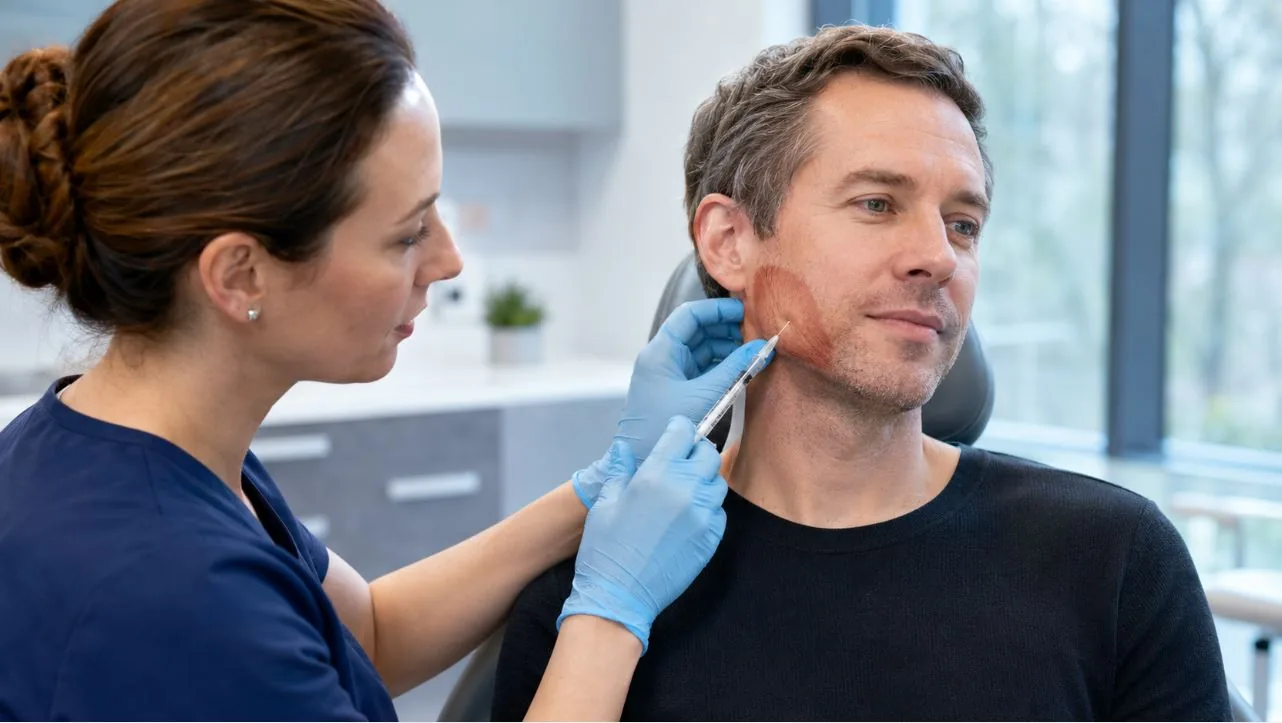
The injection itself is brief — typically 10 to 15 minutes in the chair. The provider palpates the masseter muscle at the angle of the jaw while the patient clenches, identifies the thickest part of the muscle belly, and injects small aliquots of reconstituted toxin at three to five sites per side. The total dose for the masseter typically falls in the range of 25 to 50 units per side, depending on the patient's muscle bulk, the severity of grinding, and the provider's protocol. If the temporalis is also being treated, smaller doses are placed in two or three sites along the muscle's length.
The needle is small. The discomfort is roughly comparable to a dental anaesthetic injection — a brief sting that resolves within a few seconds. No local anaesthesia is usually required for the injections themselves; some providers offer a topical numbing cream over the injection sites if the patient prefers. Total procedure time, including the consultation and post-injection observation, is rarely more than 30 minutes.
The effect is not immediate. Botulinum toxin requires several days to bind fully to nerve terminals and produce its clinical effect. Most patients begin to notice reduced jaw tension within 3 to 7 days, with the full effect established by two weeks. The reduction in grinding intensity and pain typically peaks somewhere between two and six weeks after the procedure, then maintains for the following two to three months before gradually wearing off.
Read also
The first-line conversation almost every bruxism patient should have had before getting to the botox consult. What the different night-guard tiers actually deliver and where the evidence supports the higher tiers.
Cost, frequency, and the economics over time
This is the part of the conversation that the consent form does not usually frame clearly. A single session of botox for bruxism in the United States typically costs $300 to $800 depending on the provider, the geographic location, and the total units injected. Dentists, oral and maxillofacial surgeons, neurologists, sleep medicine physicians, and some general physicians all offer the procedure. Pricing varies widely; the lower end is usually a dental office offering it as an add-on; the higher end is a specialty pain or aesthetic medicine practice.
The procedure needs to be repeated, in most patients, every three to four months to maintain effect. That works out to three to four sessions per year. A patient on regular treatment is therefore looking at roughly $900 to $3,200 per year, every year, for as long as they continue. A well-made custom dental night guard, by comparison, costs $400 to $800 once and typically lasts five to ten years — call it $50 to $160 per year amortised. The cost gap is the same order of magnitude as the cost gap between a good gym membership and a luxury car payment, and it accumulates.
This is not an argument that botox is not worth the money. For the right patient, with severe symptoms that have failed conservative management, the cost-benefit may be favourable. It is an argument that the cost-benefit needs to be calculated over a realistic timeframe — five years, ten years — rather than presented as a single $500 charge. A patient who starts botox at thirty-five and continues for thirty years has spent somewhere between $30,000 and $90,000 on the treatment.
Dental insurance generally does not cover botox for bruxism because it is off-label and considered cosmetic-adjacent. Medical insurance sometimes covers it when the diagnosis is migraine (FDA-approved for chronic migraine) or TMJ disorder with appropriate documentation. The coverage picture is patchy and worth understanding before the first session.