The short version, if you only read one thing
Night guards exist on a spectrum from a five-dollar stock tray you bite into to a multi-hundred-dollar custom-fitted hard acrylic appliance made from dental impressions. The published evidence is clear on a few points and unclear on others. Clear: custom guards fit precisely, last for years, do not fall out, and do not unintentionally shift your bite if the dentist makes them correctly. They are the right answer for moderate to severe nocturnal bruxism, for anyone with significant existing tooth wear, and for anyone with TMJ symptoms that need a stable occlusal surface to manage. Less clear: for mild, occasional grinding in someone with no pre-existing damage and no TMJ symptoms, a well-fitted boil-and-bite guard offers most of the mechanical protection at a fraction of the cost. Genuinely problematic: stock OTC trays that don't conform to your bite. They sit loose, fall out, train you to clench against the foreign object, and in some cases shift teeth or aggravate jaw symptoms over time. The cheap-versus-expensive framing is the wrong axis. The right one is fit, durability, and clinical risk profile — and those map to specific products in ways the marketing usually skips.
What a night guard actually does (and does not do)
The first useful clarification is what a night guard is for. It is a passive mechanical barrier between the upper and lower teeth. Its job is to absorb the destructive forces of nocturnal bruxism — the involuntary clenching and grinding that happens during sleep — so that those forces wear down the device rather than the enamel and dentin underneath. That is the whole mechanism. The guard does not stop the grinding. The brain still issues the motor signal; the masseter and temporalis muscles still contract; the tooth surfaces still come together with significant force. The guard simply puts a sacrificial layer in between.
This is worth saying explicitly because the marketing for some products suggests the guard will cure bruxism, or that wearing it consistently will train the jaw out of grinding. The published evidence does not support either claim. The 2014 Cochrane review of occlusal splints for sleep bruxism concluded that splints reduce tooth wear and may reduce reported jaw symptoms in some patients, but they do not reliably reduce the frequency or intensity of the grinding itself. The brain keeps doing what the brain does. The guard protects the teeth from the consequences.
This matters because it means the most important property of a guard is not "comfort" or "feel" — it is whether the device successfully sits between the teeth for eight hours of motor activity you have no conscious control over. A guard that falls out at 2 a.m., or that gets pushed aside by an enthusiastic molar, or that you wake up to find on the pillow next to you, is functionally not protecting your teeth from anything for the rest of the night.
The three categories of night guard
Almost every product on the market falls into one of three categories, distinguished mostly by how the fit is achieved.
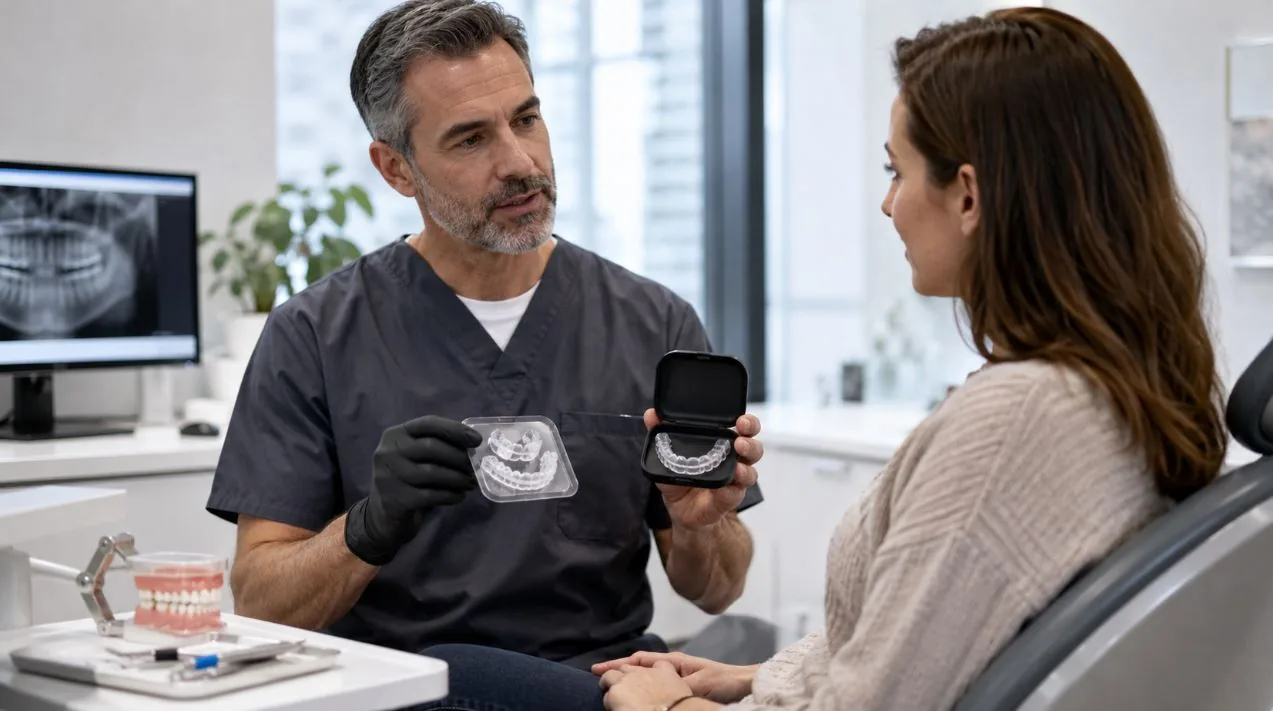
Custom-fitted. The dentist takes impressions of your upper and lower teeth, either with traditional putty or a digital intraoral scanner, and sends the impressions to a dental laboratory. The lab makes a model of your dentition and fabricates the guard against that model from a hard acrylic, a dual-laminate (hard outside, soft inside), or in some cases a soft thermoplastic. The guard returns to the office a week or two later. The dentist fits it, makes any needed adjustments to the occlusion (the way the upper and lower teeth meet through the guard), and you take it home. Cost in the United States typically runs $300 to $800 for a standard acrylic; specialty appliances for TMJ or sleep-apnea overlap cost more. Lifespan is typically five to ten years with reasonable care.
Boil-and-bite. A pre-made thermoplastic tray, typically purchased at a pharmacy or online for $20 to $60. You soften it in boiling water, bite into it, and shape it around your own teeth as it cools. The fit is approximate — the guard takes the gross shape of your dental arch but does not capture the precise topography of individual cusps and fossae the way a lab-fabricated guard does. Lifespan is generally six months to two years depending on grinding intensity. Some users find them comfortable; others find the bulk and approximate fit irritating.
Stock / one-size-fits-all. The cheapest category, often sold at gas stations, sporting goods stores, and the bottom shelf of pharmacies for under $20. These are pre-formed trays in two or three generic sizes; you do not customise them in any way before use. They are mostly designed for the sports-mouthguard market and are not intended for nocturnal use, although they get marketed for it. The fit is poor. They fall out frequently and the published clinical guidance generally does not recommend them for bruxism.
A fourth category — direct-to-consumer custom guards delivered by mail, where the company sends you an impression kit and fabricates a guard from your at-home impression — has emerged in the last decade. These sit between boil-and-bite and dentist-fitted custom: they are made from your dental impressions, but the impression quality is variable and there is no in-person fitting or bite-adjustment step. Cost is typically $100 to $300. Quality varies considerably between providers.
The fit conversation, and why it actually matters
"Fit" gets used as a fuzzy comfort term in product marketing, but in the context of a night guard it has a specific clinical meaning. A well-fitted guard does three things at once. First, it makes contact with every tooth in the dental arch it is covering. Second, it allows the teeth in the opposite arch to make even, simultaneous contact across the guard's biting surface — so when you close down on it in sleep, the load is distributed across all the contact points rather than concentrated on a few. Third, it stays put through the entire night regardless of jaw posture, tongue movement, or saliva flow.
A custom-fitted guard achieves all three by being made from a precise mould of your teeth and adjusted at delivery. A well-made boil-and-bite, fitted carefully by someone who follows the instructions exactly, can achieve a reasonable approximation of the first two. A stock tray achieves none of them reliably. The reason this matters is that a poorly fitted guard does not simply fail to protect the teeth — it can actively cause problems.
5–10 yr
Typical lifespan of a well-made custom acrylic night guard with normal grinding and reasonable care. Boil-and-bite guards under the same grinding load typically last six months to two years; they tend to develop visible perforations or compressed bite surfaces well before the custom acrylics show meaningful wear. The lifespan difference is one of the strongest cost-versus-cost arguments for the custom option, even before clinical factors are considered.
What goes wrong with bad fit
The two specific failure modes worth knowing about are tooth movement and occlusal change. A guard that does not cover every tooth completely, or that covers only the front teeth, creates a setup where the uncovered posterior teeth can over-erupt slightly over months and years of wear. The dentition shifts. The patient eventually presents with a different bite than the one they had before they started wearing the guard. This is uncommon with custom-fitted full-arch guards. It is documented in the literature with partial-coverage anterior-only devices and with some of the cheaper one-size trays that don't fully seat against the back teeth.
The other failure mode is a guard that introduces a heavy occlusal interference — a single point where the upper and lower teeth meet through the guard before any others do, when the patient closes down. Over months, that interference can trigger or aggravate temporomandibular joint symptoms in susceptible people: morning jaw soreness, clicking, headaches that didn't exist before the guard. A good dentist screens for this at the fitting appointment, adjusts the guard chairside with articulating paper, and verifies even contact. An online custom guard or a self-fitted boil-and-bite has no equivalent quality check.
The risk profile is small in absolute terms, but it is also asymmetric. The downside of a poorly fitting guard is not "you wasted twenty dollars." It is potentially weeks of jaw symptoms or, in the worst case, dentition changes that take orthodontic intervention to reverse. This is the cost the cheap-versus-expensive framing tends to omit.
Read also
Companion piece in the same skeptical register — what happens when the science behind a clinical claim doesn't quite match the headline version, and how to read the difference.
Hard, soft, or dual-laminate
Within the custom-fitted category there is a second decision that gets less attention but matters for the patient experience. Night guards come in different material grades.
A hard acrylic guard is the traditional standard. It is rigid, durable, lasts the longest, and provides the most stable occlusal surface — important for TMJ-targeted appliances where the dentist wants a precise, reproducible bite position. Hard guards are sometimes initially uncomfortable; the patient adapts over the first week or two. They are the default recommendation for moderate to severe grinders.
A soft thermoplastic guard, often described as "soft EVA," is more comfortable from day one and easier to tolerate for new wearers. The trade-off is durability — soft guards compress faster under heavy grinding forces and need replacement sooner. There is also a counter-intuitive effect documented in some studies: in heavy bruxers, a soft guard can sometimes increase grinding-muscle activity rather than decrease it, possibly because the brain registers the soft surface as something to chew on. For light or anxious grinders, soft is fine and often more compliant. For heavy bruxers, soft is usually the wrong material.
A dual-laminate guard is hard on the outside (durable, doesn't compress) and soft on the inside (comfortable against the gums). It is the modern compromise and is what most labs now make by default unless asked for something else. For most patients this is the right material.