The short version, if you only read one thing
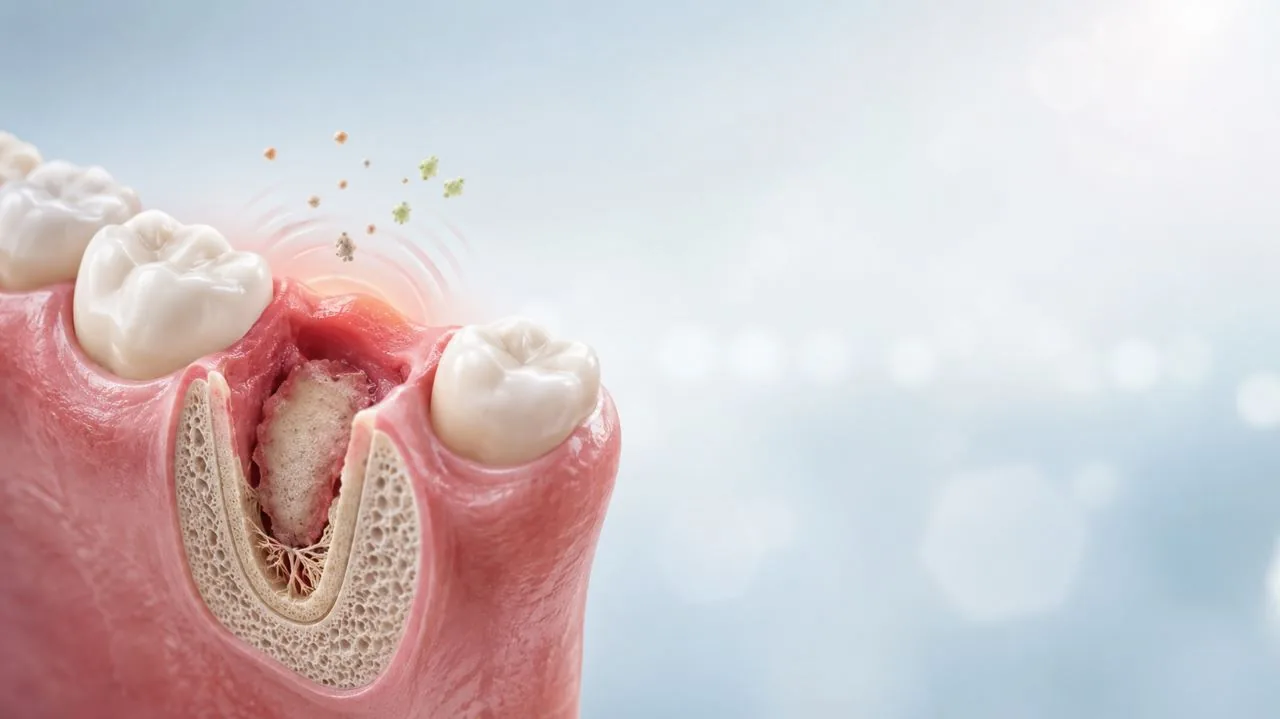
Dry socket is what happens when the protective blood clot inside an extraction socket fails to form properly, breaks down too early, or gets mechanically dislodged. The exposed bone underneath produces a deep, throbbing pain that classically begins three to five days after surgery, after the initial post-op pain had begun to improve. The pain is poorly controlled by the usual painkillers, often radiates up the face and into the ear, and is frequently accompanied by a foul taste and a noticeable bad smell. It is not dangerous, it is not an infection in the strict sense, and it will eventually heal on its own. But it is meaningfully unpleasant — and treatment by the surgeon (gentle irrigation and a medicated dressing) usually brings rapid relief within an hour. The key things to avoid: smoking, vigorous rinsing, drinking through a straw, spitting, and aggressive physical activity for the first few days. The key things to recognise: timing (day three to five, not day one), quality (deep throbbing, not bruised soreness), and pattern (worsening rather than improving). Call the surgeon the same day if those line up.
What dry socket actually is
The mechanism is more interesting than the name suggests. When a tooth is extracted, blood fills the empty socket and forms a clot — a soft, gelatinous structure made of fibrin, platelets, and trapped red blood cells. The clot does several jobs at once. It physically seals the socket against bacteria from the mouth. It scaffolds the growth of granulation tissue, which will eventually be replaced by bone in the weeks ahead. And it protects the exposed bone surface and the nerve endings within it from the constant traffic of saliva, food particles, and acidic drinks that pass through the mouth all day.
In a normal post-extraction socket, the clot stays put for the first several days, gradually becoming organised, more solid, and incorporated into the healing tissues. In dry socket, the clot either fails to form completely, breaks down prematurely (a process called fibrinolysis), or is mechanically disrupted before it has consolidated. The result is an empty socket — sometimes literally dry-looking when the surgeon examines it, hence the name — with exposed alveolar bone at the bottom. The bone is dense, full of pain-sensitive nerve endings, and now in direct contact with whatever is in the mouth. The brain interprets that contact as severe pain.
It is worth saying explicitly that dry socket is not infection in the strict medical sense. There is no abscess, no pus, no systemic involvement. There is no fever, the patient does not feel unwell in a general way, and untreated dry socket does not progress to a more dangerous condition. It is a local problem of clot failure with a local solution. Bacteria do play a role in fibrinolysis — certain oral bacteria produce enzymes that break down fibrin — but this is biochemical interference with healing, not infection in the colloquial sense.
Why it happens to some patients and not others
The published risk factors for dry socket have been studied extensively, and the same handful keep coming up across different patient populations and clinical settings. Some are modifiable, some are not.
Smoking. The single strongest modifiable risk factor. Smokers develop dry socket at roughly three to four times the rate of non-smokers in most studies. There are two mechanisms at work. The act of drawing on a cigarette creates a literal suction force that can mechanically dislodge a forming clot. And nicotine vasoconstricts the small vessels feeding the wound, reducing local blood flow and impairing the normal healing response. Vaping has both effects too and is not a safe substitute. Forty-eight hours is the absolute minimum window of abstinence the literature supports; a full week is what the evidence suggests for meaningful risk reduction; longer is better.
Hormonal contraceptives. Multiple studies have shown an elevated rate of dry socket in women taking estrogen-containing oral contraceptives, likely because of estrogen's effect on the fibrinolytic system. The increase in risk is modest but reproducible. Surgeons sometimes schedule elective extractions for the last week of the pill cycle, when estrogen levels are lower, in patients who are willing to coordinate the timing.
Lower wisdom teeth and difficult extractions. Lower third molars have the highest dry socket rates of any tooth, and the rate climbs steeply with the difficulty of the extraction. Simple extractions of fully erupted teeth have rates around two to three percent; full bony impactions of lower wisdom teeth can have rates of fifteen to thirty percent. The mechanism involves both the more traumatic nature of complex extraction and the lower oxygen tension in the deeper, narrower socket that results.
Age. Risk increases gradually with age, particularly after thirty-five. The mechanisms are not fully worked out but probably involve slower healing kinetics, denser bone, and reduced vascular response in older patients.
Previous history of dry socket. Patients who have had dry socket on a prior extraction are at higher risk on subsequent extractions. The reasons are not entirely clear, but the pattern is consistent enough to be clinically meaningful.
Poor oral hygiene and pre-existing inflammation. A mouth with active periodontal disease, or a recently extracted tooth that had a long-standing pericoronitis, has a higher rate of post-operative complications including dry socket.
2–5%
Approximate baseline incidence of dry socket after routine, uncomplicated tooth extractions in the general population. The rate climbs sharply for lower third molar extractions — particularly difficult impactions — where studies have reported incidences ranging from 15% to 30% depending on the surgical complexity, patient risk profile, and post-operative compliance. The variability tells you the rate is highly modifiable through both surgical technique and post-operative care.
Prevention — what actually works, before and after surgery
Most of the practical prevention conversation is about post-operative behaviour during the first three to five days, when the clot is forming and most vulnerable.
- Do not smoke, vape, or use any nicotine product. Forty-eight hours is the floor; a week is the goal; longer is better. This single intervention reduces your risk by more than any other thing you can do.
- No straws, no spitting, no vigorous rinsing. Anything that creates negative pressure in the mouth can dislodge the clot. Drink from a cup or glass, let saliva drool into a tissue rather than spitting for the first day or two, rinse very gently if at all (and only after day two).
- Bite firmly on gauze for the prescribed time after surgery. Pressure helps the clot form and stay put. The surgeon will tell you how long; usually 30 to 60 minutes per gauze change for the first few hours.
- Avoid hot foods and drinks for the first 24 hours. Heat can thin the clot and dissolve it before it consolidates. Cool or room-temperature liquids and very soft foods are the right register for day one.
- Avoid vigorous physical exercise for the first 48 hours. The increase in blood pressure and physical exertion can dislodge a still-fragile clot. Walking is fine; heavy lifting, cardio, and contact sports are not.
- Take your prescribed medications on schedule — including any antibiotic or chlorhexidine mouthwash the surgeon has recommended. Some surgeons prescribe a chlorhexidine rinse starting the day after surgery; in the published trials this modestly reduces dry socket rates.
- If you take oral contraceptives and you are scheduling an elective extraction, consider asking whether timing the procedure for the placebo week of the pill cycle is appropriate.
On the surgeon's side, there are also prevention measures: gentle surgical technique, copious irrigation of the socket during extraction, careful debridement of any sharp bone edges, and in some practices the placement of intra-socket medications (chlorhexidine gel, antimicrobial dressings, or even platelet-rich fibrin in specialised settings). The evidence for each of these is variable. The strongest prevention remains patient compliance with the first few days of post-operative restrictions.
Recognising dry socket — the diagnostic triangle
What distinguishes dry socket from normal post-operative pain comes down to three things, taken together. Any one alone is not enough; the combination is the signature.
Timing. Normal post-operative pain peaks in the first 24 to 48 hours and then gradually improves day by day. Dry socket pain typically starts three to five days after surgery, after the initial pain has been improving. The late onset, after a period of getting better, is the most distinctive feature. Dry socket starting on day one is very rare; the timing pattern is what differentiates it from a complicated normal recovery.
Quality. Dry socket pain has a specific character. It is deep, throbbing, and constant rather than the bruised, soreness-on-pressure feel of normal post-op pain. It often radiates up the side of the face, into the ear, sometimes down the neck. It feels like it is coming from inside the bone, which it essentially is. The pain is poorly controlled by the analgesics that worked fine in the first few days — ibuprofen and paracetamol that managed day one no longer make a meaningful dent.
Associated features. A foul taste in the mouth that does not clear with rinsing. A noticeable bad smell from the socket. Sometimes a visible empty socket if you look in a mirror — instead of a dark red filled-in cavity, you see exposed yellowish-white bone. Sometimes food particles visible in the socket because there is no clot to keep them out. These features together with the timing and the quality of pain are the diagnostic triangle that a surgeon recognises immediately.
When to call rather than wait
Dry socket itself is not an emergency in the strict sense. It will not become more dangerous if you wait until morning to call. But it is also not a situation that improves on its own quickly — treated dry socket settles within a day or two, untreated dry socket can persist for 7 to 10 days of significant pain. The right thing to do, the moment you have the three signs together, is to call the surgeon's after-hours line and arrange to be seen as soon as the office opens.
The features that do warrant urgent attention — separately from dry socket and worth distinguishing — are fever above 38°C / 100.4°F, increasing rather than decreasing swelling after day three, visible pus from the socket, difficulty swallowing or breathing, or systemic feeling of being unwell. These suggest infection, which is a different problem and warrants same-day rather than next-day evaluation.
Read also
The companion piece on the broader recovery arc — peak swelling at 48-72 hours, what's normal versus what means a phone call, and the food-by-stage guide for the first month after extraction.