The short version, if you only read one thing
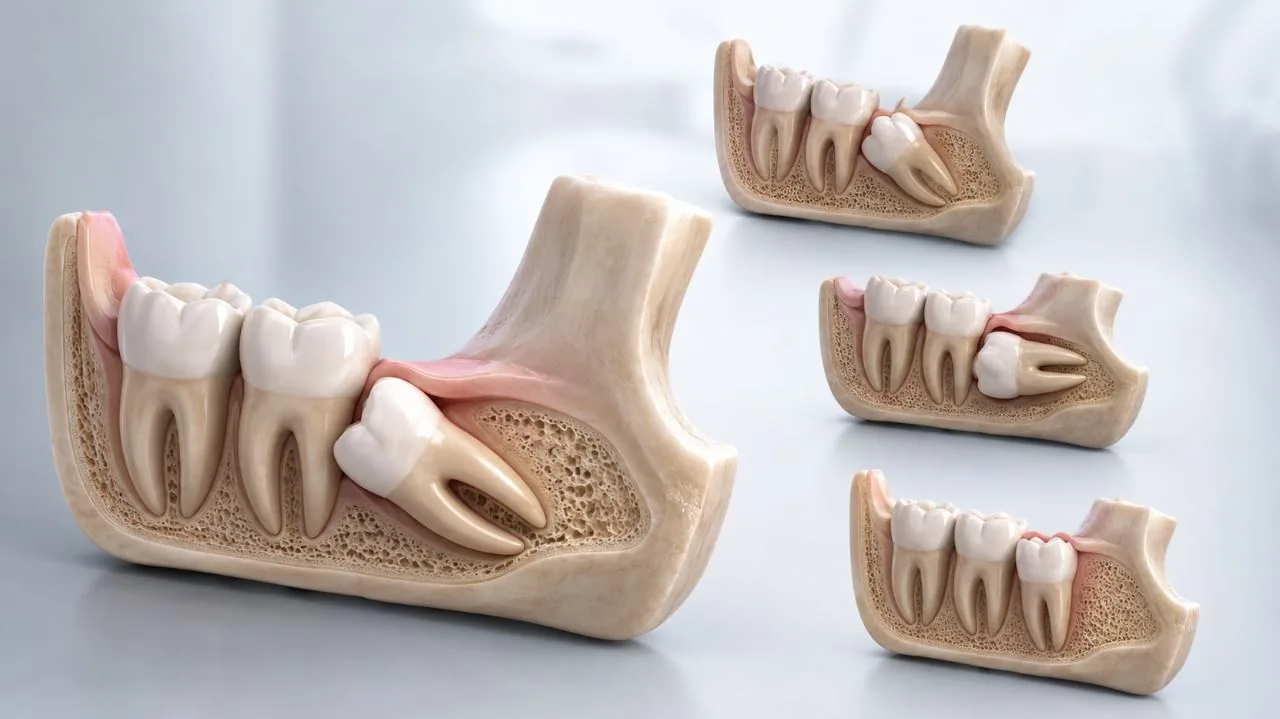
Impacted third molars are classified along two axes that any oral surgeon will reference: angulation (which way the tooth is leaning) using the Winter classification, and depth and position (how deep it sits and how it relates to the jawbone) using the Pell and Gregory classification. The classifications are not academic — they predict surgical difficulty, time in the chair, complication rate, and whether a cone-beam CT is appropriate before surgery. Roughly: vertical impactions are the easiest, mesioangular (tilted forward) are the most common and moderately difficult, horizontal (lying down) and distoangular (tilted backward) are the hardest. The deeper and further back the tooth sits, the more bone has to be removed and the higher the risk of meaningful complications. Knowing your specific classification before the consult lets you ask better questions and recognise when the case warrants imaging or a referral to a more experienced surgeon.
How a tooth becomes impacted in the first place
An impacted tooth is one that fails to erupt fully into its normal functional position. For third molars, this is overwhelmingly common: in the adult population, somewhere between a third and three-quarters of people have at least one impacted wisdom tooth depending on the dataset and the definition used. The mechanism is straightforward — the human jaw has been getting smaller across evolutionary time while the dentition has not, and the third molars are the last teeth to develop. When they try to erupt in the late teens, they often arrive at a space that is too small, in front of a second molar that is unwilling to move, with surrounding bone that has finished growing. The tooth gets stuck. Sometimes it pushes partway through the gum and stalls there. Sometimes it stays fully under the gumline. Sometimes it angles itself into the path of least resistance, which often happens to be sideways or forward.
None of this is unusual. None of it is automatically a problem. Many impacted teeth, especially deeply buried ones with no eruption pathway and no symptoms, can stay where they are for a lifetime. The classification system exists not because every impacted tooth needs to come out, but because when one does, the geometry tells the surgeon what they are dealing with.
The Winter classification — which way is the tooth leaning?
The first axis describes the angle of the tooth's long axis relative to the long axis of the second molar in front of it. This is the Winter classification, named after the British dental surgeon George Winter who described it in 1926. Four categories cover most of the cases you will see described on a radiograph.
Vertical. The tooth sits roughly upright, in the same axis as if it had erupted normally. It just hasn't completed eruption — perhaps the gum tissue still covers part of the crown, perhaps the second molar is in the way of full eruption. These are the most straightforward extractions of the four. The tooth can usually be elevated out along its own long axis with minimal bone removal. Vertical impactions account for roughly 30 to 40 percent of impacted third molars in most populations studied.
Mesioangular. The tooth is tilted forward, with its crown angled toward the second molar in front of it. This is the single most common pattern — somewhere between 40 and 45 percent of cases in most large series. It is also the impaction most often associated with damage to the adjacent second molar, because the inclined crown sits against the second molar's distal surface and traps food, plaque, and bacteria in a space that is almost impossible to clean. Surgically, mesioangular impactions are moderately difficult: the surgeon usually has to section the tooth into pieces to release it without traumatising the second molar.
Distoangular. The tooth is tilted backward, with its crown angled toward the ramus of the jaw behind it. This is the least common and one of the most surgically difficult patterns — perhaps 5 to 10 percent of cases. The geometry resists the normal direction of elevation; the tooth wants to be removed by being pulled through the ramus, which is impossible. Distoangular impactions almost always require significant bone removal and tooth sectioning to release.
Horizontal. The tooth is lying on its side, with its long axis roughly parallel to the floor of the mouth. Perhaps 10 to 15 percent of cases. The crown faces forward, often directly against the root surface of the second molar, and the roots point backward toward the ramus. Horizontal impactions are the most difficult to remove cleanly because everything about the geometry resists conventional elevation. They are also the impactions most likely to be sitting in intimate contact with the inferior alveolar nerve canal that runs through the lower jaw.
40–45%
Approximate share of impacted third molars that fall into the mesioangular pattern in most large radiographic surveys. This is also the pattern most strongly associated with caries and periodontal damage on the distal surface of the adjacent second molar — the single most common reason to remove a third molar for a real clinical indication rather than for prophylaxis.
The Pell and Gregory classification — how deep and how far back?
Where Winter describes the angle, Pell and Gregory describe the position. Their system was published in 1933 and remains the standard for grading depth of impaction and relationship to the surrounding bone. It has two parts.
The first part grades the depth of impaction relative to the occlusal plane — the level at which the rest of your teeth meet. Class A: the highest part of the impacted tooth sits at or above the occlusal plane of the second molar. The tooth is close to the surface; the surgeon does not have far to go to expose it. Class B: the highest part of the impacted tooth sits between the occlusal plane and the cervical line (the gumline area) of the second molar. Moderately deep. Class C: the highest part of the impacted tooth sits below the cervical line of the second molar. Genuinely deep impaction. More bone removal required, longer surgery, generally higher complication rates.
The second part grades the ramus relationship — how much space is available between the distal surface of the second molar and the anterior border of the ramus (the upright part of the lower jawbone). Class I: there is sufficient space for the third molar's full mesiodistal width to sit anterior to the ramus. Plenty of room for delivery. Class II: about half the tooth sits within the ramus. The available space is constrained but workable. Class III: the tooth is mostly or entirely embedded in the ramus. The least surgical space; significant bone removal almost always required.
So a typical surgical note describing a lower third molar might read: "Mesioangular impaction, Pell & Gregory Class II, Position B." Anyone trained in the system reads that as: tilted forward, moderately deep, the available space against the ramus is constrained. Difficulty grade: moderate to high.
Soft tissue, partial bony, full bony — the depth language
Patients also encounter another set of terms that describe what is covering the tooth. Soft tissue impaction means the tooth has emerged through the bone but is still partly covered by gum tissue. Partial bony impaction means part of the crown is still covered by bone in addition to the gum. Full bony impaction means the entire tooth is still encased in bone, with no communication into the oral cavity. The deeper the bone coverage, the longer the surgery and the higher the surgical fee in most American practices. Full bony impactions are billed at the top of the scale and take the longest to remove.
Read also
If your impacted third molars are still in at forty-plus, the classification still matters but the surgery changes meaningfully — denser bone, mature roots, longer recovery. The companion piece on why the same procedure becomes a different operation later in life.
Why the classifications matter for the consent conversation
The reason a thoughtful patient should understand these systems is not to second-guess the surgeon's classification, but to recognise which procedures genuinely warrant the higher tier of preparation and which can be handled at a more routine level. A vertical, Class I, Position A soft-tissue impaction in a healthy young adult is a brief, low-risk procedure that most general dentists with surgical training can manage well. A horizontal, Class III, Position C full-bony impaction in a forty-five-year-old, with roots that imaging shows running near the inferior alveolar nerve, is a fundamentally different operation that benefits significantly from an oral and maxillofacial surgeon who does cases at this difficulty level routinely.
The corresponding investigations differ as well. For straightforward impactions, a panoramic X-ray is usually sufficient pre-operative imaging. For deeper or more anatomically complex impactions — particularly any case where the panoramic suggests the third molar roots may be in contact with the inferior alveolar nerve canal — a cone-beam CT scan should be ordered. The CBCT shows the three-dimensional relationship between the roots and the nerve in a way that flat radiographs cannot, and it allows the surgeon to plan the osteotomy and the order of root sectioning before touching tissue. Asking, before surgery, whether the imaging plan is appropriate for the classification of the impaction is a reasonable question.