The short version, if you only read one thing
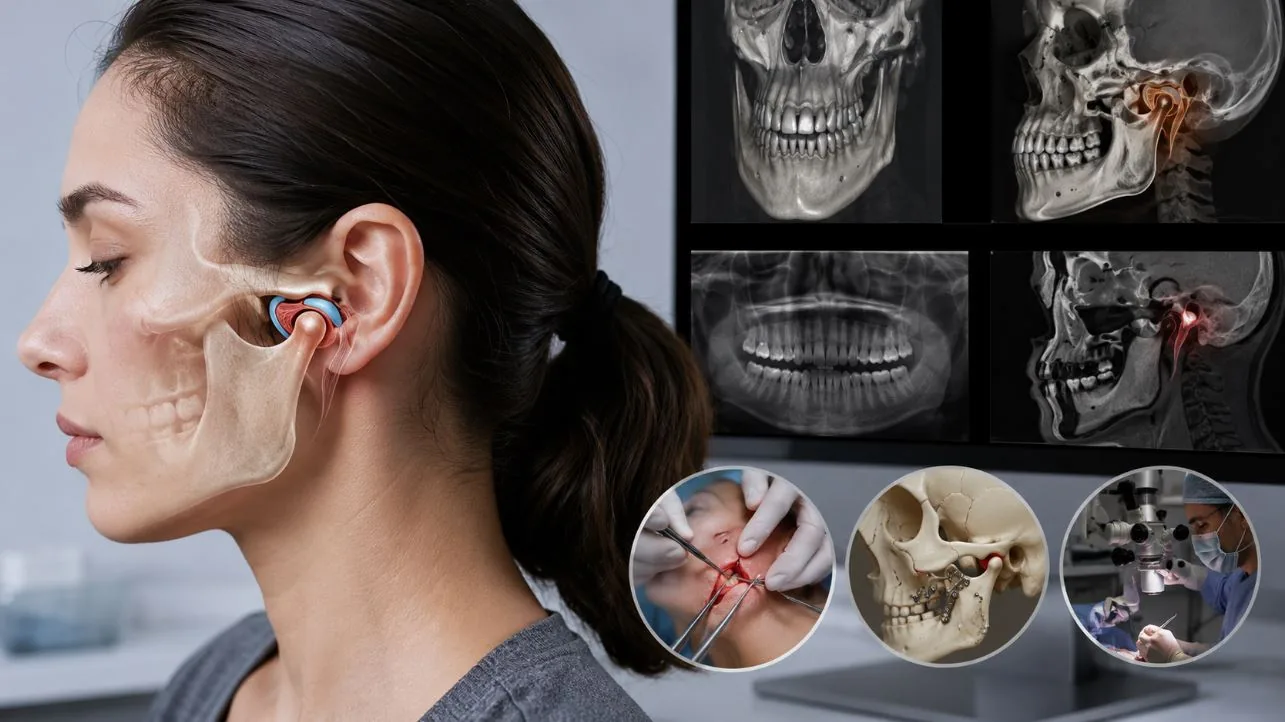
TMJ surgery exists on a spectrum from minimally invasive (arthrocentesis — a joint flush, usually done under sedation, often in office) through arthroscopy (small-camera-guided minor procedures inside the joint) to open joint surgery (arthroplasty, discectomy, disc repositioning) to total joint replacement with a custom prosthesis. The published professional guidance is consistent on one point: surgical intervention is a last-resort, not first-line, treatment, indicated only after a documented, sustained trial of conservative therapy — physical therapy, occlusal splint, behavioural modification, and medical management — has failed to provide acceptable function and quality of life. Within the surgical category, the right operation depends on the specific underlying pathology (internal derangement, osteoarthritis, ankylosis, tumour) and on imaging that shows what the joint actually looks like, not just what it feels like. The least invasive procedure that has a reasonable chance of producing the desired outcome is almost always the right starting point. Open joint surgery and total joint replacement are reserved for cases where less invasive options have failed or are not anatomically appropriate. Selecting the right surgeon — one whose volume of TMJ cases is measured in weeks rather than years — matters more here than for almost any other surgical decision in dentistry.
Before the surgical conversation: who actually needs an operation
The first useful framing is how rare surgery is, even within the population of patients with significant TMJ symptoms. Most temporomandibular disorders are myofascial — driven by the muscles around the joint rather than by structural damage inside it. They respond well to conservative measures: targeted physical therapy, a well-fitted occlusal splint, addressing contributing factors like sleep bruxism and stress, and a course of anti-inflammatory medication during flares. The published literature on TMD broadly suggests that something like 80 to 90 percent of patients with significant symptoms improve substantially with appropriate conservative care, with no surgical intervention.
That leaves a meaningful minority — somewhere between 10 and 20 percent of significantly symptomatic patients — who do not improve, or who improve incompletely, or who have specific structural pathology that conservative care cannot fix. For these patients the surgical conversation is real. The job of the surgical consult is to identify which patients actually fall into this group, distinguish them from patients who simply have not yet had a fair trial of conservative care, and match the right operation to the right pathology.
The diagnoses that genuinely warrant a surgical conversation include severe internal derangement with disc displacement that cannot be reduced, advanced osteoarthritis of the joint, ankylosis (the joint becoming functionally locked by bony or fibrous adhesion), tumours or cysts of the joint, condylar hyperplasia or hypoplasia producing facial asymmetry and bite problems, and severe traumatic injury. The diagnoses that do not warrant a surgical conversation, despite sometimes being presented as if they do, include simple muscle-driven jaw pain, mild to moderate clicking without lockup, and occasional morning soreness in an otherwise functioning joint.
The conservative ladder that should come first
Any thoughtful surgical consult should begin with a careful review of what conservative treatments the patient has already tried, for how long, and with what response. The standard expectation is that a patient considering surgery should have had at least six to twelve months of documented, well-supervised conservative care that has either failed or produced inadequate improvement.
The conservative ladder generally includes: physical therapy specifically trained in temporomandibular disorders (not generic neck-and-shoulder physiotherapy); a custom occlusal splint fitted and adjusted by a dentist with TMJ experience; behavioural modifications including stress management, sleep hygiene, and avoiding habits that overload the joint; non-steroidal anti-inflammatory medication during flares; muscle relaxants for acute episodes; and, where indicated, targeted injections such as botulinum toxin into the masseter, or intra-articular steroid in select cases. Each step should be given an adequate trial — typically two to three months — before moving on.
A surgical consult where the surgeon has not first verified that this ladder has been climbed seriously, with documentation, is a consult that has skipped the most important step in patient selection.
Read also
One of the conservative-tier interventions that often comes up before surgery — what it actually does, what the evidence supports, and when it sits as a sensible step in the ladder.
Arthrocentesis — the simplest entry point
The least invasive procedure in the TMJ surgical category is arthrocentesis: the introduction of small needles into the upper joint space, irrigation with sterile saline, and sometimes injection of a corticosteroid or hyaluronic acid afterwards. The whole procedure takes 20 to 40 minutes, is typically done under intravenous sedation or general anaesthesia in an outpatient setting, and recovery is measured in days rather than weeks.
The mechanism is mechanical. Internal derangement of the TMJ — the most common indication for any kind of TMJ procedure — often involves chronic inflammation and the accumulation of inflammatory mediators in the upper joint space, along with adhesions that limit normal disc movement. Flushing the joint physically clears these and lyses small adhesions, often producing meaningful improvement in opening, clicking, and pain. The published success rates for arthrocentesis in well-selected patients with closed-lock or disc displacement without reduction are in the range of 70 to 85 percent for clinically meaningful improvement.
Arthrocentesis is the appropriate first surgical step for most patients whose conservative care has failed and who have imaging consistent with internal derangement or inflammatory joint disease. It is reversible in the sense that it does not alter the anatomy of the joint; if it does not work, more substantial procedures remain available. Its main limitations are that it does not address structural pathology — a torn disc that needs repositioning, advanced osteoarthritis, ankylosis — and the benefit can fade over months in some patients who then need to repeat the procedure or escalate.
Arthroscopy — looking inside the joint while treating it
The next step up in invasiveness is TMJ arthroscopy: a small fiberoptic camera introduced into the upper joint space through a tiny incision, allowing the surgeon to see the joint interior directly and perform targeted procedures through additional small instruments — lysing adhesions, removing inflamed synovial tissue, repositioning the disc if anatomically possible. The procedure is typically done under general anaesthesia, takes 60 to 120 minutes, and recovery is one to two weeks of soft diet and reduced activity.
The advantage of arthroscopy over arthrocentesis is precision. The surgeon is no longer working blind. They can see the specific pathology and address it directly. The disadvantage is the increase in cost, surgical complexity, and recovery time. Arthroscopy is the right step when arthrocentesis has been tried and inadequate, or when imaging shows pathology that would clearly benefit from direct visualisation and manipulation that the simpler joint flush cannot accomplish.
Published success rates for arthroscopy in appropriate patients are similar to arthrocentesis — somewhere in the 70 to 85 percent range for clinically meaningful improvement — though the patient population is typically more difficult, with pathology that the simpler procedure could not address.
80–90%
Approximate proportion of patients with significant TMJ symptoms who improve substantially with appropriate conservative treatment alone — physical therapy, occlusal splint, behavioural modification, medical management — and never require surgical intervention. Surgical evaluation is relevant for the remaining 10–20%. Within that group, the choice of procedure should follow imaging and the specific underlying pathology, not surgeon preference or what the practice happens to offer.
Open joint surgery — when the inside of the joint needs reconstruction
For more advanced internal derangement — particularly cases where the disc is so severely displaced or damaged that arthroscopic manipulation cannot reposition it — open joint surgery becomes the appropriate step. The term covers a range of procedures: arthroplasty (smoothing or reshaping the articular surfaces), discoplasty or disc repositioning (surgically moving the disc back into its proper anatomical position and securing it), discectomy (removing the disc entirely when it is too damaged to preserve), and various combinations.
The surgical approach involves an incision in front of the ear, careful dissection through the layers above the joint, and direct access to the joint capsule. The risks are correspondingly higher than for less invasive procedures: the facial nerve runs through this area and can be injured, producing temporary or rarely permanent weakness of facial muscles; the surgical site can scar visibly; the bite can shift if joint mechanics change postoperatively; and recovery is measured in weeks rather than days, including a period of restricted jaw function and physical therapy.
Open joint surgery is the right step for a specific subset of patients — those with documented severe internal derangement that has not responded to less invasive procedures, those with advanced osteoarthritis where joint reshaping can provide meaningful improvement, and those with specific structural problems that direct surgical access can address. It is not a first surgical step in most cases. It is a second or third step after the less invasive options have either failed or been ruled out.
Total joint replacement — the final tier
At the top of the surgical pyramid sits total joint replacement: removal of the damaged condyle and articular fossa and replacement with a custom prosthetic device made from medical-grade metals and polymers. The procedure has evolved substantially over the last twenty years, with custom-designed prostheses planned from the patient's specific CT scan now standard in major centres. The operation typically takes three to five hours, requires several days in hospital, and involves a long rehabilitation: weeks of restricted opening, months of supervised physical therapy, and a sustained programme of jaw mobility maintenance for life.
Total joint replacement is indicated for end-stage TMJ disease — severe osteoarthritis with complete joint destruction, ankylosis, failed previous open joint surgeries, congenital absence or major resection of the joint, and cases of severe condylar resorption. It is the right answer for a small number of patients and the wrong answer for everyone else. The procedure has the highest cost (often $50,000 to $100,000 in the United States), the longest recovery, the highest complication rate of the TMJ procedures, and the consequences of a poor outcome are the most significant.
The published outcomes for total joint replacement in appropriate patients are actually quite favourable in modern series — substantial improvement in pain and opening, with prosthesis survival in the range of 90 percent or more at ten years. The challenge is patient selection. A total joint replacement performed for the wrong indication, or on a patient who could have done well with less aggressive treatment, is a major intervention with major consequences for what may have been a problem that did not require it.
The risks worth being honest about
The major risks of TMJ surgery vary by procedure but include: facial nerve injury producing temporary or rarely permanent facial weakness; auriculotemporal nerve injury producing altered sensation around the ear and temple; persistent or recurrent pain despite anatomic improvement; bite changes requiring orthodontic or further surgical correction; infection; need for revision surgery; and, for total joint replacement, prosthesis failure or loosening that requires removal. The probability of each risk varies with the procedure, the surgeon, and the specific anatomy of the case.
The most important pre-operative conversation is the realistic one about success rates, complication rates, and what failure looks like. A surgeon who frames the procedure as straightforward and the outcome as essentially guaranteed is not being thoughtful. A surgeon who can describe, specifically, the probability of meaningful improvement and the probability of various complications in patients like you, is one who has the right relationship to the data.