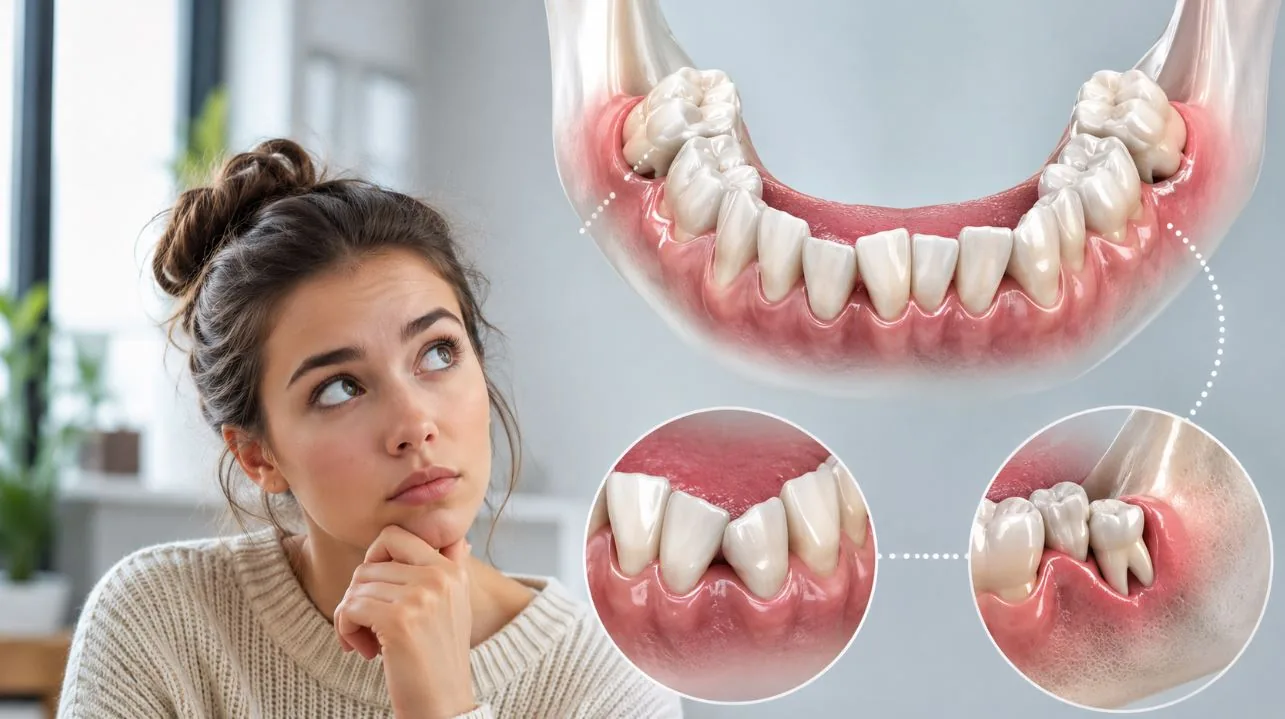
The short version, if you only read one thing
The published evidence — including controlled studies comparing patients whose wisdom teeth were extracted with patients whose were retained — does not support the popular claim that wisdom teeth cause meaningful crowding of the front teeth. Late mandibular crowding does happen, often into the thirties and forties, but it happens at similar rates in adults whose third molars are present, absent congenitally, or surgically removed. The professional positions of both the American Association of Orthodontists and the American Association of Oral and Maxillofacial Surgeons explicitly state that prevention of orthodontic crowding is not, on its own, an evidence-based indication for prophylactic extraction of asymptomatic wisdom teeth. That does not mean wisdom teeth should never come out. It means the "stop the crowding" justification, used in isolation, does not hold up — and a parent or patient should not feel guilty pushing back on it.
What "crowding" actually means
The word "crowding" gets used loosely. Orthodontists use it specifically: it refers to a discrepancy between the amount of space available in the dental arch and the total mesio-distal width of the teeth that have to fit into that arch. When the teeth are wider than the arch can accommodate, they rotate, tip, or overlap as the body finds room for them. Crowding can be present at the start of orthodontic life — many teenagers go into braces precisely to resolve it — or it can develop or recur in adulthood, classically in the lower front teeth, in patients whose teeth were perfectly straight in their twenties.
That late adult lower-incisor crowding is the version of crowding that the wisdom-tooth story is almost always told about. The mechanism the story proposes is intuitive: the third molars develop at the back of the arch, and as they push forward to erupt, they exert a sustained anterior force that travels through the row of teeth and crowds the incisors at the front. This sounds plausible enough that almost no one questions it. The problem is that when you actually measure it, the data does not behave the way the story predicts.
Why everyone believes wisdom teeth cause crowding
The story has a few sources, none of which are the controlled evidence. The first is timing. Late mandibular crowding tends to appear in the late teens and twenties, which is exactly the window in which third molars are erupting or attempting to erupt. The temporal correlation is obvious to any patient who has lived through it. The body has a strong intuition that things which happen at the same time must be related.
The second source is clinical observation. A dentist who sees a teenager with developing third molars and increasing lower incisor crowding, year after year, will form the impression that the two are related. This is not a foolish impression. It is just an unreliable one — because what those dentists are observing is the conjunction of two normal age-related changes, not a causal relationship between them.
The third source is institutional habit. The recommendation to prophylactically extract third molars in late adolescence has been part of mainstream dental practice for so long, and has been driven by enough overlapping concerns (pericoronitis, root development, surgical complexity later in life), that the orthodontic-crowding justification has been absorbed into the rationale almost by osmosis. It is rarely the only reason. It is often the most legible reason to a worried parent. So it gets emphasised.
What is missing from the story is the controlled comparison. If wisdom teeth genuinely caused incisor crowding, we would expect patients without wisdom teeth — either because they were congenitally absent or because they were surgically removed in adolescence — to develop less crowding than patients with retained third molars. This is exactly the comparison that has been done, multiple times, and the answer keeps coming back the same.
What the evidence actually shows
Several lines of evidence converge on a single conclusion. The first is a body of long-term follow-up studies, beginning with Lindqvist and Thilander's work in the early 1980s and continuing through Ades, Joondeph, Little and Chapko's well-known 1990 paper, that tracked patients whose third molars had been extracted versus those whose had been retained. After many years of follow-up, the amount of lower incisor crowding that developed was essentially the same in both groups. The presence or absence of third molars did not meaningfully predict the magnitude of late incisor crowding.
The second is a parallel literature on adults with congenitally missing third molars — a natural experiment, since these patients never had wisdom teeth to push anything forward. If the story were correct, they should age into straight lower teeth. They don't. They develop the same patterns and the same average magnitude of late incisor crowding as patients with intact third molars.
The third is the work of Richardson and others in the late 1980s and early 1990s, looking specifically at the forces actually generated by erupting third molars and the patterns of incisor change observed in matched populations. The conclusion was that whatever force third molars exert during eruption is small compared with the other physiological and developmental factors at play, and is not measurable as the main driver of incisor crowding.
By the late 1990s, this evidence had accumulated to the point that the American Association of Orthodontists adopted a position statement explicitly stating that prevention of late incisor crowding was not a valid indication for prophylactic extraction of third molars. The American Association of Oral and Maxillofacial Surgeons, in its parallel positioning, has acknowledged the same point: third molars come out for reasons related to symptomatic disease, decay, periodontal damage to the second molar, cysts, or imminent eruption complications — not because removing them will keep the front teeth straight.
~0.4 mm
Approximate order-of-magnitude difference in lower incisor irregularity reported between long-term-follow-up patients whose third molars were retained versus those whose were extracted in well-controlled cohort studies. The difference is small, frequently statistically non-significant, and below the threshold most orthodontists consider clinically meaningful. For comparison, the natural late-twenties-to-forties drift in incisor position can produce several millimetres of irregularity in patients of both groups.
The mechanism, told fairly
The fair version of the story is more nuanced than either the popular claim or its outright dismissal. Erupting third molars probably do exert some small forward force during eruption — not zero. The point is that the magnitude of that force, against the resistance of intact periodontal ligaments holding the front teeth in place, is one of many small contributors to a process that is dominated by other variables. The dominant drivers of late mandibular crowding appear to be:
Continued, slow forward and inward drift of the entire lower arch as a normal feature of facial growth and dental ageing, which continues well into the third and fourth decades of life. Late mandibular growth itself, which is more anterior than the maxilla's, contributing to a relative mismatch between the arches. Continued attrition and interproximal wear, which subtly changes the way teeth contact each other. Tongue posture, lip pressure, and breathing patterns, each of which can shift the balance of forces on the dentition over decades. Retainer compliance after orthodontic treatment, which is by far the largest single variable for patients who were previously aligned: the lower incisors in particular have a strong tendency to drift back toward their pre-treatment position if night-time retention is abandoned in the years after braces.
Against all of these, the contribution of an erupting third molar is small. The reason the popular story persists is partly the timing correlation already discussed, and partly that "your wisdom teeth are crowding your front teeth" is a simpler, more actionable explanation than "your face is still growing in subtle ways, your tongue is exerting a constant pressure, and the way you have been wearing your retainer is the dominant variable."
Read also
If extraction is being considered for a real clinical reason rather than the crowding myth, the timing question matters — the same surgery becomes meaningfully different after forty, and is worth understanding ahead of time.
Late mandibular crowding is real — but its causes are mostly not wisdom teeth
Pushing back on the wisdom-tooth story does not mean denying that late mandibular crowding exists. It clearly does. Many patients who finished braces at fifteen with beautifully aligned lower teeth find that the same teeth are subtly rotated and overlapping by their early thirties. The point is that this is a multi-factorial age-related change driven primarily by ongoing growth, dental drift, tongue posture, and retainer non-compliance, not by an erupting wisdom tooth that has long since either erupted or been extracted.
The practical implications of this are not nothing. For an adult patient unhappy with the alignment of their lower front teeth, the relevant interventions are usually retainer-based, or interproximal reduction (a small amount of enamel polished off between teeth to create space), or short-cycle clear-aligner therapy — not a wisdom-tooth extraction at thirty-five in the hope that it will straighten the teeth in front. That hope is, on the evidence, misplaced.